Introduction
Most enterprise SAP landscapes carry a hidden liability: years of in-core modifications that made sense at the time but now make every S/4HANA upgrade a high-stakes, high-cost event. As data volumes grow and integration demands multiply, that technical debt compounds. Extending SAP's capabilities without adding to it requires a fundamentally different approach.
SAP BTP (Business Technology Platform) is that approach. It's a cloud platform purpose-built to extend, integrate, and automate SAP systems while keeping the core clean and upgrade-ready.
Navigating BTP successfully, however, requires more than a software license. It demands consulting expertise that spans business process knowledge, cloud architecture, and integration design. Organizations that attempt BTP adoption without that guidance routinely encounter integration failures, budget overruns, and timelines that stretch well past initial projections.
Key Takeaways
- SAP BTP unifies integration, app development, analytics, and automation on one cloud platform—no core ERP modifications needed
- Businesses without expert guidance often face integration failures, cost overruns, and stalled timelines
- A skilled BTP consultant turns your requirements into clean-core solutions that stay upgrade-ready as SAP evolves
- The right partner cuts go-live time, reduces downtime, and delivers faster time-to-value from your SAP investment
What Is SAP BTP and Why Does It Matter for Your Business?
Defining SAP BTP in Business Terms
SAP BTP (Business Technology Platform) is a unified cloud platform for building applications, integrating SAP and non-SAP systems, analyzing data in real time, and automating business processes—all without touching the stable SAP core.
Think of it as the extension and innovation layer alongside your ERP. It lets you adapt quickly to changing business needs without the upgrade disruption that comes with traditional customizations.
The Clean Core Principle
Instead of customizing the S/4HANA core—which creates upgrade pain and technical debt—BTP allows extensions to be built as separate, modular components that connect to the core via APIs. This "clean core" approach makes upgrades smoother and reduces long-term maintenance costs. When your core system remains standard, you can adopt new SAP features and patches without worrying about breaking custom code.
The Business Case for BTP
SAP BTP has reached enterprise-scale maturity, with over 33,000 customers actively succeeding on the platform. The financial case is compelling: IDC research indicates a 514% three-year ROI with an 8-month payback period when BTP is used alongside SAP business applications. SAP Integration Suite deployments yield a 345% ROI with a payback period of less than six months, per Forrester research.
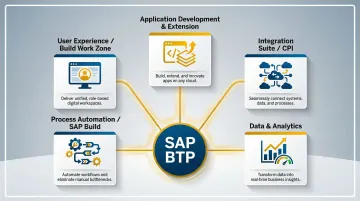
Five Core Pillars of SAP BTP
Application Development & Extension Build cloud-ready Fiori apps and lightweight backend services that capture additional business data without altering the S/4HANA core, so you ship features faster with no upgrade risk.
Integration Suite (SAP CPI) Unify applications across hybrid and multi-cloud environments, replacing slow file-based transfers with real-time API-driven data exchange.
Data & Analytics (SAP Analytics Cloud / Datasphere) Access live SAP data for real-time dashboards and connect AI with process data, replacing static Excel-based reporting with dynamic insights.
Process Automation (SAP Build) Automate repetitive approval workflows and document-heavy processes with drag-and-drop simplicity, reducing manual errors and accelerating cycle times.
User Experience (SAP Build Work Zone) Design engaging digital workspaces that connect teams and streamline collaboration across desktop and mobile.
Who Needs SAP BTP?
SAP BTP is built for organizations running SAP ECC or S/4HANA that want faster innovation cycles, better system interoperability, and real-time data visibility without the overhead of heavy customizations.
If your business struggles with slow upgrades, integration gaps between SAP and non-SAP systems, or limited process visibility, BTP addresses each of these pain points directly.
What Does an SAP BTP Development Consultant Actually Do?
An SAP BTP development consultant bridges the gap between organizational requirements and platform capabilities — translating business processes into technically sound, operationally practical solutions across the full project lifecycle.
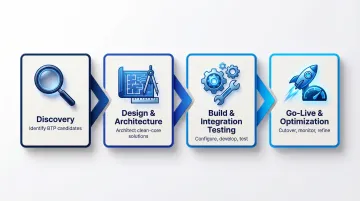
Role Across the Project Lifecycle
- Discovery — Identify which business processes are candidates for BTP extension or automation, and where clean-core solutions can replace risky in-core modifications.
- Design & Architecture — Architect solutions using ABAP Cloud for tightly integrated extensions or side-by-side extensibility on SAP BTP for scalable, decoupled applications.
- Build & Integration Testing — Configure integration flows, develop custom apps using the SAP Cloud Application Programming Model (CAP), and run end-to-end testing to ensure accurate, reliable data exchange.
- Go-Live & Optimization — Provide cutover support, monitor system performance, and refine configurations based on real-world usage patterns.
Integration Responsibilities
Consultants design and configure integration flows between SAP and third-party systems—logistics partners, vendor portals, CRM tools—using SAP Integration Suite (CPI). They replace slow, error-prone file-based transfers with real-time API-driven data exchange. For example, Samsung C&T scaled processes to handle 100,000 daily transactions reliably across 30 system interfaces using Integration Suite.
Analytics and Automation Scope
On top of integration work, consultants configure SAP Analytics Cloud dashboards for real-time KPI visibility, replacing static Excel-based reporting. They also automate repetitive approval workflows using SAP Build Process Automation — De Agostini achieved a 91% automation rate for PO-referred invoices, saving approximately 500 hours per month.
Strategic Advisory Function
Technical delivery is only part of the picture. Experienced BTP consultants help businesses define their BTP roadmap, prioritize extension use cases by business impact, and advise on governance, data security, and compliance in multi-cloud environments. The goal is ensuring your BTP investment serves long-term business strategy — not short-term fixes that create downstream complexity.
Core SAP BTP Service Areas That Deliver Business Value
Application Development and Extension
Side-by-side extensions—custom Fiori apps, mobile-ready UIs, lightweight CAPM backend services—capture additional business data or support new approval processes without touching the S/4HANA core. This means faster feature delivery with zero upgrade risk.
Vorwerk's results show what's possible: 85% digital sales (up from 1%) and 100% elimination of manual tasks in their sales process, achieved through custom apps on BTP.
System Integration and API Management
In multi-cloud and hybrid environments, unreliable data flow creates costly errors and delays. Integration consultants address this by:
- Designing iFlows in Cloud Integration (CPI) connecting SAP to logistics providers, e-commerce platforms, and vendor portals
- Configuring API proxies and security policies in API Management
- Ensuring consistent, live data exchange across all connected systems
CONA Services cut runtime costs by 50% by centralizing processes across their bottling ecosystem using this approach.
Process Automation and Workflow Optimization
The highest-value automation targets are usually hiding in plain sight: repetitive approvals, vendor onboarding steps, and compliance checks that eat hours every week. Consultants map these workflows, build the logic in SAP Build Process Automation, and measure the reduction in cycle time before and after deployment.
The business case is well-documented. Lufthansa Technik grew transaction volume by over 40% without expanding headcount. Blue Diamond Growers recovered 2,000 hours annually just by automating ocean freight document handling.
Data, Analytics, and AI Enablement
Connecting live SAP data to SAP Analytics Cloud requires more than a data pipeline—backend modeling (CDS annotations and BW queries) must be optimized to keep dashboards performant at scale. Consultants also implement AI services within BTP for use cases including predictive maintenance, inventory optimization, and anomaly detection.
AI-powered predictive maintenance alone can reduce unplanned downtime by up to 40%. Reaching that outcome, however, depends entirely on data quality and governance foundations being in place before AI tools are switched on.
Common SAP BTP Implementation Challenges (and How Expert Consultants Solve Them)
Legacy System Integration Complexity
Many enterprises run older SAP landscapes where data is inconsistent or not structured for API consumption. Experienced consultants address this before a single integration flow is built:
- Assess data quality and perform pre-migration cleansing to prevent downstream failures
- Document existing interfaces and map data dependencies across legacy systems
- Design transformation logic that bridges old data structures to BTP-compatible formats
Organizational Resistance and Change Management
Moving from customized SAP cores to a clean-core BTP model often means changing how teams work. Consultants bridge this gap through several parallel workstreams:
- Align stakeholders early by mapping technical decisions to concrete business outcomes
- Document measurable benefits (cost reduction, cycle time improvements) in terms non-technical leaders understand
- Train end users on new Fiori interfaces and workflows before go-live, not after
Multi-Cloud Governance and Data Security
Managing data flows across cloud providers introduces compliance and access control risks. Consultants implement:
- Role Collections configured with least-privilege access (RBAC), limiting exposure at the service and subaccount level
- Federated authentication via Identity Authentication Service and XSUAA, connecting BTP to existing corporate identity providers
- Token lifecycle controls that monitor validity windows and enforce secret rotation every 90 days
- Data governance policies mapped to GDPR, APAC data residency rules, and other jurisdiction-specific requirements
For global organizations running workloads across the EU, APAC, and other regions, getting these controls right from day one prevents costly compliance remediation later.
Hard Numbers on Implementation Risk
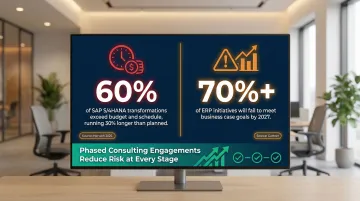
ERP and cloud transformation risks remain elevated. Recent 2025 data from Horváth shows that approximately 60% of SAP S/4HANA transformations exceed their budget and schedule, running 30% longer than planned.
Gartner adds that by 2027, more than 70% of recently implemented ERP initiatives will fail to fully meet their original business case goals. Consultants counter this through phased rollouts with fixed-scope discovery phases — catching scope creep and integration gaps before they become budget overruns.
How to Choose the Right SAP BTP Consulting Partner
Look for Proven SAP Delivery Track Record
Documented experience across multiple SAP project types—not just BTP—is non-negotiable. The right partner has navigated complex integrations, go-live pressure, and post-deployment firefighting across real enterprise environments. Vorstel Technologies brings 200+ SAP project experiences to engagements, providing the depth required for complex BTP implementations.
Prioritize Flexibility and Global Reach
The right partner can engage at any stage of your digital transformation journey—whether you're starting from scratch, mid-implementation, or optimizing an existing BTP landscape. They should support your operations across multiple geographies and time zones without disrupting continuity. Vorstel Technologies operates delivery teams across India, Germany, Singapore, Hungary, and Finland, ensuring continuous support regardless of your location.
Evaluate Responsiveness and Outcome Orientation
Before committing, look for a partner who checks three boxes:
- Offers solution evaluation without upfront financial commitment
- Maintains measurable outcomes—faster deployment cycles, reduced system downtime
- Brings both technical depth and strategic advisory capability to the engagement
Vorstel Technologies delivers on all three: 97% client satisfaction across multiple countries and a Zero-Fee Solution Evaluation for businesses ready to explore BTP consulting.
Verify SAP Competency Framework Credentials
SAP replaced legacy Gold/Silver partner tiers with the SAP Competency Framework in 2022. Look for partners that hold a specific Business Technology Platform Competency at one of three maturity levels: Essential, Advanced, or Expert. Use the official SAP Partner Finder tool to independently verify a partner's BTP credentials, certified headcount, and Partner Center of Expertise (PCoE) certification before signing any consulting agreement.
Frequently Asked Questions
What is BTP in SAP?
SAP BTP (Business Technology Platform) is SAP's unified cloud platform that enables organizations to develop applications, integrate systems, analyze data, and automate processes—all while keeping the core SAP system clean and upgrade-ready.
What does an SAP BTP development consultant do?
They design, build, and manage BTP-based solutions including custom app extensions, system integrations, process automations, and analytics dashboards. Every implementation is grounded in clean-core principles, so you avoid technical debt and stay upgrade-ready.
Can SAP BTP work with our existing SAP ECC or S/4HANA system?
Yes. SAP BTP is specifically designed to extend and integrate with both ECC and S/4HANA landscapes via APIs and pre-built integration content, without requiring changes to the core system.
What is the difference between SAP BTP and SAP S/4HANA?
SAP S/4HANA is the core ERP system managing business processes (finance, supply chain, manufacturing). SAP BTP is the extension and innovation layer that sits alongside it, enabling custom integrations, applications, and analytics without touching S/4HANA's stable core.
How do I know if my business needs SAP BTP consulting services?
SAP BTP consulting is worth exploring if your organization is experiencing any of the following:
- Slow upgrades caused by heavy core customizations
- Integration gaps between SAP and non-SAP systems
- Manual approval workflows that could be automated
- Limited real-time visibility into business data