Most business leaders know what they want to achieve. Fewer have a clear picture of how to get there without burning through budget, losing organizational support, or arriving at a go-live that nobody actually uses. That gap between vision and execution is where methodology does its work.
This guide is written for business leaders, IT decision-makers, and transformation teams — whether you're scoping a first initiative or already mid-journey and wondering why momentum has stalled. We'll clarify what a digital transformation methodology actually is, how it differs from a framework or strategy, how it operates phase by phase, and where organizations predictably go wrong.
Key Takeaways
- A digital transformation methodology bridges business vision and execution, connecting people, processes, and technology into a single operational framework
- Only 48% of enterprise digital initiatives meet or exceed business outcome targets, per Gartner's 2024 CIO Survey — making methodology design a critical variable
- Sound methodology runs through four phases — discovery, strategy, execution, and iteration — and skipping any one is a leading cause of cost overruns and stalled projects
- Vorstel Technologies supports organizations at any transformation stage with structured methodology and deep SAP, Microsoft, Salesforce, and cloud expertise
What Is a Digital Transformation Methodology?
A digital transformation methodology is the structured, repeatable process by which an organization plans, sequences, executes, and evaluates its shift to digital operations.
Understanding what a methodology is starts with what it isn't:
- A strategy — which defines what you want to achieve and why
- A framework — which provides a reference model or conceptual structure (TOGAF, McKinsey 7S, SAFe)
- A technology roadmap — which lists platforms and tools without the surrounding governance
The methodology is the operational bridge between those elements. It specifies the actual sequence of activities, decisions, and governance checkpoints that make transformation happen.
What a Methodology Is Designed to Produce
A well-designed methodology delivers four things that ad hoc approaches cannot:
- Alignment between business goals and technology investments
- Managed risk through phased planning and defined decision gates
- Measurable progress with KPIs tied to each phase, not just to go-live
- Sustained adoption — meaning the organization actually changes how it works, not just what tools it uses
That last point is where most transformations fall short — technology deployment and organizational transformation are not the same thing, and a methodology is what bridges the gap between the two.
Frameworks vs. Methodology — The Practical Difference
Organizations frequently conflate these terms, and the confusion causes real damage. Consider what the most commonly referenced frameworks actually cover:
| Framework | What It Provides | What It Doesn't Cover |
|---|---|---|
| TOGAF | Enterprise architecture standard | Change management or adoption planning |
| SAFe | Lean-agile knowledge base | Business case or benefits realization |
| McKinsey 4Ds | Conceptual strategic lens | Governance calendar or execution sequencing |
Frameworks are reference models. A methodology turns them into an executable plan specific to your organization's context, constraints, and objectives.
Why Organizations Need a Defined Digital Transformation Methodology
The numbers on transformation failure are consistent across research firms — and unambiguous about what's driving it.
BCG's research found that 70% of digital transformations fall short of objectives. Critically, BCG also identified that organizations addressing all six key success factors — integrated strategy, leadership engagement, talent, agile governance, outcome monitoring, and a capable technology platform — can shift success odds from 30% to 80%. That's not a technology gap. That's a methodology gap.
What Goes Wrong Without Structure
When organizations run transformation initiatives without defined methodology, four failure patterns emerge reliably:
- Scope expansion without governance — initiatives grow because there are no phase gates to control what enters the work queue
- Technology investment without business connection — platforms get implemented without clear linkage to operational outcomes
- Employee resistance — people encounter new systems with no change management preparation, so adoption stalls even when the technology works
- No meaningful ROI measurement — without phase-level KPIs, organizations can't demonstrate value or course-correct early
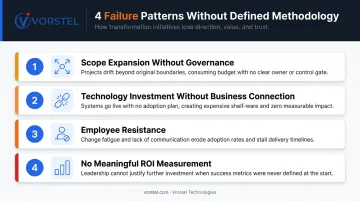
None of these are technology problems. Every one is a methodology problem.
What Cross-Functional Demands Require
Transformation touches finance, operations, HR, IT, and customer-facing functions simultaneously. An ad hoc approach — where each function pursues its own initiative on its own timeline — cannot produce the cross-functional alignment that enterprise transformation requires.
A defined methodology creates a shared operating model: consistent decision-making criteria, clear ownership at each phase, and the ability to course-correct without abandoning the initiative entirely. That flexibility rarely gets enough credit. With methodology in place, a team can pause, reassess, and restart a specific phase — rather than facing the harder choice of pushing forward blindly or scrapping the initiative altogether.
How a Digital Transformation Methodology Works: Phases and Core Flow
A methodology functions as a phased operating system for transformation. Inputs — business goals, current technology state, workforce readiness, budget — are converted into sequenced decisions and actions. Outputs are measurable improvements in efficiency, capability, and delivered customer value.
That structure means each phase produces defined deliverables and decision gates. Leadership must confirm alignment before the next phase begins. Without that governance layer, phases blur together, accountability breaks down, and the project drifts.
Phase 1: Discovery and Current-State Assessment
This phase establishes a clear baseline before any roadmap is drafted. The work involves auditing existing processes, technology infrastructure, data capabilities, and organizational culture — not to justify transformation, but to identify where digital gaps are creating the most friction or risk.
Critically, this phase also assesses change readiness. An organization's appetite and capacity for change are as important as its technical baseline. Skipping this assessment is why Phase 3 timelines routinely blow out — legacy system complexity and integration dependencies are underestimated when discovery is rushed or treated as a checkbox.
Phase 2: Strategy Definition and Roadmap Design
Discovery findings translate into a prioritized roadmap with defined outcomes, sequenced initiatives, resource requirements, and measurable KPIs. Two principles govern effective roadmap design:
- Business objectives drive sequencing — every initiative on the roadmap must connect to a business outcome, not an IT objective
- Foundational work precedes advanced capability — organizations that try to build advanced analytics on top of fragmented data architectures, or deploy cloud-native applications over unresolved legacy dependencies, pay for it in Phase 3
The roadmap is not a Gantt chart. It's a living prioritization model that governs what gets funded, in what order, and against what success criteria.
Phase 3: Technology Selection and Execution
This is where methodology intersects with implementation. Technology choices — ERP systems like SAP, CRM platforms like Salesforce, cloud infrastructure, DevOps pipelines — must be selected based on fit with the defined roadmap, not vendor familiarity or incumbent preference.
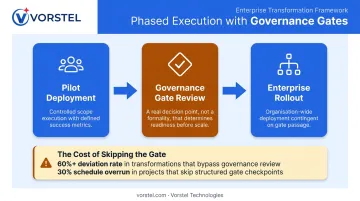
Execution should follow an iterative approach: pilot deployments before enterprise rollout, with genuine review cycles between them. The risk of skipping pilots is concrete — Horvath's 2025 research found that more than 60% of SAP S/4HANA transformations report deviations in budget, schedule, and result quality, with projects running an average of 30% longer than planned.
Phased delivery with governance gates directly reduces that exposure. The organizations that stay on track are typically those that treat each pilot as a real decision point — not a formality before the rollout they already planned.
Organizations benefit from implementation partners who bring deep cross-platform expertise and can join an in-progress initiative without requiring a restart. Vorstel Technologies — 200+ SAP implementations, 95% success rate in Salesforce CRM deployments — is built to engage at any phase of an existing transformation, including ones already off track.
Phase 4: Change Management, Scale, and Iteration
Technology deployment does not constitute transformation. This phase is where many organizations declare premature victory.
Effective Phase 4 requires three things running in parallel:
- Structured change management — communication, training, and role redefinition that drives genuine workflow adoption, not compliance theater
- Monitored scale — successful pilots expanded enterprise-wide with adoption metrics tracked in real time (speed of adoption, ultimate utilization, proficiency)
- Continuous improvement loop — outcomes fed back into the methodology, treating transformation as an ongoing operating model rather than a project with an end date
Prosci's research makes the stakes plain: projects with excellent change management are approximately 7x more likely to meet objectives than projects with poor change management. McKinsey's data reinforces this — only 16% of digital transformations both improved performance and sustained those changes. Sustainment is not automatic. It must be designed in.
Key Factors That Affect Methodology Outcomes
Methodology design is only half the equation. These four organizational factors determine whether a well-structured approach delivers results — or quietly collapses mid-execution.
Leadership Alignment and Sponsorship
Transformation stalls most often at the leadership layer. When executive sponsors treat methodology as an IT initiative rather than a business-wide operating change, funding and prioritization erode mid-cycle.
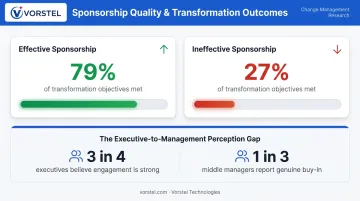
The data on sponsorship is stark: Prosci found 79% of respondents with extremely effective sponsors met or exceeded objectives, compared with 27% with very ineffective sponsors. BCG adds an important nuance — three out of four executives believe they have strong leadership engagement, but only one in three have committed middle-management engagement. Executive commitment without middle-management buy-in leaves transformation stranded at the implementation layer.
Legacy System Complexity
Even with strong sponsorship, the existing technology landscape creates its own friction. ERP systems, on-premise infrastructure, and fragmented data architectures directly determine how much foundational work Phase 1 must surface before Phase 3 can scale. Organizations that underestimate integration dependencies in discovery discover them instead during execution, when the cost of addressing them is highest.
Change Readiness and Organizational Culture
A methodology applied to a risk-averse, siloed culture without explicit culture-change investment generates adoption in name only. Employees complete training; workflows don't change.
McKinsey found transformation success is more than 3x more likely when organizations invest appropriately in digital talent and capability building. Build that investment into the roadmap from Phase 2 — not bolted on as a Phase 4 afterthought.
Measurement Cadence and KPI Design
Organizations that define KPIs only at project close lose the ability to course-correct during execution. Effective methodology requires leading indicators at each phase gate:
- Stakeholder alignment scores — tracked from Phase 1 through Phase 2 governance checkpoints
- Process cycle time reductions — operational signal in Phase 3
- Adoption rates and utilization — leading indicator heading into Phase 4
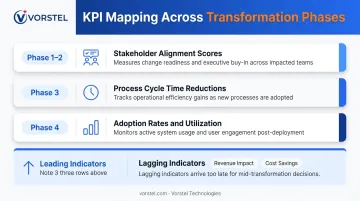
Lagging indicators — revenue impact, cost savings — matter, but they arrive too late to inform mid-transformation decisions.
Common Misconceptions About Digital Transformation Methodology
Misconception 1: Methodology Equals Technology Roadmap
Confusing platform selection with methodology is the most common error. A technology roadmap lists what gets built and when. A methodology defines how the organization governs, adopts, and derives value from what gets built. Skipping change management and governance because the technology roadmap looks comprehensive is a direct path to Phase 4 failure.
Misconception 2: Methodology Is a One-Time Activity
Transformation doesn't end at go-live. The methodology must be designed to loop — feeding outcomes from Phase 4 back into Phase 1 reassessment, continuously. Organizations that treat methodology as a project plan with a completion date end up with technology that drifts out of alignment with evolving business needs.
Misconception 3: Published Frameworks Are Ready-to-Execute Plans
TOGAF, McKinsey's 4Ds, SAFe — these are reference models that require significant adaptation to become operational plans. Organizations that apply them directly, without customizing for their industry, size, legacy infrastructure, and change readiness, consistently encounter gaps in sponsorship design, adoption planning, and benefits realization.
Understanding what methodology isn't tells you as much as knowing what it is. That includes recognizing when a formal approach isn't the right tool at all.
When Formal Methodology Isn't Necessary
A structured multi-phase methodology fits cross-functional transformation initiatives well. In three scenarios, however, it adds friction without value:
- Early-stage startups making a first digital investment with no legacy infrastructure
- Single-department digitization with no cross-functional dependencies
- Organizations already mid-transformation with a functioning methodology, who need execution support rather than a methodology restart
The third case deserves particular attention. Organizations that have run through multiple failed transformation attempts often resist new methodology frameworks. This resistance rarely signals that methodology itself is flawed. Prior implementations were over-engineered, vendor-driven, or lacked genuine business ownership. What's needed is simpler methodology with clearer business sponsorship — not another framework layered on top of the last one.
Frequently Asked Questions
What are the key stages of a digital transformation methodology?
The four core phases are: discovery and current-state assessment, strategy and roadmap definition, technology selection and execution, and change management with continuous iteration. Sequence matters — each phase produces inputs the next phase depends on, and skipping any phase undermines the whole effort.
What is the difference between a digital transformation strategy and a methodology?
A strategy defines what the organization wants to achieve and why. A methodology defines how the transformation will be planned, sequenced, executed, and measured. Without a methodology, strategy sets direction but provides no operational structure for getting there.
How long does a digital transformation typically take?
Timelines vary by scope and complexity. Focused departmental initiatives typically run 3–12 months; enterprise-wide transformations commonly span 2–5 years. A structured methodology keeps timelines predictable by surfacing scope and dependency issues at phase gates, before they compound.
What are the most common reasons digital transformation initiatives fail?
The consistent failure drivers across research: lack of executive sponsorship, absence of structured methodology, underestimating change management requirements, and disconnecting technology investment from defined business outcomes. These failures are rooted in organizational structure and process gaps — not in the technology itself.
Which roles should lead a digital transformation methodology?
Effective methodology governance requires cross-functional leadership: a C-suite sponsor (typically CIO or CDO), a dedicated transformation program lead, and business unit owners for each initiative. Technology teams should not own the methodology; they execute within it.
How do you measure the success of a digital transformation methodology?
Success metrics should span three dimensions:
- Operational KPIs: process efficiency, system adoption rates, downtime reduction
- Business KPIs: revenue impact, cost savings
- People KPIs: employee adoption rates, change readiness scores
Track these at each phase gate, not only at project close.