Introduction
Organizations across industries are racing to digitally transform, yet the execution gap remains stubbornly wide. Despite global IT spending projected to reach $6.15 trillion in 2026, 65-70% of enterprise digital transformations still fail to meet their objectives. This paradox highlights a critical reality: massive capital deployment doesn't guarantee transformation success.
What separates organizations that succeed from those that stall is a deliberate, structured digital transformation strategy. Technology investment alone isn't enough. When companies deploy modern tools over outdated workflows, they create what's known as "expensive old operations" — activity without meaningful business impact.
This guide covers the definition of a digital transformation strategy, seven foundational principles that drive success, best practices for execution, common pitfalls to avoid, and how to measure meaningful progress.
TLDR:
- Digital transformation requires a business-outcome-driven roadmap, not just technology upgrades
- 65-70% of enterprise digital transformations fail to meet objectives, even with significant capital investment
- Seven integrated principles — executive sponsorship, data readiness, change management, and more — determine success
- Organizations must invest in change management, data readiness, and cultural preparation
- Quick-win pilots that prove value before scaling horizontally reduce risk and build momentum
What Is a Digital Transformation Strategy (and Why It Fails Without One)
Defining True Enterprise Transformation
A digital transformation strategy is a structured, business-outcome-driven roadmap for how an organization uses technology, people, and processes to fundamentally change how it operates. McKinsey defines it as "the fundamental rewiring of how an organization operates," with the goal of building competitive advantage by continuously deploying technology at scale.
This differs sharply from one-off tech upgrades or digitization projects. True transformation requires:
- Cultural change and leadership alignment
- Operating model shifts across functions
- Data capabilities that power decision-making
- Systematic process redesign before automation
The Adoption vs. Success Chasm
While 90% of organizations are currently undergoing some form of digital transformation, only 35% achieve their objectives. Only 48% of digital initiatives meet or exceed their business outcome targets, according to Gartner's 2024 survey of over 3,100 CIOs.
The gap between adoption and success comes down to one consistent failure: organizations invest in new tools without changing the underlying structures those tools are supposed to improve.
Why Strategy, Not Technology, Drives Success
Deploying modern technology without redesigning underlying operations simply creates a more expensive version of the status quo. This concept traces back to Michael Hammer's foundational 1990 Harvard Business Review mandate: "Don't Automate, Obliterate," which warned that using technology to speed up outdated workflows results in higher costs and minimal impact.
BCG's research confirms this directly: "deploying new IT architecture without addressing product and process complexity would have minimal business impact." Organizations that succeed prioritize radical simplification of processes first — then bring in new platforms to scale what already works.
The 7 Key Principles of a Digital Transformation Strategy
These seven principles work as an integrated system — each one reinforces the others. Organizations that skip steps don't just slow down; they tend to stall entirely or burn investment on initiatives that never scale.
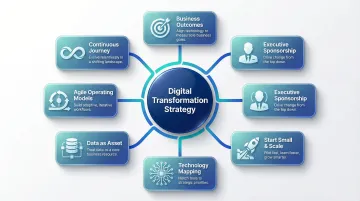
Principle 1: Anchor Strategy in Business Outcomes, Not Technology
Every digital transformation initiative must trace back to a defined business goal—whether reducing operational costs, improving customer experience, or accelerating time-to-market. Technology decisions should follow business needs, not the reverse.
How to Translate Vision into Use Cases:
Start with your organization's 5-10 year strategic vision, then identify specific, digital-ready use cases that deliver near-term measurable results. For example, a manufacturer might target quality assurance improvement as the first initiative, deploying machine learning for real-time defect detection rather than pursuing a broad "Industry 4.0" transformation.
The key is specificity: define what success looks like in operational terms before selecting technologies.
Principle 2: Secure Executive Sponsorship and Build Cultural Readiness
Digital transformation must be a CEO-level agenda item. C-suite ownership ensures cross-functional alignment, budget prioritization, and the cultural mandate required for change to take hold.
The Digital Vanguard Advantage:
Gartner's 2024 research identified organizations where CIOs and CxOs equally co-own digital delivery achieve a 71% success rate, compared to the 48% average. Adding a leader familiar with digital technologies to the top management team makes successful transformation 1.6 times more likely.
Managing Cultural Resistance:
BCG reports that the "people dimension (organization, operating model, processes, and culture) is usually the determining factor" in the 70% of transformations that fall short. The "frozen middle"—middle managers defending functional silos—often presents the strongest resistance.
Counter this with three deliberate actions:
- Build a transformation coalition spanning IT, operations, and sales
- Nurture a culture of continuous learning and tolerance for iterative failure
- Apply Prosci's ADKAR model to guide individuals through awareness, desire, knowledge, ability, and reinforcement
Principle 3: Start Small, Prove Value, Then Scale
Identify a first proof-of-concept initiative that is both quantifiable and achievable within six months or less. Early ROI builds organizational momentum and leadership confidence.
The Lighthouse Approach:
BCG advocates for starting with one or two major "lighthouse" opportunities, building a minimum viable solution, and testing until it works in the market before scaling. This modular approach—piloting in one department or factory before scaling across the organization—reduces risk while creating a replicable model.
Escaping Pilot Purgatory:
While 88% of organizations use AI, only about a third successfully scale beyond pilots. To avoid getting stuck, approach opportunities based on bottom-line value and establish a comprehensive target-state technology stack that supports enterprise-wide scaling from the beginning.
Principle 4: Map Technology to Business Needs (Don't Chase Trends)
Select your technology stack by working backwards from defined business outcomes. Core digital transformation technologies—cloud, AI/ML, IoT, data platforms, ERP systems like SAP—are levers to reach goals, not goals themselves.
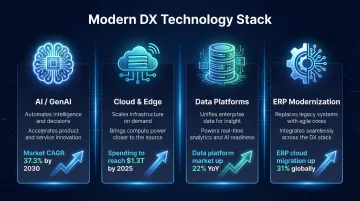
The Modern DX Technology Stack:
| Stack Component | Role in DX | Market Trend |
|---|---|---|
| AI / GenAI | Foundation models driving workflow reinvention and decision-making | Worldwide AI spending forecast to reach $2.52 trillion in 2026 |
| Cloud & Edge | Distributed workloads optimizing latency and providing scalable infrastructure | Public cloud spending projected to surpass $1 trillion in 2026 |
| Data Platforms | Lakehouses and fabrics enabling unified, governed data access | Data architecture modernization market expected to reach $24.4 billion by 2033 |
| ERP Modernization | Composable, API-driven architectures supporting agile capabilities | Foundational for integrating AI into core transactions |
Integration Is Critical:
New technologies must work with existing systems, especially legacy ERP and CRM platforms. Firms like Vorstel Technologies, which bring deep expertise across AI, SAP, cloud, and custom development, reduce time-to-value by combining advisory and delivery capabilities. With 200+ SAP project experiences, specialized partners can navigate integration complexities that derail in-house teams.
Principle 5: Prioritize Data as a Strategic Asset
A digital transformation without a data strategy is incomplete. Organizations need accessible, trustworthy, well-governed data to power decision-making, AI models, and operational insights.
The AI Readiness Crisis:
Only 7% of enterprises say their data is completely ready for AI, and Gartner predicts 60% of AI projects will be abandoned by 2026 due to poor data readiness.
What Strong Data Architecture Looks Like:
- Unified data fabrics or lakehouses that eliminate silos
- Master data governance ensuring consistency and accuracy
- Real-time data availability for operational decisions
- Data products designed for specific business use cases
With 56% of organizations citing siloed data as a top barrier—and only 23% having a clear data strategy—most AI initiatives are set up to fail before they start.
Principle 6: Adopt Agile Operating Models and Cross-Functional Collaboration
IT cannot own digital transformation alone. Successful organizations build cross-functional teams bringing together business, technology, operations, and data expertise. Agile working methods enable faster iteration and course correction.
Governance That Supports Scale:
Establish transformation steering bodies with shared accountability mechanisms that create feedback loops between business priorities and delivery teams. When business leaders and IT jointly own outcomes — not just outputs — execution improves dramatically.
The goal isn't a committee — it's a standing governance structure that keeps strategy and execution in sync as priorities shift.
Principle 7: Treat Transformation as a Continuous Journey, Not a Project
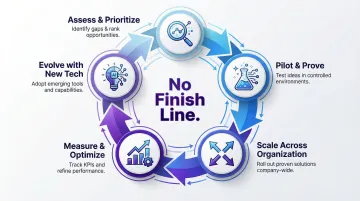
Digital transformation has no finish line. As technologies evolve—especially generative AI—organizations must continuously revisit roadmaps, retire outdated processes, and discover new transformation domains.
MIT Sloan's George Westerman emphasizes that leaders must convert digital transformation from a time-limited project into a continuous capability, stating: "When that happens, digital transformation never stops. Instead, it becomes an ongoing process in which employees and their leaders continually identify new ways to change the company for the better."
Generative AI as a Catalyst:
McKinsey's 2025 State of AI report notes that AI high performers treat AI as a catalyst to transform their organizations, redesigning workflows and accelerating innovation rather than seeking incremental efficiency gains. The practical implication: transformation teams need a standing mandate to evaluate emerging tools, not a one-time roadmap that ages out within 18 months.
Best Practices for Executing Your Digital Transformation Strategy
Conduct a Digital Maturity Assessment First
Understanding where your organization currently stands—technology infrastructure, talent capabilities, data readiness, cultural openness—sets realistic baselines and prioritization criteria.
Leading frameworks include:
- Gartner's Digital Business Maturity Model covering strategy, customer experience, digital revenue, business agility, and innovation culture
- Deloitte/TM Forum's Digital Maturity Model assessing customer, strategy, technology, operations, and organizational culture
- MIT CISR's Future Ready Pathways focusing on customer experience and operational efficiency
Define KPIs Before Launching Any Initiative
Each digital transformation project should have pre-agreed performance indicators covering:
- Cost reduction, revenue growth, and efficiency gains (value creation)
- Adoption rates and agile maturity (team readiness)
- Technology usage and employee engagement (change management health)
These create accountability and signal when to pivot.
Invest in Change Management Proportionally to Technology
According to Prosci's benchmarking, the average project allocates 20% of its budget to change management, with 10% being the most common baseline. This is often the most underfunded area of digital transformation programs.
Deloitte's analysis found that organizations effectively aligning digital change initiatives with strategy and technology investments experience a 14% market cap differential compared to those that fail to manage change.
For every dollar spent building a digital solution, invest comparably in training, process redesign, and adoption support.
Build or Acquire the Right Talent
There's a natural tension between hiring in-house digital talent for strategic long-term capability and bringing in external expertise for speed and specialized implementations.
When to hire in-house:
- Building core organizational capabilities
- Developing proprietary competitive advantages
- Long-term strategic technology leadership
When to leverage external partners:
- Specialized implementations (SAP, Salesforce, cloud migrations)
- Accelerating time-to-value with proven methodologies
- Accessing deep domain expertise quickly
- Maintaining momentum when internal capacity hits its limits
Firms like Vorstel Technologies combine advisory and delivery expertise across AI, SAP, cloud, and custom development — engaging at any stage of a transformation journey to reduce time-to-value without requiring a full internal build-out.
Create Structured Feedback Loops and Waypoints
Regular check-ins tied to KPI reviews, stakeholder input, and technology assessments allow the strategy to remain adaptive without losing direction.
Quarterly reviews tied to OKRs or strategic milestones give leadership a structured moment to redirect investment and address underperforming initiatives before they compound.
Common Pitfalls That Derail Digital Transformation Strategies
Treating DX as a Technology Project Rather Than Business Transformation
Organizations that let IT or vendors define the strategy—rather than business leaders—end up with expensive tools that don't solve the right problems. McKinsey identifies failure to set fact-based, high aspirations as a primary pitfall — leaders aim at targets built on consensus rather than data, undermining transformation before it begins.
Common signs this is happening:
- Business outcomes aren't defined before tool selection begins
- IT or vendor roadmaps drive the transformation narrative
- Success is measured by deployments, not by business results
Pursuing Too Many Initiatives Simultaneously Without Prioritization
Spreading resources across too many initiatives at once prevents any single use case from demonstrating clear value — and erodes organizational confidence fast. Focus on one or two lighthouse projects first, prove ROI, then expand the portfolio.
Underestimating Culture and Change Resistance
Technically sound programs still fail when employee adoption is treated as an afterthought. BCG identifies the "frozen middle"—middle managers defending functional silos—as a primary source of resistance.
Address this by:
- Involving middle management in planning and execution
- Building transformation coalitions across functions
- Using change management frameworks like ADKAR
- Celebrating early wins to build momentum
How to Measure Digital Transformation Success
Three Categories of DX KPIs
Relying solely on financial metrics obscures leading indicators of digital adoption and operational agility. Track all three:
| KPI Category | Examples |
|---|---|
| Value Creation | ROI, EBIT impact, revenue uplift, cost reduction |
| Team Health | Digital literacy, agile delivery speed, employee productivity |
| Change Management | Tool adoption rates, process adherence, employee engagement |
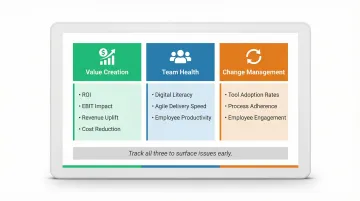
Organizations that track across all three categories consistently surface issues earlier — and build a clearer case for continued investment in transformation initiatives.
The Portfolio View of Measurement
Evaluate the cumulative impact of the full transformation program, not individual projects in isolation. This approach builds tolerance for calculated risk-taking and protects overall program ROI when a single initiative underperforms. It also gives leadership a more accurate picture of where value is actually being generated.
Setting a Measurement Cadence
With a portfolio view in place, the next step is building a consistent review rhythm. Quarterly business reviews tied to OKRs or strategic milestones help leadership:
- Recalibrate investment priorities
- Communicate early wins to sustain organizational momentum
- Course-correct underperforming initiatives before they consume excessive resources
Frequently Asked Questions
What is a digital transformation strategy?
A digital transformation strategy is a business-outcome-driven roadmap for using digital technologies, processes, and people to change how an organization operates and delivers value — covering culture, operating models, and data capabilities, not just technology upgrades.
How to implement a digital transformation?
Define clear business goals, secure executive sponsorship, and run a pilot that proves value within six months. From there, build your technology and data foundation, then scale iteratively — investing as much in change management as in the technology itself.
What are the 5 stages of digital transformation?
Commonly cited stages include: Traditional → Digitized → Digital → Digital-First → Transformative/Innovative. Organizations move through these stages at different speeds depending on maturity, strategic intent, and execution capability.
What are the 5 pillars of digital transformation?
The core pillars are customer experience, operational agility, culture and leadership, workforce enablement, and technology integration. These pillars must be addressed together for transformation to be sustainable—focusing on technology alone rarely delivers lasting results.
What are the 3 P's of transformation?
The 3 P's are People, Process, and Platform (Technology). Most transformation failures occur when organizations invest heavily in one dimension—usually technology—while neglecting the other two. Balancing all three from the outset is what separates lasting change from costly overhauls.
What is an IT transformation?
IT transformation focuses on modernizing technology infrastructure, systems, and IT operating models to reduce costs and respond faster to business demands. Digital transformation is broader—a business-wide reinvention that includes IT transformation as one necessary component within a larger strategic initiative.