Introduction
In boardrooms from Mumbai to Munich, "digital transformation" has become the rallying cry for organizations facing unprecedented pressure—yet for many, the term remains frustratingly vague. Customer expectations shift overnight. Competitors leverage technology to rewrite industry rules. Operational demands multiply while margins tighten. Leaders know they must transform, but too often confuse digital transformation with buying new software, migrating to the cloud, or launching a single technology project.
This guide cuts through the confusion. You'll learn what digital transformation actually means, how it differs from digitization and digitalization, the five distinct types organizations pursue, and the technologies that power them.
You'll also see why, according to McKinsey research, roughly 70% of digital transformations fall short of their goals — and what separates the ones that don't. Whether you're a CEO, IT decision-maker, or transformation leader, this guide gives you a concrete framework to move from confusion to execution.
Key Takeaways
- Digital transformation rewires how organizations operate and deliver value — technology enables it, but strategy and culture determine whether it sticks
- It goes far beyond IT upgrades, encompassing process redesign, product innovation, business model shifts, customer experience, and cultural change
- Most transformation failures trace back to unclear strategy, cultural resistance, and siloed data — rarely to a shortage of technology
- Successful transformation is ongoing, requires CEO-level commitment, and demands measurable KPIs from day one
- Organizations at any stage of the journey can accelerate outcomes with the right consulting framework and domain expertise
What Is Digital Transformation? (And What It Isn't)
Digital transformation is the strategic adoption of digital technologies across all areas of an organization to fundamentally change how it operates, creates value, and delivers experiences to customers. The driver is always a business objective — not a technology trend. McKinsey & Company defines it as "the rewiring of an organization, with the goal of creating value by continuously deploying tech at scale." Because technology constantly evolves and becomes further integrated into business, most executives will be on this journey for the rest of their careers.
The Three-Tier Distinction Most Leaders Miss
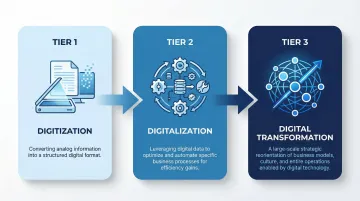
Leaders routinely conflate three fundamentally different concepts — and the confusion leads to misaligned investments:
Digitization converts analog information to digital format—scanning paper invoices into PDFs, for example. It's foundational but limited in scope.
Digitalization uses digital data to improve a specific process. When architects moved from drafting tables to CAD software, that was digitalization—taking one workflow and making it digital to gain efficiency, accuracy, or speed.
Digital Transformation is the large-scale strategic reorientation of business models, culture, and operations made possible when multiple digitalized processes converge. Netflix's shift from DVD rental logistics to streaming and original content creation represents true transformation—the company redefined its entire business model, its content supply chain, and its relationship with customers.
What Digital Transformation Is NOT
Digital transformation is not:
- Simply moving to the cloud or buying new software
- A single technology project with a defined end date
- An IT department initiative that business units can ignore
- A checklist of tools to implement
Start With "Why," Not "What"
Successful digital transformation always begins by identifying the business problem, opportunity, or aspiration—before selecting any technology. The common pitfall of technology-first thinking explains why only 35% of digital transformation initiatives achieve their objectives.
The People and Culture Challenge
Digital transformation is as much a people and culture challenge as a technology challenge. It requires:
- New ways of working and organizational alignment
- Comprehensive change management
- A fundamental shift in how leadership thinks about innovation and risk
- Cross-functional collaboration where product, operations, and IT teams share ownership of outcomes
Organizations that invest heavily in culture change see 5.3x higher success rates than those pursuing technology-only approaches.
Why Digital Transformation Matters: The Business Imperative
The Competitive Survival Argument
The performance gap between digital leaders and laggards has become a chasm. BCG research reveals that AI and digital leaders achieve 1.7x higher revenue growth, 1.6x higher EBIT margins, and 3.6x higher three-year Total Shareholder Return compared to laggards. That's not incremental advantage. It's the difference between leading a market and losing ground in it.
Global spending underscores the urgency: IDC forecasts worldwide digital transformation spending will reach nearly $4 trillion by 2027, growing at a 16.2% CAGR. By 2027, DX investments are projected to reach or surpass two-thirds of all ICT spending.
Three Core Business Pressures Driving Adoption
Three pressures are pushing organizations off the fence:
- Customer expectations: Buyers now demand always-on, personalized experiences across every touchpoint. Without omnichannel capabilities, customers move to competitors who have them.
- Cost pressure: McKinsey found that transforming core business functions can yield 25% efficiencies within the first year. In tight-margin environments, that's not a nice-to-have.
- Digital disruption: New entrants use digital-native business models to upend established industries — Uber without owning vehicles, Netflix without physical distribution, AWS turning retail profits into cloud dominance.
The COVID-19 Accelerator Effect
Those three pressures had been building for years. The pandemic forced the issue. McKinsey data shows the crisis compressed three to four years of customer and supply-chain digitization into months, while digital product portfolios accelerated by seven years.
The sectoral shifts were stark. In healthcare alone, physician adoption of virtual video visits grew from 14% in 2018 to 68% in 2022. Retail and financial services saw similarly abrupt pivots. The lesson: digital readiness doesn't just drive growth — it determines how well an organization survives disruption.
The 5 Types of Digital Transformation
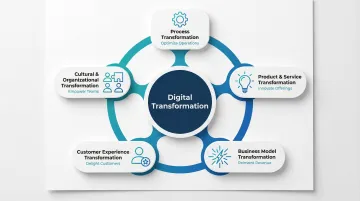
Most organizations don't pursue just one type of digital transformation—they often overlap and reinforce each other. MIT Center for Information Systems Research identifies five essential building blocks that map directly to transformation types.
Process Transformation
Process transformation redefines workflows to eliminate inefficiencies, reduce costs, and improve speed. Examples include:
- Replacing manual approval chains with intelligent workflow automation
- Using AI to process supply chain data in real time instead of manually
- Automating invoice processing with machine learning–based data extraction and ERP integration
Vorstel Technologies helped a manufacturing client replace a time-consuming manual invoice process—downloading, data entry, and archiving—with a fully automated AI-powered workflow using AI Builder. Invoices are now automatically read, validated, updated in the ERP, and stored, eliminating manual errors and accelerating processing.
Product and Service Transformation
Organizations embed digital technology into their offerings and how they develop them. This includes:
- Connected IoT-enabled products (smart vehicles, wearable health devices)
- Software-enhanced services (delivery tracking apps, predictive maintenance alerts)
- Data-driven product development cycles
A manufacturer might transform a traditional industrial machine into a connected asset that reports performance data, predicts failures, and enables remote diagnostics—shifting the business relationship from a one-time equipment sale to an ongoing service and insights model.
Business Model Transformation
The most disruptive form: when digital technology enables a new way of delivering value. Classic examples:
- Netflix: Evolved from DVD rental logistics to streaming subscription to original content studio
- Amazon: Started as an online bookstore, expanded into global commerce, then built AWS into the world's dominant cloud infrastructure business
- Uber: Enabling transportation without owning vehicles—creating a digital marketplace that connects supply and demand
New entrants have repeatedly used this playbook to disrupt established industries precisely because they had no legacy infrastructure to protect.
When customers expect seamless digital experiences, the pressure on businesses extends well beyond internal operations.
Customer Experience Transformation
Digital transformation enables organizations to engage customers across any channel, at any time, with personalized and seamless experiences:
- AI-powered chatbots for 24/7 service
- Personalized content and recommendations in context
- Omnichannel shopping (research online, buy in-store, return anywhere)
- Predictive service delivery (knowing what customers need before they ask)
Gartner research indicates that 91% of customer service leaders are under pressure to implement AI to improve customer satisfaction, operational efficiency, and first-contact resolution.
Cultural and Organizational Transformation
This is the foundation all other types depend on. It involves:
- Shifting to agile ways of working
- Fostering cross-functional collaboration
- Embracing experimentation and "fail fast" learning
- Securing leadership alignment from the CEO down
Cultural resistance is consistently cited as a top barrier to digital transformation success. Fewer than 20% of digital transformations deliver sustained performance improvements, largely due to insufficient focus on organizational and cultural change.
The Technologies Powering Digital Transformation
Technology is the enabler, not the driver. Organizations should select technologies based on business goals, not trends.
AI, Machine Learning, and Automation
AI enables predictive analytics, personalization at scale, intelligent process automation, and decision support. Key applications:
- Predictive analytics: Machine learning models forecast demand, detect defects, and anticipate equipment failures
- Process automation: AI-powered workflows eliminate manual tasks, reduce errors, and accelerate operations
- Natural language processing: Chatbots, sentiment analysis, and automated document processing
- Generative AI: Content creation, code generation, and decision support
McKinsey's 2025 State of AI report notes that 88% of organizations now report regular AI use in at least one business function. By 2026, 40% of enterprise applications will feature task-specific AI agents, up from less than 5% today.
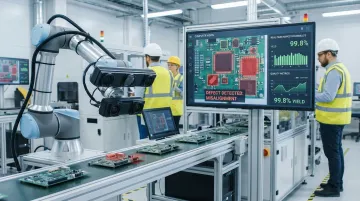
Platforms like SAP, Salesforce, and Microsoft—which Vorstel Technologies specializes in implementing—are central to putting AI-driven insights to work across enterprise functions. Vorstel's machine learning implementation for a manufacturing client demonstrates this: a custom ML model trained on product images now detects defects in real time on the production line, measurably improving quality control and reducing waste.
Cloud Computing, IoT, and Data Integration
Cloud computing provides the scalable, flexible infrastructure digital transformation requires. Gartner forecasts worldwide public cloud spending will reach $723.4 billion in 2025, driven by AI workloads and enterprise modernization. 82% of cloud buyers plan to modernize their cloud estates to support distributed, AI-driven workloads.
Internet of Things (IoT) connects physical operations to digital intelligence. IDC reports that 71% of industrial organizations rely on AIoT for predictive maintenance to anticipate failures. IoT-enabled predictive maintenance reduces unplanned downtime by up to 30%.
Data integration—breaking down silos and enabling real-time data access—is the backbone of successful transformation. Without unified, accessible data, AI models produce unreliable results, analytics miss critical insights, and automation workflows fail.
DevOps and Modern Development Practices
DevOps bridges the gap between stable infrastructure and fast delivery — ensuring that the data pipelines and cloud platforms built in transformation programs stay current with business needs. By automating integration and deployment through CI/CD pipelines, teams can ship faster and respond to real-world feedback without disrupting live systems.
Core DevOps capabilities that support transformation include:
- CI/CD pipelines: Automate testing and deployment to cut release cycles from weeks to days
- Infrastructure as Code: Provision and manage cloud environments consistently and at scale
- Monitoring and observability: Catch issues in production before they affect end users
- Iterative releases: Deploy incremental updates rather than high-risk big-bang rollouts
Benefits, Common Challenges, and How to Start Your DT Journey
Core Business Benefits
Digital transformation delivers measurable value across three key areas:
Operational efficiency and cost reduction:
- McKinsey found enterprise platform transformation yields 25% efficiencies within the first year
- Accenture research shows complete digital operations transformation generates an average 4% lift on operating income
- Automation eliminates manual errors and accelerates workflows
Enhanced customer satisfaction and new revenue streams:
- Personalized experiences increase loyalty and lifetime value
- Omnichannel capabilities meet customers where they are
- Data-driven insights enable proactive service delivery
Organizational resilience and agility:
- Faster response to market changes and disruption
- Digital infrastructure enables rapid experimentation
- BCG notes companies comprehensively addressing digital success factors report 21% EBIT increase
The Strategy Gap: Why Most Transformations Fail
Despite massive investments, only 35% of digital transformation initiatives achieve their objectives. Gartner's 2024 survey found that only 48% of digital initiatives meet or exceed their business outcome targets.
The primary culprit? Deloitte reports that lack of a transformation strategy is cited as a top barrier by almost 60% of respondents. Organizations launch initiatives without clear business objectives, success metrics, or alignment across functions.
Escaping "Pilot Purgatory"
Many organizations successfully test new technologies but fail to generate enterprise-wide value. Forrester research reveals that only 10-15% of AI projects make it into long-term production use, with over 60% of pilots failing to scale due to integration issues, data quality problems, and delays in redesigning workflows.
Why this happens:
- Siloed implementation without enterprise architecture alignment
- Lack of a scalable operating model
- Underinvestment in change management and user adoption
- No clear path from pilot to production defined upfront
Data Silos and Change Management Barriers
Siloed data reduces the effectiveness of every digital transformation investment. When data sources are fragmented across departments and systems, organizations can't achieve real-time decision-making, comprehensive analytics, or effective automation. Forrester emphasizes that companies must tear down functional silo structures to become future-fit.
Cultural resistance from employees who fear change can stall even well-funded initiatives. Addressing it requires investment in both technical infrastructure and people-oriented programs:
- Training staff on new tools and workflows
- Consistent communication about the "why" behind changes
- Leadership visibly modeling new behaviors
- Incentive alignment that rewards adoption, not just compliance
Practical Starting Framework
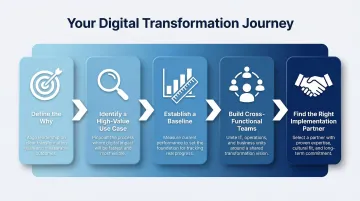
Knowing where the common failure points are makes it easier to avoid them. This five-step approach gives organizations a structured path forward:
- Define the "why": Identify the specific business problem or aspiration driving transformation
- Identify a high-value, measurable use case: Start with one initiative that delivers clear ROI
- Establish a baseline: Measure current performance to track progress
- Build cross-functional teams: Break down silos with shared accountability
- Find the right implementation partner: Look for expertise, proven methodology, and ability to join at any stage
On that last point: the right partner can join mid-journey, not just at day one. Vorstel Technologies, for example, takes over engagements at any stage — whether a client needs to rescue a stalled SAP rollout, integrate AI into existing workflows, or build out a cloud migration that's already in progress. With 200+ SAP project experiences, a 95% Salesforce implementation success rate, and 97% client satisfaction across global deployments, Vorstel brings the technical depth and cross-domain experience to turn strategy into measurable results.
Frequently Asked Questions
What is digital transformation?
Digital transformation is the strategic, technology-driven rewiring of how an organization operates and delivers value to customers. It encompasses both technology implementation and cultural change—not a single IT project, but an ongoing evolution of business models, processes, and customer experiences enabled by digital capabilities.
What is digital transformation and innovation?
Digital transformation and innovation are deeply connected. Transformation builds the infrastructure, data foundation, and agile processes that make continuous innovation possible. In turn, innovation sustains transformation by surfacing new opportunities and business models that keep the organization moving forward.
What are the 5 stages of digital transformation model?
Most frameworks define five stages:
- Traditional — minimal digital adoption; largely analog operations
- Experimental — isolated teams test digital tools independently
- Systematized — digital capabilities expand across functions
- Integrated — strategy and technology align around business value
- Continuous — digital is embedded in culture; transformation becomes ongoing
What is the best example of digital transformation?
Netflix is a strong example — it evolved from a DVD rental service to a global streaming platform to an original content studio. Each shift was driven by digital capability, not just tooling. The common thread across the best transformations: technology changed what the business fundamentally is, not just how it operates.
What is the difference between digitization and digital transformation?
Digitization is converting analog information to digital format — scanning paper records to PDFs, for instance. Digital transformation goes further: it's the strategic reimagining of how an organization operates, competes, and creates value using interconnected digital capabilities. Digitization changes the format of information; transformation changes the business itself.
How long does digital transformation take?
There is no fixed timeline. Individual initiatives may show results in months—a cloud migration might take 3-6 months, a CRM implementation 4-9 months—but true organization-wide transformation is a multi-year, ongoing journey. McKinsey research notes most executives will be managing their digital transformation journey for the duration of their careers. Success comes from treating transformation as continuous evolution, not a project with an end date.