Introduction
SAP powers the enterprise operations of over 90% of Fortune 500 companies, managing everything from supply chains to financial reporting across global operations. Choosing the wrong SAP consulting partner can trigger consequences that extend far beyond budget overruns: Gartner predicts that by 2027, more than 70% of recently implemented ERP initiatives will fail to fully meet their original business case goals, with up to 25% failing catastrophically. These failures stem not from technology limitations but from mismatched partnerships, inadequate change management, and partners who lack the depth to navigate complex transformations.
- Gartner reports 70% of ERP projects fail to meet goals; partner selection is the critical control variable
- SAP's 2027 ECC maintenance deadline is accelerating S/4HANA migrations globally
- Top partners combine SAP Platinum status, industry-specific expertise, and end-to-end service coverage
- Boutique specialists like Vorstel Technologies deliver 92% faster deployment cycles with 97% client satisfaction
- Decision framework: align partner type to project complexity, budget, and transformation stage
Why Choosing the Right SAP Consulting Partner Matters
SAP transformations demand far more than technical installation. They require process redesign, data migration across legacy systems, change management across departments, and tight alignment between IT and business leadership. A mismatched partner doesn't just delay go-live dates — it creates scope creep, user adoption failures, and systems that produce data without producing decisions.
SAP confirmed that mainstream maintenance for SAP Business Suite 7 (including ECC 6.0) ends December 31, 2027, with optional extended maintenance running only until 2030. That deadline is compressing timelines fast. SAPinsider's 2025 benchmark report shows 32% of organizations have already transitioned to S/4HANA, while 27% are actively implementing. Partner quality and delivery speed directly determine whether your organization lands in the prepared majority — or scrambles at the deadline.
That urgency makes the partner selection decision more consequential. Most organizations face a core choice between large global system integrators (GSIs) and specialized boutique firms — and neither is universally better.
Global system integrators (Accenture, Deloitte, IBM) offer:
- Broad multi-domain resources for complex, multi-country rollouts
- Established delivery frameworks and risk management structures
- Brand credibility that satisfies enterprise procurement requirements
Boutique SAP consultancies typically offer:
- Direct access to senior consultants on day one
- Faster deployment cycles and leaner project governance
- Deep industry-specific expertise without generalist overhead
This guide helps you navigate that choice based on your business size, current SAP landscape, and how much time you have before the 2027 deadline.
What to Look for in a Top SAP Consulting Company
Proven SAP Expertise and Certifications
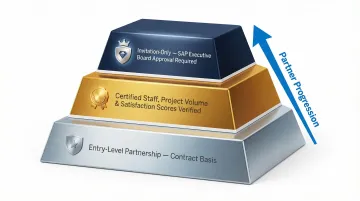
SAP partner tiers signal validated expertise. The SAP PartnerEdge program defines three levels:
- Silver: Entry-level status based on partnership contract
- Gold: Advanced tier requiring elevated certified staff count, completed project volume, and customer satisfaction scores
- Platinum: The most strategic tier, granted by invitation only after SAP Executive Board approval
Verify partner status directly through the SAP Partner Finder. Beyond tier status, assess module-specific depth. A partner with 200+ project experiences across S/4HANA, EWM, TM, Ariba, and BTP is a different category of partner than a generalist IT firm with limited SAP exposure. Find out how many S/4HANA migrations they've completed in the past 24 months, and what percentage of their consultants hold current certifications.
Industry-Specific Experience
Vertical expertise matters because SAP configurations must reflect real business processes. A partner experienced in manufacturing understands production planning, shop floor integration, and quality management nuances that a generalist misses. Retail-focused partners bring omnichannel inventory management and demand forecasting depth that general IT firms rarely develop.
Before shortlisting, request industry-specific case studies and client references. Key questions to probe:
- Have they implemented SAP for companies in your sector?
- Can they demonstrate familiarity with your regulatory requirements?
- Do they offer pre-configured industry templates that accelerate deployment?
End-to-End Service Coverage
A top partner should offer the full service spectrum:
- Strategy and advisory (roadmap development, business case)
- Implementation (greenfield/brownfield)
- Data migration and validation
- Integration with existing systems
- Post-go-live Application Management Services (AMS)
- Upgrade and continuous optimization support
Partners who only handle implementation leave clients without ongoing optimization support. The most successful SAP transformations treat go-live as the beginning, not the end. Verify that your partner has dedicated AMS capabilities, clear SLA commitments, and senior consultants available post-implementation.
Deployment Methodology and Speed
SAP Activate is the official cloud adoption framework and recommended methodology for S/4HANA implementations. It provides a structured approach across six phases: Discover, Prepare, Explore, Realize, Deploy, Run. Confirm whether your partner follows SAP Activate and whether they support Agile or hybrid delivery models.
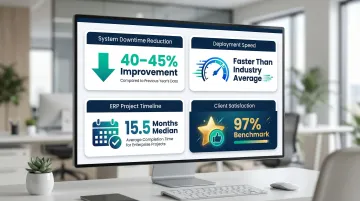
Speed matters: Panorama Consulting's 2024 ERP Report found the median ERP project timeline is 15.5 months. Less than a quarter of organizations use "big bang" implementations due to high risk; phased approaches reduce both technical and organizational risk while accelerating time-to-value.
Client Satisfaction and Transparency
Look for measurable satisfaction metrics, transparent communication practices, and clear escalation frameworks. Red flags include:
- Vague timelines with no milestone-based accountability
- Fixed rigid contracts with no flexibility for scope adjustments
- Difficulty accessing senior consultants post-sale
- No references from clients in your industry or size range
Request quantifiable results from past clients: reduction in system downtime, faster deployment cycles, improved data accuracy. For context, strong SAP partners typically report metrics like 40–45% reductions in system downtime and deployment cycles that outpace industry averages by a significant margin. If a partner can't point to specific, measurable outcomes from past engagements, that's a signal worth taking seriously.
Top SAP Consulting Companies and Partners to Consider
This curated list highlights SAP consulting firms recognized for delivery quality, SAP expertise, and client outcomes. The right choice depends on your business size, geography, and transformation needs—not brand name alone.
Accenture
Accenture is an SAP Platinum Partner with over 40 years of collaboration with SAP as both customer and partner. The firm offers comprehensive SAP services including S/4HANA, supply chain, finance, HR, and cloud migrations across industries.
Accenture earned multiple 2026 SAP Partner Awards, including Global Winner designations for Delivery Quality, RISE with SAP Methodology, and SAP Business Data Cloud Success. Notable capabilities include co-innovation for circular economy solutions (SAP Responsible Design and Production) and the ADVANCE pathway for high-growth companies. Accenture's global delivery scale and multi-domain resources make it a strong fit for complex, multi-country transformations requiring extensive governance.
Deloitte
Deloitte is a Platinum SAP Partner with a relationship dating to 1989. The firm maintains a global network of SAP-focused professionals and holds 10,000-15,000 Cloud Certified Individuals according to SAP's 2024 Global SI Certifications report.
Deloitte won 2026 SAP Partner Awards for Partner Learning and Skills Growth and SAP Business AI: Customer Adoption. The firm's Kinetic Enterprise transformation approach emphasizes business outcome alignment alongside technical implementation. Deloitte is particularly strong in finance, public sector, and life sciences verticals, offering deep regulatory and compliance expertise.
IBM
IBM is an SAP Platinum Partner with over 50 years of collaboration. IBM's strength lies in integration capabilities across its own cloud and AI platforms, including SAP-certified Power and Intel x86 instances on IBM Cloud.
IBM is a premium supplier for RISE with SAP, offering RISE with SAP on IBM Power Virtual Server. The firm has expanded collaboration to embed IBM watsonx generative AI capabilities into SAP's cloud solutions. IBM excels in custom SAP roadmap development, cloud hosting, and multi-industry ERP methodologies for globally distributed organizations.
NTT DATA Business Solutions
NTT DATA Business Solutions is an SAP Platinum Partner with over 30 years of focused SAP consulting experience. The firm is particularly strong in manufacturing, distribution, and consumer goods sectors.
NTT DATA won 2025 SAP Pinnacle Awards in four categories and maintains RISE with SAP Validated Partner status. The firm's transparent implementation roadmap and ongoing support model make it a strong fit for mid-market and international companies requiring industry-specific solutions. NTT DATA's whitepapers and case studies demonstrate deep specialization in Consumer Packaged Goods (CPG), Smart Factory, and manufacturing execution systems.
Vorstel Technologies
Vorstel Technologies is an SAP consulting partner that uses AI-driven automation to accelerate deployments, with 200+ SAP project experiences and a 97% client satisfaction rate across India, Germany, Hungary, Singapore, and Finland. The firm serves global enterprises and startups that need speed, flexibility, and measurable outcomes.
A core differentiator is Vorstel's ability to join and deliver at any stage of a client's SAP journey—from greenfield implementations to mid-project recovery. The firm reports significantly faster deployment cycles than industry averages through AI-powered automation and streamlined methodologies.
SAP service coverage includes:
- S/4HANA implementation and migration
- SAP Fiori UX design
- SAP Ariba procurement solutions
- SAP BTP integration
- SAP MDG (Master Data Governance)
- SAP Automation & Analytics
Vorstel's Zero-Fee Solution Evaluation gives organizations a risk-free way to explore SAP consulting options before committing. The consultation covers automation, IT strategy, cloud solutions, and software development, delivered via virtual meetings. For organizations that need senior expertise without large-GSI overhead, Vorstel offers a practical alternative with global reach.
How to Choose the Right SAP Consulting Partner for Your Business
Define Your SAP Scope and Transformation Stage
Before evaluating partners, clarify what you need:
- Greenfield implementation: New SAP deployment with no legacy system migration
- Brownfield migration: Upgrading existing SAP ECC to S/4HANA while preserving customizations
- Module-specific rollout: Adding Ariba, SuccessFactors, or other modules to existing SAP landscape
- Mid-project rescue: Stabilizing or accelerating a stalled implementation
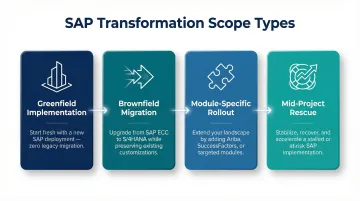
The answer determines which partner type fits best. Greenfield projects benefit from partners with strong change management and process redesign capabilities. Brownfield migrations require deep technical expertise in data migration and custom code cleanup. Mid-project rescues are a different challenge entirely — they demand partners who can rapidly assess, stabilize, and deliver, a specialized capability not all firms offer.
Align on Engagement Model and Flexibility
Understand the main engagement models and when each is appropriate:
- Fixed-price project: Best for well-defined scope with minimal expected changes; transfers risk to partner but reduces flexibility
- Time-and-material: Suitable for exploratory or evolving projects; provides flexibility but requires strong governance
- Managed services: Ongoing support model with predictable monthly costs; ideal for post-go-live optimization
- On-demand consultant augmentation: Fills specific skill gaps without full project commitment
Business requirements shift — and rigid contracts create real friction when they do. Before signing, ask: Can we adjust scope without renegotiating the entire contract? What happens if we need to pause or accelerate the project?
Assess Post-Go-Live Support Capabilities
Go-live is not the finish line. The partner's Application Management Services (AMS) capability, SLA commitments, and access to senior consultants after implementation is complete often determine long-term SAP ROI.
Ask specific questions:
- What are your standard SLA response times for critical vs. non-critical issues?
- Do you provide 24/7 support across our operating time zones?
- Will the same consultants who led implementation be available for post-go-live support?
- What is your process for handling system upgrades and quarterly SAP releases?
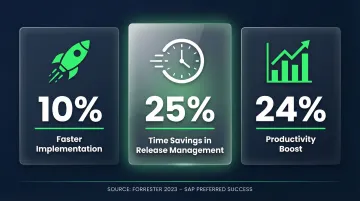
The numbers back this up: a 2023 Forrester study found that SAP Preferred Success delivers 10% faster implementation, 25% time savings in release management, and a 24% productivity boost. Vet post-go-live commitments as rigorously as you vet the implementation proposal itself.
Request References and Measurable Outcomes
Ask for quantifiable results from past clients rather than generic testimonials:
- Reduction in system downtime (percentage and hours)
- Faster deployment cycles (months saved vs. baseline)
- Improved data accuracy (error rate reduction)
- User adoption rates (percentage of users actively using the system)
- ROI achievement (percentage of clients meeting business case targets)
Panorama Consulting reports that 83% of organizations that performed an ROI analysis prior to their project and have been live for at least a year met their ROI expectations. If a partner can't provide specific outcome metrics from past engagements, that's a signal worth taking seriously.
Evaluate Global vs. Local Delivery Capability
For organizations operating across multiple countries, the consulting partner must demonstrate:
- Multi-country rollout experience with documented case studies
- Cross-time-zone support (24/7 coverage or follow-the-sun model)
- Familiarity with local compliance and regulatory requirements (GDPR, tax regulations, labor laws)
- In-country resources or partnerships for on-site support
SAPinsider research shows that 73% of organizations plan to either completely outsource their SAP S/4HANA project or leverage consultants with specific skills. When evaluating global delivery, verify that your partner has established delivery centers or regional partnerships — not just a presence on paper.
Large Global Firms vs. Boutique SAP Consultants: Which Is Right for You?
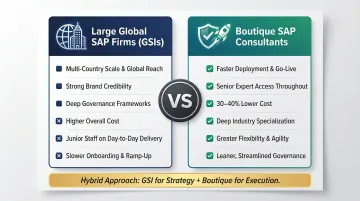
Large global firms (Accenture, Deloitte, IBM) offer scale, brand credibility, and multi-domain resources. They excel in complex, multi-country transformations that demand deep governance, regulatory compliance, and cross-system integration.
The trade-off is real, though. Expect higher costs, slower onboarding, and limited senior attention on mid-sized accounts. Junior consultants typically handle day-to-day work, with senior partners surfacing mainly during sales pitches and steering committee meetings.
Boutique and specialized SAP partners offer faster deployment, more direct access to senior expertise, greater flexibility in engagement terms, and stronger focus on specific industries or modules. They're often the better fit for SMEs, startups, and companies needing mid-project agility or rapid delivery. Vorstel Technologies, for instance, reports 92% faster deployment cycles and 97% client satisfaction — outcomes it attributes to focused expertise and leaner delivery processes rather than large-firm overhead.
The decision should be driven by:
- Scope: Multi-country, multi-module rollouts favor GSIs; focused implementations favor specialists
- Budget: Boutiques typically charge 30–40% less than large global firms
- Speed: Specialists move faster with less internal bureaucracy slowing decisions
- Seniority: Boutiques give you direct access to senior consultants throughout the project — not just at kickoff
A hybrid approach is also worth considering: engage a large firm for strategy and roadmap development, then bring in a boutique for execution. You get the planning rigor of a GSI without locking in their day rates for the full project lifecycle.
Frequently Asked Questions
What is an SAP consulting partner?
An SAP consulting partner is a certified firm or individual that helps businesses plan, implement, integrate, and optimize SAP software solutions. Services span initial strategy and business case development through technical deployment, data migration, user training, and post-go-live support.
What is the difference between an SAP consulting company and an SAP implementation partner?
Consulting companies focus on strategy, advisory, and optimization guidance—helping you define what to implement and why. Implementation partners handle the technical deployment and configuration of SAP systems. Many firms offer both services under one umbrella, providing end-to-end coverage.
How much does SAP consulting typically cost?
SAP consulting costs vary widely based on project scope, company size, modules involved, and partner tier. Panorama Consulting's 2024 report found median ERP project costs of $450,000. Request itemized quotes and look for partners offering transparent pricing or no-cost initial evaluations.
What SAP modules do consulting companies typically support?
Common modules include S/4HANA (core ERP), Ariba (procurement), SuccessFactors (HR), SAP BTP (Business Technology Platform), EWM (Extended Warehouse Management), TM (Transportation Management), and industry-specific solutions. Look for partners with depth across multiple modules relevant to your business.
How do I know if an SAP consulting partner is right for my industry?
Request industry-specific case studies and client references in your sector. A partner with genuine vertical expertise will understand your regulatory requirements and common pain points—not just the technical configuration.
Can an SAP consulting company take over a project that is already in progress?
Yes, experienced SAP firms can join mid-project to stabilize, recover, or accelerate a stalled implementation. Not all partners offer this capability, so confirm it upfront and ask for relevant case studies.
With the 2027 ECC deadline approaching, use this guide's framework to evaluate partners on expertise, industry fit, delivery methodology, and post-go-live support. Prioritize measurable outcomes and transparency—those are the markers of a partner worth choosing, regardless of firm size.