Introduction
Aging software systems are no longer just an IT problem—they're a business liability. Escalating maintenance costs, security gaps, and the inability to integrate with AI or cloud-native tools have moved from distant risks to daily operational realities that erode competitiveness and profitability.
"Modernization" gets used loosely in strategy decks, but the real measure is concrete: deployment speed, system uptime, cost savings, and competitive agility—outcomes that show up in quarterly results, not just IT roadmaps.
The cost of inaction is well documented. Technical debt now consumes 20% to 40% of an entire IT estate's value, draining critical funding away from innovation just to keep legacy systems running.
What follows breaks down what legacy application modernization actually involves, the business case for acting now, and the compounding cost of waiting.
Key Takeaways
- Legacy application modernization updates outdated software systems to meet current business needs, security standards, and technology capabilities
- It is a structural transformation that goes beyond cloud migration or one-time upgrades, improving how applications perform, scale, and connect with modern tools
- Key advantages include lower operating costs, faster time-to-market, reduced security exposure, and the freedom to adopt AI and cloud-native capabilities
- Organizations that delay modernization face compounding technical debt, rising maintenance costs, security vulnerabilities, and blocked adoption of AI or cloud-native tools
- Maximum value comes from phased execution, clear business alignment, and a partner who can step in at any stage of the transformation
What Is Legacy Application Modernization?
A legacy application is software or a system built on older technology stacks, architectures, or platforms that now struggles to meet current performance, security, or integration requirements—even if it still technically functions. These systems often rely on outdated programming languages, monolithic architectures, or on-premise infrastructure built before modern cloud-native design principles existed.
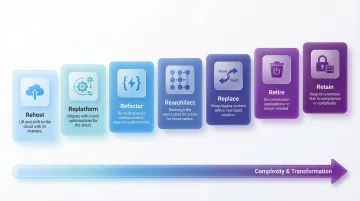
Modernization spans a spectrum of approaches—not a single fix, and not automatically a full replacement. The right path depends on the system's complexity, business criticality, and target outcomes:
- Rehost (lift-and-shift): move applications to the cloud without changing the underlying code
- Replatform: migrate with targeted optimizations, such as adopting managed databases
- Refactor: modify code to take advantage of cloud-native features
- Rearchitect: fundamentally redesign the application architecture (for example, breaking into microservices)
- Replace: swap the legacy system for a modern SaaS solution
- Retire: decommission applications that no longer deliver business value
- Retain: keep specific systems on-premise temporarily due to compliance constraints or complexity
**Modernization vs. digital transformation** are related but distinct. Modernization is a targeted initiative: update specific systems, resolve specific constraints, deliver specific outcomes. Digital transformation is the broader strategic journey that reimagines how an organization operates and delivers value at every level.
Modernization is typically the essential first step. Attempting to transform digitally while running on aging, inflexible infrastructure is like trying to build on an unstable foundation—progress stalls before it starts.
Key Advantages of Legacy Application Modernization
Each advantage below maps directly to outcomes organizations track: cost, speed, risk, and competitive positioning. These are the operational changes that follow when aging systems are replaced with architectures built for how businesses run today.
Reduced Operational Costs and Improved ROI
Maintaining legacy systems generates compounding costs that drain IT budgets and limit strategic investment. ServiceNow reports that legacy systems cost IT departments an average of nearly $40,000 per year to maintain each system, with manufacturing and energy companies spending over $53,000 annually per legacy application.
These costs stem from multiple sources:
- Expensive specialist talent for outdated languages like COBOL (average programmer age: 58)
- Hardware dependencies and vendor support fees for end-of-life platforms
- Frequent emergency fixes that disrupt operations
- Manual workarounds that consume staff time and introduce errors
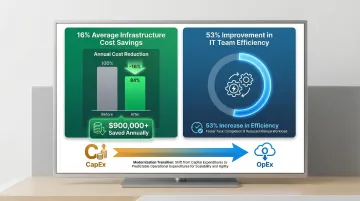
Cloud-native and SaaS-based architectures shift spending from capital-heavy on-premise infrastructure (CapEx) to consumption-based operating expenses (OpEx). Organizations save an average of 16% on direct infrastructure costs, equating to over $900,000 annually, while IT infrastructure teams become 53% more efficient through automation.
The financial impact extends beyond line-item savings. Lower total cost of ownership frees budget for reinvestment into product development and market expansion. When operational systems run efficiently at lower cost, leadership can redirect resources to innovation and hiring instead of maintaining aging infrastructure.
KPIs to track: IT infrastructure spend, total cost of ownership, system maintenance hours, unplanned downtime costs, resource utilization rates
This advantage is most pronounced for organizations with aging on-premise infrastructure, heavy vendor lock-in, or systems requiring costly specialized talent — particularly in manufacturing and enterprise environments where downtime carries direct revenue impact.
Cost improvements create the runway for the next challenge: moving faster than competitors.
Increased Business Agility and Faster Time-to-Market
Legacy monolithic systems are architecturally rigid. Changing one component risks breaking others, which turns feature releases into multi-month efforts and makes responding to market shifts slower than it needs to be.
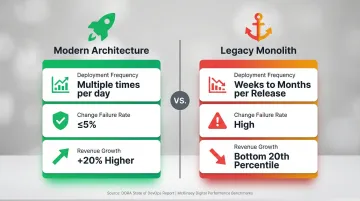
Microservices architecture, API-driven design, and cloud-native platforms decouple application components so teams can build, test, and deploy updates independently. Elite performers using these modern architectures deploy code multiple times per day with a 5% or lower change failure rate, compared to the weeks or months legacy monoliths require per release. DevOps practices integrated during modernization — specifically CI/CD pipelines — compound this further.
The business case is measurable: organizations in the top tier for delivery speed achieve revenue growth 20% higher than those in the bottom 20th percentile. Speed is not just an engineering metric — it determines how quickly ideas reach customers.
There is a second implication worth noting. Organizations running legacy systems cannot easily adopt AI tools, real-time analytics, or modern integration platforms. The architecture itself becomes a ceiling on what the business can do with its data.
KPIs to track: Deployment frequency, release cycle time, mean time to recovery (MTTR), feature delivery lead time, application availability
This advantage is most relevant for fast-growing startups, e-commerce platforms, and enterprises launching digital products in markets where delivery speed directly affects revenue.
Speed gains also expose another vulnerability that modernization directly addresses: security.
Enhanced Security and Regulatory Compliance
Legacy applications are disproportionately vulnerable. They rely on unpatched code, end-of-life software no longer receiving security updates, and architectures that predate standards like zero-trust, identity and access management, or encrypted data transit.
Modern architectures address this by embedding security controls directly into the application — encryption, role-based access, multifactor authentication, and continuous monitoring are built in rather than bolted on after the fact.
The financial exposure from delaying this work is substantial:
- The global average cost of a data breach reached a record $4.88 million in 2024, up 10% from 2023
- Breaches involving on-premise legacy environments averaged over $5 million and took 283 days to identify and contain
- PCI DSS 4.0 and HIPAA now explicitly classify end-of-life and unpatched software as severe compliance violations
- For healthcare, financial services, and retail organizations, modernization is a compliance mandate — not simply an efficiency upgrade
Security incidents carry costs beyond the breach itself: operational disruption, customer trust erosion, and regulatory penalties. Modernization reduces this exposure at the architecture level rather than through reactive patching.
KPIs to track: Security incident frequency, mean time to detect/respond (MTTD/MTTR), compliance audit pass rate, data breach costs, regulatory penalty exposure
This advantage is most critical for regulated industries — financial services, healthcare, retail handling PCI data — and any enterprise processing customer data under GDPR or regional data protection frameworks.
What Happens When Modernization Is Delayed or Ignored
Each year of deferred modernization adds layers of patches, workarounds, and undocumented dependencies that make the system progressively harder and more expensive to update. This "technical debt spiral" is not just a technical problem—it is a business liability.
Four operational consequences organizations consistently report:
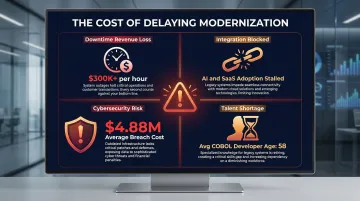
- Unplanned downtime erodes revenue fast. Over 90% of midsize and large enterprises report that a single hour of downtime costs more than $300,000, with large enterprises facing costs up to $23,750 per minute. Legacy systems — with their software flaws, bugs, and configuration drift — are among the chief culprits.
- Integration with modern platforms stalls. Aging systems cannot connect with AI tools, analytics platforms, or SaaS ecosystems without extensive custom integration work. This blocks adoption of technologies that competitors are already using.
- Cybersecurity exposure compounds over time. As unpatched vulnerabilities accumulate and vendors discontinue security support, legacy systems become prime targets. The longer modernization is delayed, the higher the risk of a catastrophic breach.
- Talent to maintain old systems is running out. With the average COBOL programmer now 58 years old and tech hiring cycles stretching to 95 days, finding developers who can support outdated codebases is increasingly difficult. Developers already spend only 16% of their time actually coding — the remaining 84% is consumed by maintenance and technical debt management.
Beyond operational strain, a strategic gap opens. Organizations running rigid legacy architectures struggle to launch new digital products, respond to market shifts, or scale into new geographies at the pace modern competitors can. What starts as a technology problem becomes a competitive disadvantage.
How to Get the Most Value from Legacy Application Modernization
Modernization delivers the most value when it starts with a structured assessment—mapping current application dependencies, identifying mission-critical components, and evaluating which systems carry the highest technical debt relative to business impact. This assessment determines the right modernization path (rehost, refactor, rearchitect, rebuild, replace, or retire) rather than defaulting to a one-size-fits-all approach.
Rather than attempting full-system overhauls simultaneously, high-performing organizations prioritize by business value—starting with the systems that create the most drag or carry the highest risk, then modernizing incrementally. The Strangler Fig pattern, which gradually creates a new system around the edges of the old, proves far more successful than big-bang rewrites, which frequently end in costly overruns and failed deliveries.
This phased approach:
- Reduces disruption to core business operations
- Manages budget by spreading investment over time
- Demonstrates measurable ROI at each phase
- Allows teams to learn and adjust strategy as they progress
Modernization is not a one-time project. Without ongoing architectural monitoring and performance validation, new technical debt accumulates—quietly undermining the gains made during the initial effort.
For organizations that need expert guidance at any stage—whether still in assessment or already mid-execution—Vorstel Technologies provides a Zero-Fee Solution Evaluation to map a clear path forward. With 200+ SAP transformation projects, cloud migration experience, and AI-powered automation capabilities, Vorstel helps teams modernize incrementally without disrupting business continuity.

Conclusion
Legacy application modernization is not a purely technical decision—it is a strategic business decision that directly determines whether an organization can control costs, respond to market changes, protect customer data, and scale operations effectively.
The advantages of modernization build on each other over time. Each improvement creates room for the next:
- Faster deployment cycles compress time-to-market for new features
- Lower maintenance overhead frees budget for AI adoption and product development
- Stronger security removes the compliance friction that slows market expansion
Organizations that treat modernization as an ongoing practice rather than a one-time project are consistently better positioned to absorb new technology and act on market shifts.
Those who defer modernization face compounding costs and narrowing options. Technical debt rarely stays static — it grows. Every year of deferred action typically increases migration complexity, raises remediation costs, and shrinks the pool of engineers who can work on aging systems. Starting with a scoped, phased approach now is almost always less disruptive than a forced overhaul under pressure later.
Frequently Asked Questions
What does 'legacy application' mean?
A legacy application is software or a system built on older technology that still functions but is increasingly difficult to maintain, integrate with modern platforms, or scale. These systems often become liabilities as business needs evolve, despite continuing to perform their original functions.
What is legacy system modernization?
Legacy system modernization is the process of updating or transforming outdated software systems to meet current business and technology standards. Approaches range from refactoring and replatforming to rearchitecting or replacing components entirely, selected based on system complexity and business objectives.
What are the 5 R's of modernization?
The 5 Rs are Rehost, Refactor, Replatform, Rearchitect, and Replace — each representing a different depth of change, from a simple lift-and-shift to a full rebuild. The framework has since grown to 7 Rs, with Retire (decommission unused systems) and Retain (keep on-premise where justified) added to cover the full range of modernization decisions.
What are examples of application modernization strategies?
Common strategies include rehosting (moving an app to the cloud without code changes), rearchitecting (breaking a monolith into microservices), encapsulation (wrapping legacy systems in APIs for integration), and replacement (swapping a custom tool for a SaaS solution like Salesforce or SAP S/4HANA). The right approach depends on system complexity and how much change the business can absorb.
Is it worth it to modernize your legacy code base?
For most organisations, yes. Modernization cuts maintenance costs, closes security gaps, and enables capabilities — faster releases, AI integration, and real scalability — that legacy architecture cannot support. The longer modernization is deferred, the more technical debt accumulates and the harder it becomes to catch up with competitors who have already made the move.
How much does legacy software cost?
ServiceNow research shows legacy systems cost IT departments an average of nearly $40,000 per year to maintain each system, with manufacturing and energy companies spending over $53,000 annually. These costs include not just direct IT spend but also indirect costs from downtime, security incidents, and opportunity loss from delayed innovation.