— Complete Guide](https://file-host.link/website/vorstel-pz5oo8/assets/blog-images/30441aeb-4b9d-45cd-ac1b-c0be3219a0d1/1773426109782948_7166861392164d0892630a7105082b6c/360.webp)
Introduction
Most organizations have no shortage of digital tools — yet 70% of digital transformations still fall short of their objectives, often at significant cost. The failure rarely comes from the technology. It comes from the absence of a coherent strategy behind it.
BCG's Five Rules of Digital Strategy offers a proven framework that connects digital investment directly to measurable business outcomes.
This guide walks through each rule in turn — covering how to assess your current position, set ambitious targets, concentrate resources on what matters most, and manage transformation in a way that actually sticks.
What Is Digital Strategy?
Digital strategy is an organization's structured plan to deploy digital technologies, data, and capabilities to achieve specific business goals. It differs fundamentally from digital marketing strategy (which focuses on customer acquisition and engagement channels) and from digital transformation itself (the broader organizational outcome).
An effective digital strategy operates at the intersection of business model innovation and operational efficiency. Deloitte emphasizes that effective strategies address both business model improvement and process digitalization simultaneously — not one at the expense of the other.
The relationship between strategy and transformation:
- Digital strategy is the focused roadmap — the where-to-play and how-to-win choices
- Digital transformation is the broader, enterprise-wide outcome it enables
- Neither succeeds alone — strategy without execution stalls, while transformation without strategy scatters resources
That distinction matters in practice. Digital strategy must be anchored in measurable business outcomes, not technology deployments. Organizations that track KPIs tied to business value — revenue impact, cost reduction, cycle time — rather than counting software go-lives, consistently reach their transformation goals.
Rules 1 and 2 — Understand Your Digital Landscape and Aim Higher
Rule 1: Assess the Strategic Impact of Digital
Smart digital strategy begins with rigorous competitive-environment analysis, not just internal capability audits. Organizations must develop an honest picture of how digital disruption is reshaping their industry: who is gaining market share, who is losing ground, and why.
Critical diagnostic questions leaders must answer:
- Where is digital creating or destroying value in our industry?
- What are competitors doing, and what gaps can we exploit?
- Which customer pain points can digital uniquely address?
- What is the financial penalty for inaction?
The cost of underestimating disruption is severe. Before 2020, only 24% of CXOs felt completely ready to lead through potential disruptions — and the performance gap since then has widened dramatically.
For the three years ending December 2021, hyperscalers generated returns 2.5 times higher than the S&P 1200, while digital natives delivered returns 2.4x higher. Leading digital incumbents outperformed the index by roughly 50%. Legacy firms that failed to transform underperformed entirely.
Before committing any technology investment, rank digital opportunities by value potential and competitive differentiation — starting with the customer pain points only your organization is positioned to solve.
Rule 2: Set Your Digital Ambition High
Incremental digital goals produce incremental results. Organizations that outperform set high, enterprise-level targets — ones that require genuine cross-functional alignment and commit the business to meaningful change.
Renault's transformation illustrates the principle in practice. The car manufacturer set an explicit goal to drive a 25% increase in EBIT through its digital strategy, launching 15 pilot initiatives across all functions — from marketing through production — to identify where digital could deliver the greatest lift. After initially targeting €600 million per year in value, the company then raised its target to €1 billion by 2020.
Key principles for setting digital ambition:
- Anchor goals in company-wide financial metrics (EBIT, revenue growth, margin improvement)
- Ground ambition in the competitive assessment from Rule 1
- Tie targets to clear KPIs so the organization understands exactly what "digital success" looks like
- Align leadership on the vision early — ambition without executive sponsorship stalls
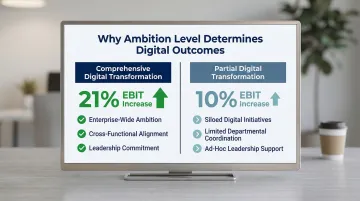
High ambition correlates directly with superior outcomes. Companies that comprehensively address digital transformation success factors report a 21% EBIT increase compared to only 10% for those that did not.
Rule 3: Place Big Bets on the Right Use Cases
Most organizations spread digital investment across too many initiatives at once — and wonder why none of them deliver. The discipline of Rule 3 is ruthless prioritization: concentrate effort on the opportunities that actually move the needle.
The concentration principle:
Focusing on two to three of the most valuable use cases delivers better outcomes than spreading resources thinly across many initiatives. Scarcity of focus is not a weakness—it is a strategic choice that enables critical mass and measurable impact.
How to identify the right bets:
Apply a dual lens when evaluating potential initiatives:
- Competitive uniqueness — What are we distinctively positioned to do that competitors cannot easily replicate?
- Value creation potential — What will move the needle most on revenue, margin, or customer loyalty?
John Deere exemplifies this focused approach. Rather than broadly digitizing, the company anchored use cases in specific jobs farmers optimize: planting seeds, adding nutrients, and minimizing chemicals. Integrating AI and computer-vision platforms into sprayers and combines, Deere's system recognizes individual plants — spraying herbicide on weeds and fertilizer on crops. On large US corn farms, this approach reduced herbicide costs by 80%.

Portfolio management approach:
Not every bet carries the same risk profile. Sequence initiatives to roll out short-term-impact use cases first, which builds organizational confidence and funds longer-term bets. This phased approach maintains momentum while managing risk.
The Common Failure Mode
Organizations that run 15 simultaneous digital initiatives without prioritization achieve none at critical mass. Research shows that only 48% of digital initiatives meet or exceed their business outcome targets.
Having actively engaged executive sponsors is the top driver of project success, yet fewer than two-thirds of projects actually have assigned executive sponsors. Fragmented initiatives lacking clear ownership face dramatically higher failure rates.
Rule 4: Build New Strategic Muscles
An ambitious digital strategy will inevitably expose capability gaps in digital talent, data literacy, agile ways of working, and organizational culture. Naming these gaps early is essential; ignoring them is the most common reason strategies stall in execution.
The talent strategy:
New digital skills—data science, AI engineering, UX design, cloud architecture—must be acquired, but existing talent must also be redirected toward the projects that matter most. Rather than building siloed digital teams within each business unit, consider shared resources that can be deployed flexibly across the enterprise. This keeps methodology consistent and prevents duplication of effort across business units.
The cultural dimension:
Building a "digital culture" means establishing:
- Flatter hierarchies with fewer approval layers between insight and action
- Cross-functional visibility so teams respond faster to market signals
- Psychological safety to experiment and learn from failure
- Continuous learning mindsets that embrace change
This cultural shift matters for talent attraction, particularly among younger workers who expect autonomy, purpose, and modern working methods. Without that shift, even a well-funded digital strategy will face a retention problem before it delivers results.
When to bring in external partners:
Not every organization can build these capabilities at the pace transformation demands. Partnering with a specialized firm lets you bridge the gap while developing internal capacity in parallel. Vorstel Technologies, for instance, works with global enterprises and startups across SAP implementations, AI/ML, cloud, and DevOps — and is structured to step in at any stage of a client's transformation journey, whether that's day one of planning or mid-way through a stalled rollout.
Rule 5: Manage Transformation Actively
Executing a digital strategy is not a set-and-forget activity. It requires a dedicated transformation management structure: a program office, clear ownership, and a cadence of progress reviews against defined milestones and KPIs.
The pace-setting challenge:
Traditional annual or quarterly planning cycles are obsolete in fast-moving digital environments. Only 18% of CIOs embrace dynamic, off-cycle reprioritization today, yet those who do are 24% more likely to be top performers. Leaders must continuously assess resource allocation and discontinue underperforming initiatives quickly, balancing top-down strategic alignment with bottom-up market intelligence.
The role of dedicated digital leadership:
The Chief Digital Officer (CDO) role has matured into a core strategic function. By 2020, over 20% of the world's 2,500 largest public companies had appointed a CDO, and that figure continues rising. To be effective, this role requires high-level authority: roughly 65% of CDOs report directly to the CEO, signaling a shift from IT-led projects to core business strategy.
The CDO — or equivalent transformation leader — is responsible for:
- Owning program momentum and keeping delivery on schedule
- Driving standardization across parallel initiatives
- Signaling when course corrections are needed before issues compound
- Keeping initiatives across teams on track through shared milestones
Combating transformation fatigue:
When employees resist change, it is rarely due to exhaustion alone. "Change fatigue is about a lack of perceived value, not stamina". Leaders must continuously demonstrate the ROI of digital initiatives through visible early wins alongside long-term transformation metrics. Each early win — a faster process, a measurable cost reduction, a resolved integration bottleneck — gives the broader organization a concrete reason to stay invested in the longer journey.
Applying All Five Rules — A Practical Roadmap
The five rules function as an interconnected system, not a checklist. Assessment (Rule 1) informs ambition (Rule 2), which shapes prioritization (Rule 3), which reveals capability gaps (Rule 4), which require active management (Rule 5). Skipping any rule weakens the others.

Where to Start
Organizations new to this framework should begin with a digital maturity assessment that benchmarks current capabilities against industry peers, sets a vision baseline, and identifies the two or three use cases most worth betting on.
Achieving high digital maturity is a proven driver of financial outperformance. Higher-maturity companies are about three times more likely than lower-maturity companies to report annual net revenue growth and net profit margins significantly above their industry average. Similarly, future-ready firms report estimated average revenue growth of 17.3 percentage points and a net margin of 14 percentage points above their industry average.
Established maturity frameworks include:
- BCG Digital Acceleration Index (DAI) — Benchmarks organizations across 41 dimensions of digital capability
- McKinsey Digital Quotient (DQ) — Evaluates 18 practices related to digital strategy, capabilities, and culture
- Deloitte Digital Maturity Model — Assesses organizations across multiple dimensions using seven digital pivots
Getting External Support
Most organizations hit execution gaps somewhere between ambition and delivery—whether that's selecting the right use cases, standing up new capabilities, or keeping momentum through disruption.
Vorstel Technologies works with global enterprises and startups at any stage of that journey. With 200+ SAP projects, 97% client satisfaction across multiple countries, and a zero-fee solution evaluation offer, their team is built to move quickly from strategy into delivery—across AI, SAP, cloud, and DevOps.
Frequently Asked Questions
What is a digital strategy?
A digital strategy is a structured plan for using digital technologies, data, and capabilities to achieve specific business objectives. It differs from digital transformation, which is the broader organizational outcome that a well-executed digital strategy enables.
What are the core components of a digital strategy?
The core components include a clear digital vision tied to business goals, assessment of the competitive and digital landscape, prioritized use cases based on value potential, identified capability requirements (talent, technology, culture), and measurable KPIs to track progress against defined outcomes.
How do you create a digital strategy?
Assess your industry's digital landscape, then set a measurable target tied to enterprise financial metrics. Prioritize two to three high-value use cases, close capability gaps in talent and technology, and establish clear ownership with regular progress reviews.
What is an example of a digital strategy?
Renault set a goal of achieving a 25% EBIT improvement through 15 cross-functional digital initiatives, targeting €1 billion in value by 2020. Starbucks is another example, using mobile ordering and loyalty data to drive repeat purchases and improve customer experience.
What are the four pillars of digital transformation?
The commonly referenced pillars are technology (infrastructure and tools), processes (workflows and operations), people and culture (skills, mindsets, and ways of working), and data and insights (analytics and decision-making capabilities). The five-rule framework covered in this guide addresses all four pillars in sequence.
What does a digital strategist do?
A digital strategist identifies where digital creates competitive value, sets measurable targets, and prioritizes high-value initiatives. They also close capability gaps in talent and technology, then keep transformation programs on track through active oversight and course correction.