Introduction
A frustrated customer abandons their shopping cart at checkout because the payment page takes too long to load. Another switches to a competitor after their mobile app freezes during login for the third time. These scenarios aren't hypothetical—they're happening thousands of times daily across every industry.
Digital interactions now shape brand perception before any human relationship is formed. For businesses across manufacturing, retail, e-commerce, and enterprise sectors, getting digital customer experience (DCX) right is no longer optional—it's a core business driver.
According to PwC research, 73% of customers cite experience as an important factor in their purchasing decisions. More critically, 74% of shoppers will abandon a brand after just three or fewer bad experiences.
Here's what DCX actually means—and how to build a strategy that makes every digital touchpoint work harder for your business.
Key Takeaways
- Digital Customer Experience (DCX) is how customers perceive your brand across all digital touchpoints—website, app, chatbot, email, and social media
- DCX is a subset of CX but distinct from UX, DX, and CRM—each serves different purposes in the experience ecosystem
- Bad DCX costs revenue directly; strong DCX builds loyalty, cuts churn, and drives brand advocacy
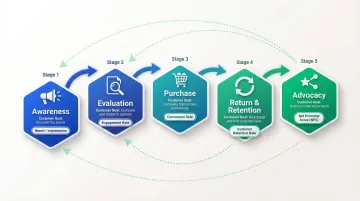
- The DCX journey spans five stages: Awareness, Evaluation, Purchase, Return, and Advocacy
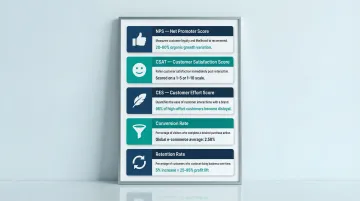
- Measure DCX using NPS, CSAT, CES, conversion rate, and customer retention rate
What is Digital Customer Experience?
Digital Customer Experience (DCX) is the cumulative perception a customer forms of your brand through every interaction across digital channels—websites, mobile apps, email, social media, live chat, chatbots, push notifications, and self-service portals.
DCX goes beyond technology and UI design. What ultimately matters is how consistent, effortless, and meaningful those interactions feel across every stage of the customer journey.
Primary Digital Touchpoints
Customers don't evaluate each touchpoint in isolation—they judge the sum total. Key touchpoints include:
- Brand website and product pages
- Mobile applications
- Email campaigns and transactional messages
- Social media interactions and community engagement
- Live chat and AI-powered chatbots
- Online reviews and ratings platforms
- Push notifications and SMS alerts
- Personalized customer accounts and dashboards
- eLearning portals and knowledge bases
The Always-On Nature of DCX
Unlike traditional CX controlled through in-store staff or scheduled calls, DCX operates 24/7 across devices and time zones. A customer in Singapore can interact with your brand at 2 AM while another in Germany browses during lunch. This always-on reality makes consistency and automation non-negotiable. No team can manually manage every interaction at that scale.
What Modern Customers Expect
Customer expectations for digital interactions are set by companies like Amazon and Netflix, where speed and personalization are the baseline, not the exception. According to Salesforce research, 83% of customers expect to interact with someone immediately when they contact a company, while 73% feel brands now treat them as unique individuals.
Four non-negotiable expectations:
- Instant responses, not "we'll get back to you in 24 hours"
- Continuity across devices and sessions so customers never repeat themselves
- Personalization that feels genuinely helpful rather than intrusive
- Self-service options that actually resolve issues without forcing escalation
DCX vs. CX, UX, and DX: Understanding the Key Distinctions
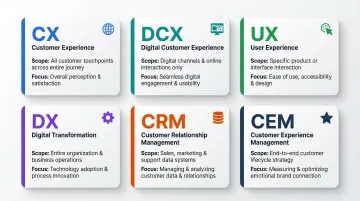
These four acronyms often get used interchangeably — but they describe fundamentally different things. Getting the distinctions right matters because misaligning them leads to investment decisions that improve internal systems without actually improving customer experience.
| Term | Scope | Focus |
|---|---|---|
| CX | All touchpoints (digital + physical) | Full customer journey |
| DCX | Digital touchpoints only | Online interactions & channels |
| UX | Single product or interface | Usability & design |
| DX | Internal organizational change | Technology adoption & operations |
| CRM | Data system/tool | Customer data & pipelines |
| CEM | Experience strategy | Designing & improving touchpoints |
DCX vs. CX (Customer Experience)
CX is the broader umbrella covering every touchpoint—offline and online. DCX is a critical subset focused exclusively on digital interactions. Customers don't consciously separate the two, which means any inconsistency between digital and physical experiences creates friction.
If your in-store staff are friendly but your website checkout is confusing, customers perceive the brand as inconsistent.
DCX vs. UX (User Experience)
UX concerns the usability and design of a specific product or interface—how intuitive your app's navigation is, for example. DCX encompasses the entire digital relationship across multiple products, channels, and moments in time.
UX is one input into DCX, not the whole picture. You can have excellent UX on your mobile app but still deliver poor DCX if your email communications are generic or your chatbot can't answer basic questions.
DX vs. CX (Digital Transformation vs. Customer Experience)
DX refers to the internal organizational process of adopting digital technologies to modernize operations and business models. CX is the outward-facing result of those efforts as experienced by customers. According to McKinsey, DX is "the fundamental rewiring of how an organization operates."
DX enables great CX—but deploying new technology doesn't automatically improve customer experience. Despite global IT spending reaching $5.06 trillion in 2024, only 14% of customer service issues are fully resolved in self-service.
CEM vs. CRM (Customer Experience Management vs. Customer Relationship Management)
The core distinction: CRM is a tool; CEM is a strategy. CRM stores and manages customer data and sales pipelines. CEM uses that data to actively design and improve every customer touchpoint. One is infrastructure — the other is intent.
You can have a sophisticated CRM full of customer data but still deliver terrible experiences if you don't use that data strategically to improve interactions.
Why Digital Customer Experience Matters for Your Business
Experience Influences Purchasing Decisions
Customers today evaluate brands not just by product quality or price, but by the quality of their digital interactions. PwC research shows that 73% of customers cite experience as a key purchasing factor—ranking behind only price and product quality.
When organisations deliver superior experiences, they unlock tangible financial benefits, including up to a 16% price premium on products and services.
Revenue Impact
Strong DCX shortens the path to purchase, reduces cart abandonment, and increases average order value. Customers who encounter frictionless digital journeys convert faster and spend more.
Research from McKinsey shows that personalisation—a core component of DCX—most often drives a 10% to 15% revenue lift. Companies that excel at personalisation generate 40% more revenue from those activities than average players.
Customer Retention and Loyalty
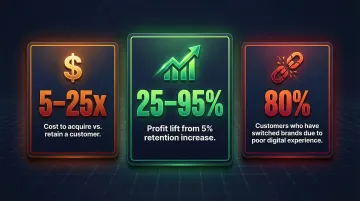
Poor DCX causes silent attrition—users stop returning without voicing complaints. The numbers make the cost of this inaction hard to ignore:
- Acquiring a new customer costs 5 to 25 times more than retaining an existing one
- A 5% increase in retention rates lifts profits by 25% to 95%
- 80% of customers have switched brands entirely due to poor digital experience
Brand Differentiation in Competitive Markets
In sectors like e-commerce, retail, and financial services, products are often commoditised—DCX becomes the primary differentiator. Amazon and Netflix have set benchmark expectations that customers now apply to all digital brands. If your checkout takes four clicks while a competitor's takes two, customers notice.
Digital-First Customer Insights
DCX generates rich behavioural data that physical interactions cannot: traffic patterns, click behaviour, session duration, conversion funnels, feature usage, and drop-off points. Organisations that analyse this data systematically can identify exactly where customers disengage—and fix it before it costs revenue.
The 5 Stages of the Digital Customer Experience Journey
The DCX journey spans five distinct stages, each presenting unique opportunities and risks.
1. Awareness
Customer goal: Discover solutions to a problem or need
Active touchpoints: Content marketing, paid ads, search results, social media
Key metric: Click-through rate (CTR) and website traffic
At this stage, customers are researching options. Your digital presence must be discoverable and compelling enough to earn attention in a crowded marketplace.
2. Evaluation
Customer goal: Compare options and validate the best choice
Active touchpoints: Product demos, customer reviews, comparison pages, case studies
Key metric: Time on site, lead conversion rate
Customers are actively comparing your offering against competitors. Transparent information, social proof, and easy access to detailed specifications reduce friction.
3. Purchase
Customer goal: Complete the transaction quickly and securely
Active touchpoints: Checkout process, payment security, order confirmation
Key metric: Cart abandonment rate, conversion rate
This is where friction costs real money. The average cart abandonment rate is 70.22%, representing over $260 billion in recoverable revenue through better checkout design alone.
4. Return (Retention)
Customer goal: Get value from the purchase and resolve any issues
Active touchpoints: Loyalty programmes, support channels, personalised email, product usage tracking
Key metric: Repeat purchase rate, Customer Satisfaction Score (CSAT)
This stage determines whether a one-time buyer becomes a loyal customer. Proactive support, personalised recommendations, and frictionless issue resolution build long-term relationships.
5. Advocacy
Customer goal: Share positive experiences and recommend the brand
Active touchpoints: Referral programmes, user-generated content, social sharing, reviews
Key metric: Net Promoter Score (NPS), referral rate
Delighted customers become brand advocates. Make it easy for them to share experiences through referral incentives, social proof campaigns, and community engagement.
Non-Linear Journeys
The journey isn't always linear. Customers may enter at any stage, skip stages, or revisit earlier ones across different devices. A customer might discover your brand on mobile during a commute, evaluate options on desktop at work, and complete purchase on a tablet at home. Maintaining context across every device and channel — so the experience picks up where it left off — is what separates forgettable DCX from truly cohesive ones.
How to Build and Optimise Your Digital CX Strategy
Start with Customer Understanding
Before deploying technology, map your target audience's digital behaviours, preferences, and pain points. Segment by customer type—enterprise buyer versus end consumer, mobile-first versus desktop-heavy—and identify which digital touchpoints create the most friction.
Combine qualitative research (customer interviews, support ticket analysis) with quantitative data (heatmaps, session recordings, funnel analytics).
Build a Connected Experience Architecture
Siloed tools produce fragmented experiences. Ensure your website, CRM, marketing automation, support platform, and analytics systems share data in real time—so customers never repeat themselves and your team always has context.
Currently, 54% of customers say it feels like sales, service, and marketing don't share information. This fragmentation worsens with AI adoption; 50% of AI agents currently operate in isolated silos, resulting in disconnected workflows.
API-first integrations and a centralised Customer Data Platform (CDP) are foundational to unified experiences. 67% of marketers have adopted a CDP, though they estimate using only 47% of available capabilities—meaning most organisations have significant headroom to improve.
Personalise at Scale
Customers expect tailored experiences: recommendations based on past behaviour, communications that reflect their journey stage, and interfaces that adapt to their needs. AI and behavioural data make this level of personalisation achievable at scale—and customers increasingly expect it as a baseline.
Getting it wrong causes real damage. Misidentified interests or irrelevant messaging erodes trust faster than no personalisation at all. Keep the focus on:
- Accuracy: Match recommendations to verified behaviour, not assumptions
- Relevance: Align messaging to the customer's current journey stage
- Timing: Deliver the right message when it's actually useful, not just when it's convenient
Continuously Collect Feedback and Optimise
Implement structured feedback loops:
- Post-interaction surveys
- NPS campaigns
- CSAT scoring after support interactions
Pair these with passive data monitoring: web analytics, heatmaps, funnel drop-off points. Treat optimisation as an ongoing cycle rather than a one-time project.
Technology Foundation Matters
Implementing a connected DCX strategy requires the right technology foundation. Platforms like Salesforce CRM unify customer data, while Microsoft and SAP solutions enable enterprise-wide process integration.
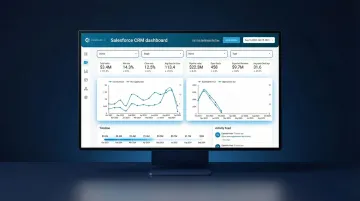
Consulting partners like Vorstel Technologies help organisations evaluate, implement, and integrate these platforms—joining the process at any stage to build a DCX-ready tech stack without disrupting existing operations.
How to Measure Digital Customer Experience
Measuring DCX requires combining relationship metrics (how customers feel about the brand overall) with transactional metrics (how well individual touchpoints perform). No single metric captures the full picture.
Five Key DCX Metrics
1. Net Promoter Score (NPS)
Tracks loyalty by subtracting the percentage of Detractors (score 0–6) from Promoters (score 9–10). In most industries, NPS explains 20%–60% of organic growth rate variation among competitors — making it one of the stronger predictors of long-term business health.
2. Customer Satisfaction Score (CSAT)
Captures how customers feel immediately after a specific interaction — typically via a single question ("How satisfied were you with this experience?") rated on a 1–5 or 1–10 scale. CSAT is best used at defined touchpoints rather than across the full journey.
3. Customer Effort Score (CES)
Focuses on friction. Research shows that 96% of customers with high-effort service interactions become disloyal — compared to just 9% with low-effort experiences. Reducing effort often matters more than delighting customers.
4. Conversion Rate
Shows how effectively digital channels turn visitors into customers. Global e-commerce averages 2.58%, with desktop at 3.5–4.0% and mobile at 1.8–2.5%. A persistent gap between those figures often points to UX or performance issues on mobile.
5. Customer Retention Rate
Tracks how many customers return over a set period. A 5% increase in retention can lift profits by 25%–95% — which is why retention often delivers better ROI than acquisition-focused campaigns.
Beyond Survey Metrics
Behavioural analytics often reveal problems that surveys miss:
- Page views and session duration
- Funnel drop-off points
- Mobile versus desktop behaviour
- Feature usage patterns
Operational data also matters:
- First-contact resolution rate
- Average handle time
- Support ticket volume trends
Used together, these signals move DCX from a feeling into a diagnosis — pinpointing exactly where the experience breaks down and which fixes will have the most impact.
Frequently Asked Questions
What is digital customer service?
Digital customer service is support delivered through digital channels like live chat, email, social media, and chatbots. It's one component of digital customer experience (DCX), which encompasses the broader perception formed across all digital interactions, not just support.
How does CX differ from UX?
CX (Customer Experience) spans the entire relationship between a brand and customer across all touchpoints—online and offline. UX (User Experience) focuses specifically on the usability and design of a single product or interface.
How does DX differ from CX?
DX (Digital Transformation) is an internal organisational process of adopting digital technologies to modernise operations. CX (Customer Experience) is the external, customer-facing outcome. DX enables better CX, but they're not the same. Technology deployment alone doesn't automatically improve customer experience.
How is CEM different from CRM?
CRM (Customer Relationship Management) is a tool for managing customer data, interactions, and sales pipelines. CEM (Customer Experience Management) is a strategic discipline focused on designing and improving every customer touchpoint. CRM is an input to CEM, not a replacement.
What are the 5 key CX metrics?
The five most widely used CX metrics are NPS (loyalty), CSAT (satisfaction), CES (effort), Conversion Rate (digital effectiveness), and Customer Retention Rate. Each captures a different dimension of experience, so they work best when used together.
What are digital experience solutions?
Digital experience solutions are platforms and technologies—CRM systems, CMS platforms, analytics tools, AI chatbots, marketing automation—that help organisations design, deliver, and optimise digital interactions across the customer journey.