Introduction
Poor data quality is not just an IT inconvenience—it's a measurable financial drain. Gartner reports that poor data quality costs organizations at least $12.9 million a year on average, while Forrester found that over 25% of data and analytics employees estimate their organizations lose more than $5 million annually due to poor data quality.
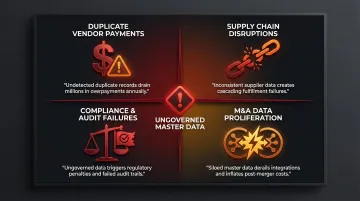
As enterprises scale and adopt ERP systems like SAP S/4HANA, ungoverned master data creates compounding operational failures. Duplicate vendor records bypass payment controls, inconsistent product data causes supply chain delays, and incorrect customer information leads to failed deliveries and billing errors.
The compliance exposure is equally serious. Without traceable change histories, organizations cannot demonstrate regulatory compliance under GDPR, SOX, and industry standards — leaving them vulnerable to audit failures and penalties.
This guide covers the complete Master Data Governance framework: what it is, why it's essential, the four pillars that make it work, how SAP MDG operates within S/4HANA and BTP environments, key governance roles, and implementation best practices.
Key Takeaways
- Master Data Governance (MDG) is a structured framework for controlling the creation, maintenance, and quality of critical business data
- It covers key domains: customer, vendor, product, finance, and assets
- SAP MDG is embedded in S/4HANA and available on BTP for cloud-based governance
- Ungoverned master data drives duplicate records, compliance failures, and costly operational errors
- Effective MDG depends on clear ownership, rule-based workflows, and phased rollout
What is Master Data Governance?
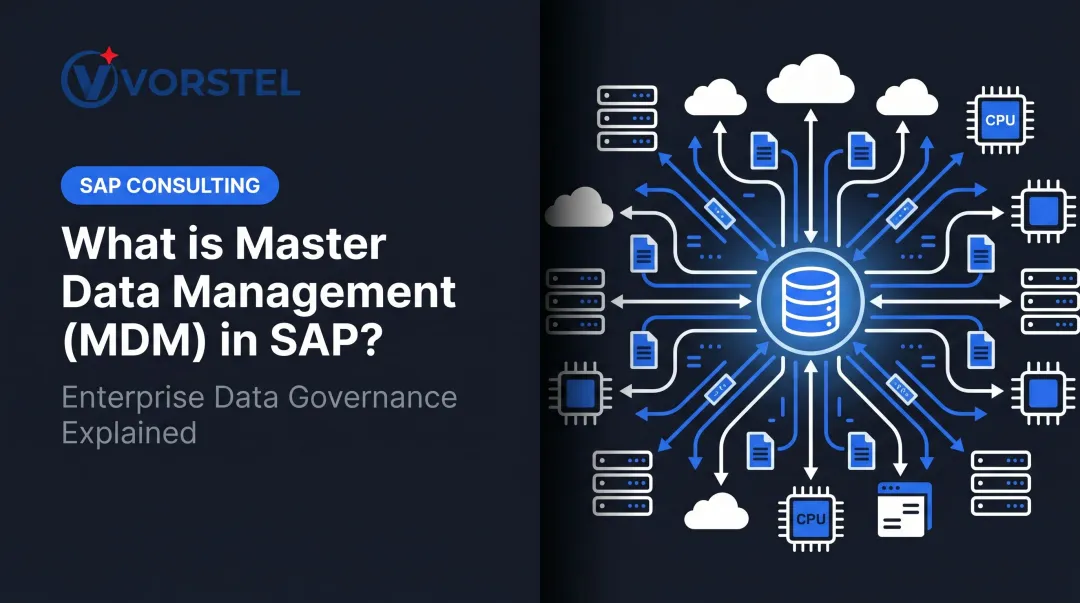
Master Data Governance (MDG) is a structured control layer that enforces policies, workflows, and standards over how master data is created, updated, and retired across enterprise systems. It focuses specifically on data integrity, standardization, and auditability, ensuring that only validated, approved data enters production systems.
Master data refers to the foundational, relatively stable data that describes key business entities: customers, vendors, products, employees, and financial objects. This data is shared and reused across multiple systems like ERP, CRM, and SCM. Unlike transactional data (which captures events like orders or invoices), master data defines who you do business with, what you sell, and where operations occur.
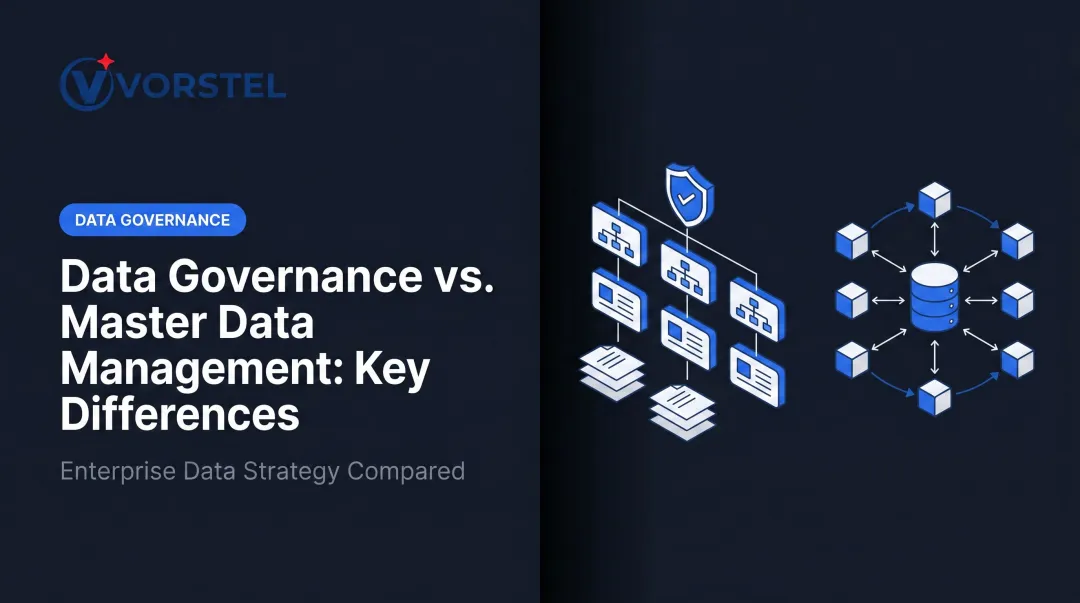
MDG differs from general data governance in its specificity. General data governance covers all data assets across the enterprise—policies, security, compliance frameworks. MDG, by contrast, targets master data domains exclusively and enforces field-level validation, duplicate prevention, and approval workflows before data enters live systems.
MDG vs. MDM: What's the Difference?
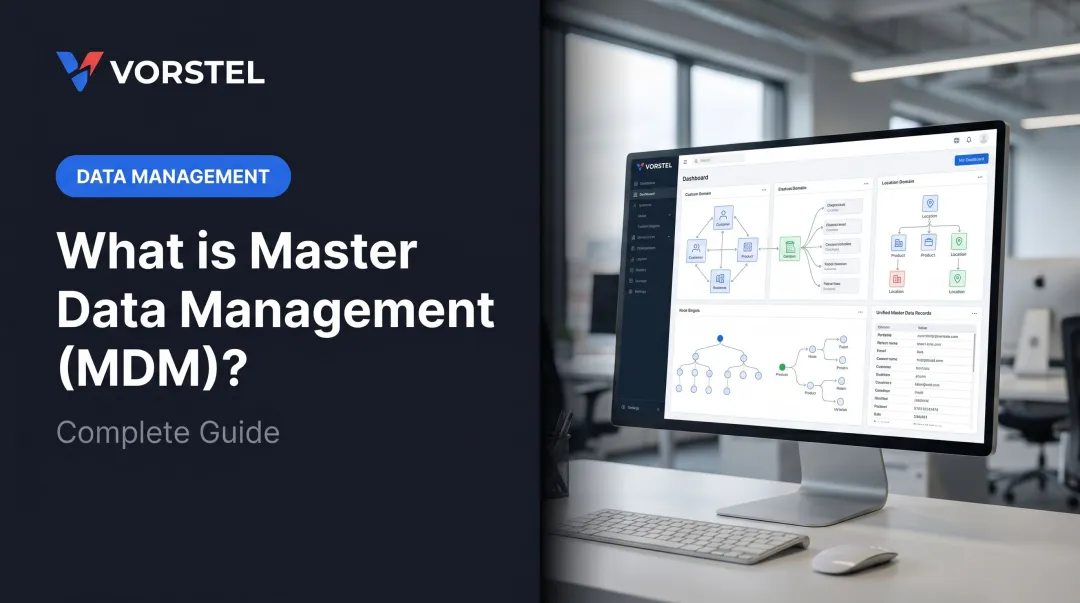
Master Data Management (MDM) is the broader discipline of managing master data—covering integration, storage, deduplication, and distribution across systems. MDG is the governance component within MDM, focused specifically on controlling who can create or change master data, under what rules, and with what approvals.
Key distinction:
- MDM answers: "How do we manage our data?" (the technical execution)
- MDG answers: "How do we control and ensure the quality of that data?" (the policy and process layer)
In practice, MDG is what gives MDM its teeth — without governance controls, even the best data management infrastructure will drift toward inconsistency.
Why MDG Is Essential in ERP Environments
ERP systems like SAP S/4HANA coordinate procurement, finance, logistics, and supply chain operations across the enterprise. Any corrupt or incomplete data entered into an ERP propagates across all of these functions, amplifying errors at scale. A single incorrect vendor record can trigger duplicate payments; a misconfigured material master can halt production lines.
Because ERP systems are tightly integrated, ungoverned data entry creates compounding problems. MDG provides a governed entry process that validates data before it reaches the ERP core — stopping errors at the source rather than chasing them downstream.
Why Enterprises Can't Afford Ungoverned Master Data
Ungoverned master data quietly erodes operations, compliance, and financial performance — often before anyone notices the source.
Duplicate Vendor Payments and Financial Leakage
The Washington State Auditor explicitly warns that duplicate vendor records increase the risk of duplicate payments, because most software controls only detect duplicate invoice numbers within the same vendor number. If two vendor records exist for the same supplier, the system cannot prevent duplicate payments.
Supply Chain and Billing Disruptions
Inaccurate master data directly disrupts fulfillment and revenue. A 2024 study published in MDPI traced a chain of failures — orders shipped to wrong customers, pricing discrepancies, and stalled consignment processes — to poor customer master data quality.
Compliance and Audit Risk
Regulatory exposure is, at its core, a data-trail problem. GDPR Article 30 requires organizations to maintain records of processing activities. The PCAOB's AS 2201 standard for Internal Control Over Financial Reporting (ICFR) requires policies that maintain records accurately reflecting transactions. Ungoverned master data lacks the auditability required to prove who changed a critical data element, when, and why—putting organizations at risk during audits.
The Scale Problem: M&A and Geographic Expansion
Informal data management becomes unsustainable during mergers and acquisitions. As systems collide, record proliferation accelerates. During a series of acquisitions, Raiffeisenbank had to consolidate portfolios across multiple banks, ultimately managing 5.7 million consolidated customer records sourced from 20 different systems. Without a centralized governance hub to match, merge, and deduplicate records, M&A synergies are held back by incompatible data formats across systems.
The 4 Pillars of Master Data Governance
A robust MDG framework rests on four interconnected pillars — and each one depends on the others to function. Strong technology without clear ownership breaks down. Clear policies without quality standards produce inconsistent results.
Pillar 1: Data Quality Standards
MDG enforces key dimensions of data quality:
- Completeness — all mandatory fields must be populated before a record reaches approval
- Accuracy — values are verified against trusted sources (such as validated addresses)
- Consistency — data stays uniform across every connected system
- Validity — values must match approved lists and defined business rules
Example: A Material Type field must match an approved classification list before a material record is approved. If a user enters an invalid type, the system rejects the request before it reaches production.
Pillar 2: Data Stewardship and Accountability
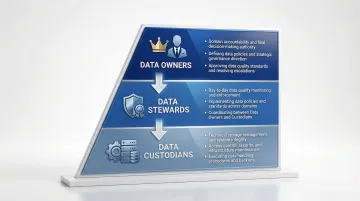
MDG assigns clear ownership over data domains:
- Data Owners — senior leaders who hold domain accountability and final decision authority
- Data Stewards — day-to-day custodians who monitor quality, resolve issues, and enforce policies
- Data Custodians — technical teams managing storage, access control, and system-level integrity
This three-tier structure means every master data record has a named owner — removing the ambiguity that allows quality issues to go unresolved.
Pillar 3: Governance Policies, Workflows, and Approvals
MDG enforces rule-based workflows that route every data creation or change request through a defined approval chain. In SAP environments, the Business Rule Framework (BRF+) configures these workflows — so no master data enters production without validation and authorization.
Example workflow:
- User submits a new vendor record
- System validates data against mandatory field rules
- Request routes to Procurement Manager for approval
- Upon approval, the system activates and replicates vendor data across ERP modules
Pillar 4: Technology and Tooling
The technology layer automates enforcement so governance holds up at volume:
- Duplicate detection: Fuzzy matching and key-field comparisons to prevent duplicate records
- Automated error correction: Pre-configured rules to standardize data formats
- System integration: APIs and IDocs to replicate master data across SAP and non-SAP systems
- Audit trails: Complete change history for compliance and troubleshooting
SAP Master Data Governance: Features, Domains, and Integration
SAP Master Data Governance (MDG) is SAP's enterprise solution for centralizing master data governance. It provides a single source of truth for master data that is validated, approved, and then replicated to consuming systems (SAP and non-SAP) across the organization.
Key Domains Supported by SAP MDG
SAP MDG supports major master data domains:
- Material Master (MDG-M): Product and inventory data
- Business Partner (MDG-BP): Customers and vendors
- Finance (MDG-F): Cost centers, profit centers, GL accounts
- Enterprise Assets (MDG-EAM): Equipment, functional locations, MRO BOMs
- Retail Articles/SKUs (MDG-RFM): Industry-specific retail data
Custom-defined master data objects can also be governed via the SAP MDG Application Foundation.
The SAP MDG Process
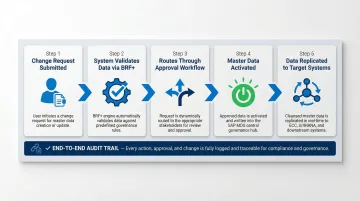
The SAP MDG process enforces governance at every step:
- User submits a change request (create or modify master data)
- System validates data against predefined business rules (BRF+)
- Request routes through approval workflow (assigned approvers based on domain and data type)
- Upon approval, master data is activated (moved from staging to active tables)
- Data is replicated to target systems (ERP modules, analytics, downstream applications)
Every step is auditable, creating a complete change history for compliance.
SAP MDG and S/4HANA: Embedded Integration
SAP MDG is natively embedded within SAP S/4HANA — no separate standalone system required. This means governance is enforced at the point of data entry, before anything reaches production. Organizations get a tighter control loop with less architectural overhead.
Two deployment approaches are available depending on your landscape:
- Embedded (S/4HANA): MDG runs as a core component within the ERP itself
- Cloud (BTP): Governance and validation managed via SAP Business Technology Platform
- Hybrid: On-premise processes paired with cloud-managed governance rules
SAP MDG on BTP: Cloud and Hybrid Options
The BTP deployment suits organizations running hybrid or non-SAP-heavy environments. Governance policies are managed in the cloud while on-premise processes continue unchanged. Non-SAP systems connect via APIs and middleware, enabling consistent governance across mixed SAP and non-SAP environments.
How to Implement SAP MDG Successfully
Steps for a Phased SAP MDG Implementation
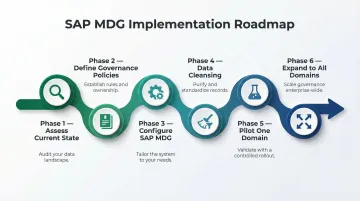
A phased approach reduces risk and ensures business readiness:
- Assess current master data state - Audit existing data quality, identify priority domains, and quantify data quality debt
- Define governance policies - Establish validation rules, approval hierarchies, and data ownership
- Configure SAP MDG - Set up domains, workflows, BRF+ rules, and role assignments
- Conduct data cleansing - Remediate duplicate records and incomplete data before migration
- Pilot with one domain - Test with a single domain (e.g., vendor master), train end users, and refine workflows
- Expand to additional domains - Roll out governance to remaining domains incrementally
Common Pitfalls and How to Avoid Them
Underestimating data quality debt — Legacy systems often contain 20–30% inaccurate or duplicate records. Invest in data cleansing tools and run a baseline assessment before implementation begins.
Lack of executive sponsorship — Without top-down backing, governance policies get ignored at the team level. Establish a cross-functional Data Governance Council with named executive ownership early.
Insufficient end-user training — Users tend to bypass workflows or submit incomplete requests when they don't understand the process. Deliver role-based training and clear documentation before go-live.
Integration complexity with legacy or non-SAP systems — Master data can fail to replicate correctly across mixed landscapes, triggering downstream errors. Use SAP Integration Suite for hybrid environments and involve experienced SAP consultants from the design phase.
Partnering with the Right SAP Consulting Expertise
Each of the pitfalls above becomes significantly harder to navigate without a partner who understands both the technical configuration and the business process side of MDG. Vorstel Technologies brings 200+ SAP project engagements and deep hands-on experience with SAP S/4HANA implementations. The team can step in at any stage of an MDG rollout — from initial scoping through go-live — and has delivered governance outcomes for global enterprises across manufacturing, retail, and beyond.
Key Roles in a Master Data Governance Framework
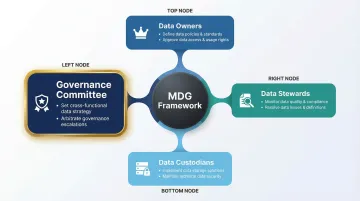
Effective MDG requires clearly defined accountability. Without it, data quality issues go unresolved, policy decisions stall, and no one owns the outcome. Four operational roles form the backbone of any working governance framework.
Data Owners
Data Owners are senior leaders who hold domain accountability and final decision authority over their data assets. Their responsibilities include:
- Define business term definitions, data quality rules, and retention requirements
- Approve or reject escalated data disputes that stewards cannot resolve independently
- Set the standard for what "correct" data looks like within their domain
Data Stewards
Data Stewards handle day-to-day governance operations. They act as the practical link between policy and execution:
- Monitor data quality, review change requests, and enforce governance policies
- Resolve data issues at the operational level before escalation is needed
- Own data content, context, and the business rules that govern it
Data Custodians
Data Custodians are the technical teams responsible for keeping data secure, accessible, and structurally sound:
- Manage data storage, access controls, and system-level integrity
- Handle MDG system configuration and Data Replication Framework (DRF) setup
- Maintain database structures, data models, and the broader technical environment
Data Governance Committee or Council
The Governance Committee is a cross-functional body — typically drawing from IT, finance, procurement, operations, and compliance — that operates at the strategic level. It differs from the three roles above in scope and authority:
- Sets governance policy and resolves disputes that operational teams cannot handle
- Aligns MDG practices with broader business objectives
- Requires executive sponsorship with binding decision-making authority to be effective
Frequently Asked Questions
What is Master Data Governance?
Master Data Governance is a framework of policies, processes, workflows, and technology that governs the creation, quality, and maintenance of critical business data—such as customers, vendors, products, and financial records—ensuring accuracy and consistency across all enterprise systems.
What is the difference between SAP MDG and MDM?
SAP MDM handles the broader management, consolidation, and distribution of master data across systems. SAP MDG sits on top as the governance layer, controlling who can create or change data, under what rules, and through what approval workflows before changes reach production.
What is the MDG process in SAP?
The SAP MDG process works as follows: a user or system submits a change request, the system validates the data against predefined business rules, the request is routed through an approval workflow, and upon approval, the governed master data is replicated to consuming SAP and non-SAP systems.
Is SAP MDG part of S/4HANA?
Yes, SAP MDG is natively embedded in SAP S/4HANA as a standard component. Organizations can govern master data directly within their ERP environment, with no separate standalone system required — a key advantage for companies on or migrating to S/4HANA.
Is SAP MDG part of BTP?
SAP MDG can be deployed on SAP Business Technology Platform (BTP) for cloud-based or hybrid governance scenarios. This supports scalable data governance with integration to both SAP and non-SAP systems via standard APIs.
What are the 4 pillars of data governance?
The four pillars are:
- Data Quality Standards
- Data Stewardship and Accountability
- Governance Policies and Workflows
- Technology and Tooling
All four must work together for a governance program to be effective and sustainable.