Introduction
Most ERP projects don't fail because of bad software — they fail because organizations attempt them without the right expertise. Costly delays, misaligned configurations, and abandoned rollouts are the predictable result.
Gartner predicts that by 2027, more than 70% of recently implemented ERP initiatives will fail to fully meet their original business case goals, with as many as 25% failing catastrophically.
This article breaks down what an ERP consultant actually does — and helps you decide whether bringing one in makes sense for your organization.
Key Takeaways
- ERP consultants guide businesses through selecting, implementing, customising, and optimising ERP systems
- Core responsibilities cover needs assessment, project management, data migration, and change management
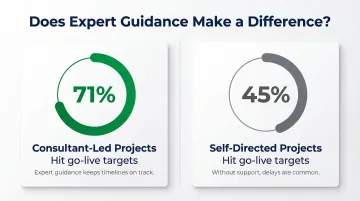
- Consultant-led ERP projects hit go-live targets 71% of the time, compared to just 45% for self-directed projects
- Hiring a consultant costs far less than recovering from a failed or delayed implementation
- Consultants add value at any stage, whether you're pre-selecting a system or stabilising one that's already gone live
What Is an ERP Consultant?
An ERP consultant is a professional (or firm) who guides organizations through every phase of the ERP lifecycle — from selecting the right system to ensuring it delivers measurable value after go-live.
Unlike an ERP vendor, a consultant provides vendor-neutral guidance focused on your business needs, not on selling a specific product.
Two Types of ERP Consultants
Your choice of consultant type depends on project scope and complexity:
- Independent consultants — Platform-specific specialists suited to smaller projects or organizations with a clearly defined system in mind
- Consulting firms — Multi-disciplinary teams covering technical implementation, change management, and post-go-live support; better suited to large or complex rollouts with dedicated project managers, functional consultants, and technical developers
Platform Specialization Matters
ERP consultants typically specialize in specific platforms such as:
- SAP (S/4HANA Cloud, ECC)
- Microsoft Dynamics 365 (Finance, Supply Chain)
- Oracle NetSuite
- Salesforce (CRM/ERP hybrid)
Platform-specific expertise matters because each system has unique configuration requirements, integration capabilities, and best practices. A consultant who has implemented SAP S/4HANA 50 times will navigate its complexities far faster than a generalist on their first deployment.
What Does an ERP Consultant Actually Do?
Needs Assessment and Business Process Mapping
Before any system is selected, consultants conduct thorough needs assessments—meeting with stakeholders across finance, operations, HR, and supply chain to map current workflows. This process typically uncovers:
- Redundant processes consuming unnecessary time
- Integration gaps between disconnected systems
- Data silos preventing real-time visibility
- Compliance risks from manual workarounds
The consultant documents these findings in a requirements specification that becomes the foundation for system selection and configuration.
ERP System Selection
Consultants evaluate and recommend ERP platforms based on your organization's size, industry, budget, integration requirements, and scalability needs. Most internal teams have deep knowledge of one system; consultants bring cross-platform perspective that's hard to build in-house.
They compare solutions across dimensions like:
- Functionality fit for your industry
- Total cost of ownership (licensing, implementation, ongoing maintenance)
- Integration capabilities with existing systems
- Scalability to support growth
- Vendor stability and support quality
Implementation Planning and Project Management
Consultants build detailed implementation roadmaps defining timelines, resource allocation, milestone tracking, and data migration planning. They manage coordination between internal teams and the ERP vendor throughout the project.
According to an ERP Research cost breakdown, ERP projects typically range from 3 months for small, out-of-the-box implementations to 24+ months for large enterprise rollouts with heavy customization and multi-site deployments.
Customization, Integration, and Data Migration
Consultants configure the ERP to match specific business processes, integrate it with third-party tools (CRM, SCM, e-commerce platforms, tax engines), and oversee data migration from legacy systems. This phase requires:
- Configuration of modules to support unique workflows
- Custom development for capabilities not available out-of-the-box
- Integration architecture connecting the ERP to existing systems
- Data cleansing and migration ensuring accuracy and completeness
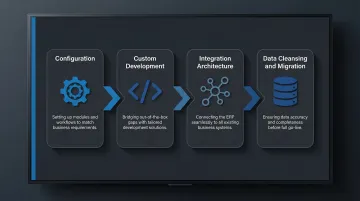
Poor data migration is a leading cause of ERP failure. Skipping or rushing this step is one of the fastest ways to derail an otherwise well-planned rollout.
Change Management and User Training
ERP rollouts are as much an organizational challenge as a technical one. Consultants develop communication plans, manage employee resistance, align department heads, and design training programs to drive adoption.
Industry research consistently shows that organizational resistance and weak change management are among the top drivers of ERP timeline overruns — yet fewer than half of organizations give OCM the attention it requires.
Post-Go-Live Support and Optimization
The consultant's role doesn't end at launch. They stress-test the system, resolve early issues, and continue to optimize the ERP as the business evolves, adjusting configurations, adding modules, or addressing compliance changes as they arise.
This "hyper-care" period typically lasts 3–6 months post-go-live, ensuring the system stabilizes and users become proficient.
Do You Really Need an ERP Consultant?
Small vs. Large Projects
Not every ERP project requires external consulting. Small businesses implementing lightweight solutions with minimal customization may manage without one. However, once a project involves multiple departments, complex integrations, data migration from legacy systems, or customization requirements, the risk profile shifts — and outside expertise moves from optional to worthwhile.
The Internal Expertise Gap
Most IT teams have generalist knowledge but lack deep ERP platform expertise. While 50% to 75% of ERP projects exceed their original budgets, the primary drivers are the unexpected need for additional technology (37.5%) and underestimated internal staffing (37.5%)—both gaps that experienced consultants prevent.
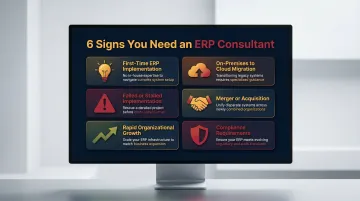
Signs You Need an ERP Consultant Now
Bring in outside expertise when you're facing:
- First-time ERP implementation with no internal experience
- **Migration from on-premises to cloud ERP** requiring re-architecture
- Previous failed or stalled implementation needing rescue
- Merger or acquisition requiring system consolidation
- Rapid organizational growth outpacing current systems
- Compliance requirements demanding specific configurations
The Cost Argument—Investment vs. Risk
If any of those scenarios sound familiar, the case for a consultant isn't just about expertise — it's about protecting the investment already being made. ERP failures involving scope creep, data corruption, missed timelines, and operational downtime routinely cost far more than consulting fees ever would.
High-profile disasters illustrate the stakes: Lidl wrote off €500 million after a failed SAP implementation, while Revlon lost $64 million in sales due to manufacturing disruptions from a poorly executed rollout.
Engaging at Any Stage
Those disasters share a common thread: problems that compounded because no one intervened early enough. The good news is that a consultant doesn't have to be present from day one. Organizations can engage at any point — during selection, mid-implementation if a project is struggling, or post-go-live for optimization.
Vorstel Technologies takes on engagements at any stage of the transformation journey — including projects already underway — and focuses on delivering the expected outcome in the shortest viable timeframe. That kind of entry flexibility means a struggling rollout doesn't have to become a write-off.
Key Benefits of Hiring an ERP Consultant
Access to Deep Platform Expertise
ERP consultants typically build their entire career around one or two platforms (e.g., SAP, Microsoft, Salesforce), which means they bring configuration knowledge, workarounds, and best practices that internal teams simply won't have.
Contrast this with hiring full-time ERP specialists: median salaries for SAP consultants reach £112,298 base salary, with fully loaded costs (including benefits and recruitment fees) exceeding £254,916. For a 12-month implementation, engaging consultants provides specialized expertise without long-term overhead.
Faster Deployment and Reduced Downtime
Experienced consultants compress timelines by avoiding common pitfalls, knowing exactly which configuration choices lead to problems, and having ready-made frameworks for data migration and testing.
Manufacturing organizations led by outside experts hit their go-live targets 71% of the time — compared to just 45% for self-directed projects. That gap comes down to one thing: experience with what goes wrong.
Ongoing Flexibility Without Full-Time Overhead
Beyond go-live, consulting firms give organizations on-demand access to expertise without maintaining a costly internal ERP team. This matters most for mid-market companies and fast-growing startups that need enterprise-grade capability but can't justify a dedicated internal team. Typical use cases include:
- Rolling out a new module after initial deployment
- Addressing compliance or regulatory updates
- Running periodic system health checks and performance audits
- Scaling ERP configuration as the business grows
How to Choose the Right ERP Consultant
Evaluate Platform Specialization and Industry Experience
Prioritize consultants with certified expertise in the specific ERP platform you're implementing (such as SAP-certified consultants or Microsoft Dynamics partners), and with demonstrated experience in your industry (manufacturing, retail, e-commerce, and similar sectors).
Industry context matters. A manufacturing ERP rollout has very different requirements than a professional services implementation, so look for consultants who understand your sector's specific challenges:
- Manufacturing teams need support with bill of materials management, shop floor integration, and quality control
- Retail businesses require inventory management, point-of-sale integration, and omnichannel capabilities
- E-commerce operations depend on order management, warehouse automation, and customer data integration
Assess Track Record, References, and Post-Go-Live Support
Conduct thorough due diligence:
- Ask for client references and review case studies
- Understand success rates on similar projects
- Confirm they offer support after go-live rather than stepping away after deployment
- Verify credentials and certifications
Vorstel Technologies is one example of what strong credentials look like in practice: 200+ SAP project engagements, a 95% success rate in Salesforce CRM implementations, a 45% reduction in system downtime for enterprise clients, and active delivery teams across India, Germany, Finland, Singapore, and Hungary.
Evaluate Cultural Fit and Communication Style
Credentials matter, but so does the working relationship. You may be partnering with this team for months — sometimes years — so the right consultant needs to understand your business culture, communicate clearly with non-technical stakeholders, and adapt as project needs shift.
During initial conversations, assess whether they:
- Ask probing questions about your business, not just technical requirements
- Explain concepts clearly without excessive jargon
- Demonstrate flexibility in their approach
- Show genuine interest in your success, not just selling hours
Frequently Asked Questions
What is ERP consulting?
ERP consulting is a professional service that helps businesses select, implement, integrate, and optimize ERP systems—addressing both the technical configuration and the organizational change that comes with it.
What does an ERP consultant do?
A consultant's core activities typically include:
- Conducting needs assessments and recommending the right platform
- Configuring the system to match business processes
- Managing the implementation project and timeline
- Handling data migration and system integrations
- Supporting change management and user adoption
- Providing post-launch tuning to maximize ROI
How much do ERP consultants charge?
Costs vary based on project scope, consultant type (independent vs. firm), and platform complexity. In the United States, experienced consultants typically charge $150 to $350 per hour. Some firms offer free initial evaluations, such as Vorstel's Zero-Fee Solution Evaluation.
What are the top 3 ERP systems?
The three most widely adopted ERP platforms are SAP S/4HANA, Microsoft Dynamics 365, and Oracle NetSuite. SAP suits large enterprises with complex processes; Dynamics 365 fits Microsoft-heavy environments; NetSuite is popular with mid-market and high-growth companies. The right fit depends on your size, industry, and budget.
How long does an ERP implementation take?
Timelines typically range from 3 months for smaller, out-of-the-box implementations to 24+ months for large, complex enterprise rollouts with heavy customization, integration requirements, and multi-site deployments.
Can I hire an ERP consultant after implementation has already started?
Yes, consultants can and do join projects at any stage—including rescuing stalled or over-budget implementations. Engaging an expert mid-project is often far preferable to continuing without the right guidance.