Introduction
Salesforce is the world's leading CRM platform, serving over 150,000 customers globally with a 20.7% market share as of 2024. Yet widespread adoption hasn't guaranteed success — 55% of CRM implementations fail to meet their planned objectives, typically due to poor strategy, low user adoption, and integration failures.
That means more than half of businesses paying for Salesforce licenses never fully realize what they paid for.
A qualified Salesforce consulting company closes that gap. The right partner brings the strategy, technical depth, and implementation experience to turn a Salesforce license into measurable business outcomes — faster adoption, cleaner integrations, and visible ROI.
This guide covers what Salesforce consulting companies do, what services they offer, when to bring one in, and how to evaluate partners — giving business leaders the criteria to choose with confidence.
TLDR:
- 55% of CRM implementations fail — poor strategy and low adoption are the leading causes
- Salesforce consulting firms provide end-to-end implementation, integration, and optimization services
- Evaluate partners on certifications, industry experience, transparent pricing, and delivery accountability
- Red flags include vague scoping, no post-launch support, and junior-heavy delivery teams
- The right partner accelerates ROI, improves adoption, and scales digital operations
What Is a Salesforce Consulting Company?
A Salesforce consulting company is a specialized technology partner that helps organizations plan, implement, customize, and optimize their Salesforce environment around specific business goals. Unlike general IT firms or Salesforce resellers focused on license sales, consulting companies focus on strategic advisory, hands-on configuration, and ongoing managed services.
Consultant vs. Consulting Firm
Understanding the difference between an individual Salesforce consultant and a consulting firm is critical when scoping your project:
- Individual consultant: Best for well-defined, smaller-scope projects — a certified freelancer handling configuration, automation, or troubleshooting.
- Consulting firm: Best for complex, multi-phase projects — a structured team of Administrators, Developers, Architects, and Project Managers with formal governance and post-go-live support.
Hiring a firm means gaining a structured delivery team with escalation paths, accountability frameworks, and the institutional knowledge to handle scope changes mid-project.
The Partner Ecosystem Spectrum
Salesforce's partner ecosystem is vast and varied. The AppExchange lists over 4,000 consulting firms employing more than 170,000 certified experts globally. This ecosystem ranges from:
- Global Big 4 firms (Accenture, Deloitte, Capgemini) — built for complex, multi-cloud, global rollouts with deep architecture and change management teams
- Regional system integrators — strong mid-market options with local expertise and faster onboarding timelines
- Boutique specialized consultancies — agile, personalized, and well-suited for growth-stage businesses with specific industry or cloud needs
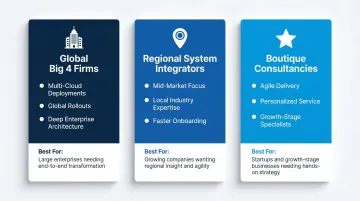
Matching the right partner type to your project scope, budget, and internal readiness typically matters more than selecting the biggest name in the room.
Services Offered by Salesforce Consulting Companies
A full-service Salesforce consulting partner covers every phase of your CRM journey — from initial strategy through ongoing optimization — so the platform actually delivers on the business outcomes it was purchased to achieve.
Salesforce Strategy and CRM Consulting
This foundational service involves:
- Auditing existing business processes to identify inefficiencies and gaps
- Defining CRM objectives aligned with revenue, customer experience, and operational goals
- Recommending the right Salesforce clouds (Sales Cloud, Service Cloud, Marketing Cloud, etc.)
- Building a phased implementation roadmap to prevent costly misalignments
Strategic consulting prevents the most common cause of CRM failure: implementing technology before defining clear business outcomes. Research shows that 68% of organizations struggle to get a single view of the customer, often because they skipped the strategy phase.
Salesforce Implementation and Configuration
Implementation is the hands-on process of deploying, configuring, and customizing Salesforce to reflect your workflows. Core deliverables include:
- Workflow automation to reduce manual tasks
- Custom objects and fields tailored to your data model
- Dashboards and reports for real-time visibility
- User permission structures that enforce security and compliance
Experienced consultants configure Salesforce using clicks rather than code wherever possible. This keeps technical debt low and makes the system far easier to maintain as your business evolves.
Salesforce Integration Services
Integration consultants connect Salesforce to external systems such as ERPs, marketing platforms, e-commerce tools, and third-party APIs to create a unified data environment. 70% of CRM integrations fail to meet their business objectives, making integration expertise one of the most critical selection criteria.
Integration today relies on middleware platforms like MuleSoft and native tools like Salesforce Data Cloud, which uses "Zero-Copy" architecture to connect directly to data warehouses like Snowflake without duplicating data. Partners with proven iPaaS expertise, API governance, and security review capabilities cut integration failure rates considerably.
Data Migration and Management
Data migration is the highest-risk phase of any CRM deployment. According to Gartner data, 83% of data migration projects either fail outright or exceed their budgets and timelines. The process includes:
- Data cleansing to remove duplicates and correct inaccuracies
- Field mapping to align legacy system data with Salesforce objects
- Multiple dry-run migrations to validate data integrity
- Cutover rehearsals and comprehensive rollback strategies
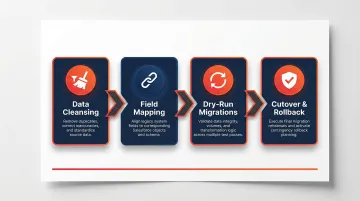
Treating migration as a multi-phase discipline rather than a one-time technical handoff is what separates projects that land on time from the 83% that don't.
Post-Implementation Support and AI Enablement
Day-1 go-live is just the beginning. Ongoing managed services include:
- System health checks and performance optimization
- User adoption training and change management
- Platform upgrades and new feature enablement
- AI enablement using Einstein Analytics and Agentforce
Salesforce is rapidly transitioning into an AI-driven platform. Agentforce and Data Cloud generated over $2.9 billion in ARR in FY2026, with Agentforce alone closing 29,000 deals. Modern consulting partners help clients apply these AI capabilities to automate workflows, surface real-time insights, and shift customer service from reactive to proactive.
When Do You Need a Salesforce Consulting Partner?
Common Trigger Scenarios
Most organizations engage Salesforce consultants in one of these situations:
- New implementation — no in-house Salesforce expertise, and the platform needs to go live correctly from day one
- Underperforming deployment — low user adoption, data inconsistencies, or process bottlenecks; users are reverting to spreadsheets and the CRM isn't delivering ROI
- Major business change — a merger, product expansion, or regulatory shift requires CRM restructuring, new integrations, or multi-cloud governance
Mid-Project Rescue Engagements
Many companies bring in consultants after a failed or stalled implementation. If your project has exceeded budget by 30–49% — the median overrun for CRM projects — or user adoption remains below 50%, a rescue engagement is worth considering. A capable partner can step in at any project stage and reorient toward the original goals without starting from scratch.
Startups vs. Enterprises
The type of support you need depends heavily on where your organization is in its growth curve:
- Startups need speed and lean configuration—getting the CRM live quickly with minimal complexity
- Enterprises need multi-cloud governance, security frameworks, and the capacity to support thousands of users across multiple regions and business units
Look for a partner with verifiable experience at both ends — case studies from startup deployments and enterprise rollouts carry more weight than general claims.
How to Choose the Right Salesforce Consulting Company
Selecting a Salesforce consulting partner is a strategic decision, not a procurement exercise. The wrong choice creates years of technical debt, low adoption rates, and wasted licensing spend — while the right one accelerates revenue, strengthens customer experience, and supports scalable digital operations.
Certifications and Technical Depth
Salesforce certifications validate a partner's platform expertise. Key certifications include:
- Salesforce Certified Administrator
- Salesforce Certified Consultant (Sales Cloud, Service Cloud, etc.)
- Salesforce Certified Architect (Application Architect, System Architect)
- Salesforce Certified Developer (Platform Developer I/II)
Ask for the team's certification count and specific cloud expertise relevant to your project — not just headline numbers.
Salesforce's "Implementation Expert Navigator" distinction goes further, requiring partners to hold specific credentials, complete CSAT-validated projects, and pass rigorous curriculum requirements. It's a stronger signal of real delivery capability than certification volume alone.
Industry Experience and Vertical Specialization
Prioritize partners with documented experience in your specific industry — manufacturing, retail, financial services, e-commerce. Sector-specific knowledge speeds up configuration decisions and reduces the risk of generic implementations that don't reflect real business workflows.
A retail-focused partner, for instance, already understands demand forecasting, inventory integration, and omnichannel customer journeys. That context translates directly into faster, more accurate implementations.
Transparent Pricing and Flexible Engagement Models
Common engagement structures include:
- Fixed-price projects: Best for well-defined scope with clear deliverables
- Time-and-materials: Flexible for evolving requirements or discovery-heavy projects
- Retainer-based managed services: Ongoing support with predictable monthly costs
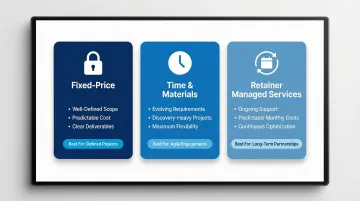
Understanding the full cost structure — including change requests, post-go-live support, and training — prevents budget overruns. Vorstel Technologies, for example, offers a Zero-Fee Solution Evaluation — giving businesses a no-risk way to assess fit and scope before any financial commitment.
Communication Standards and Delivery Accountability
Partners who can't define their escalation paths, reporting cadence, or project KPIs upfront tend to struggle when issues arise. Check Clutch, G2, or Salesforce AppExchange reviews to see how partners actually handle delays, scope changes, and stakeholder communication — not just how they describe it in a sales call.
Ask prospective partners:
- What is your status reporting cadence?
- How do you handle scope changes?
- What KPIs do you track per project phase?
- What is your escalation process for issues?
Track Record and Client References
Ask for case studies, client references, and measurable outcomes — not just project descriptions. Metrics like deployment speed, system uptime improvement, or CRM adoption rates carry more weight than testimonials alone.
With 55% of CRM implementations falling short of their planned objectives, the quality of your partner selection process has a direct impact on whether your project lands in the success column or the failure one. Ask for numbers, not narratives.
Red Flags to Watch Out For When Evaluating Salesforce Consulting Firms
Vague Scoping and No Discovery Phase
Any consulting firm that provides a fixed quote without conducting a thorough business requirements assessment is likely underestimating project complexity. This leads to scope creep, unexpected costs, and project delays.
Before signing a contract, ask for a formal discovery phase that covers:
- Process mapping across affected departments
- Stakeholder interviews to capture requirements
- Technical assessment of existing systems and integrations
Lack of Dedicated Post-Implementation Support
Implementation without structured handover, admin training, and ongoing support often results in low user adoption and platform degradation within the first year. 50% of CRM implementations fail within 2-3 years of deployment, often because organizations lack the internal capability to maintain and optimize the system.
Ask explicitly what post-go-live engagement looks like — and whether it's included in the project cost or structured as a separate retainer.
Over-Reliance on Junior Resources Without Senior Oversight
A common issue with low-cost providers is staffing projects with junior consultants who lack architectural oversight. Always review the seniority mix of the actual delivery team — not just the credentials of whoever presents during the pitch. For complex implementations and integration projects, Architect-level leadership on the delivery side is non-negotiable.
Frequently Asked Questions
What is a Salesforce consulting company?
A Salesforce consulting company is a specialized technology partner that helps businesses implement, customize, integrate, and optimize Salesforce CRM to meet specific business goals—differentiating it from general IT vendors or software resellers.
How much does a Salesforce consultant cost?
Costs depend on engagement type, project scope, and consultant seniority. Freelance consultants typically charge $30–$150/hour; boutique firms run $100–$200/hour; enterprise firms charge $200–$350+/hour. Project totals range from $10,000–$30,000 for small implementations to $150,000+ for complex multi-cloud deployments.
What does an integration consultant do?
A Salesforce integration consultant connects Salesforce to external systems such as ERPs, marketing platforms, or custom applications to create a unified data environment and automate cross-platform workflows—reducing manual data entry and improving data accuracy.
Do major consulting firms use Salesforce?
Yes. Global firms like Accenture, Deloitte, Capgemini, and PwC are official Salesforce strategic partners and manage large-scale CRM implementations for enterprise clients. Boutique consultancies often provide more personalized service for mid-market or growth-stage businesses.
Is Salesforce growing or declining?
Salesforce continues to grow, reporting FY2026 revenue of $41.5 billion, representing 10% year-over-year growth. Its expansion into AI with Agentforce and Data Cloud signals sustained enterprise demand and a broadening platform roadmap.
Selecting the right Salesforce consulting partner shapes how quickly your organization sees ROI, drives user adoption, and turns your CRM from a software expense into a strategic asset. Evaluate partners on proven delivery accountability—not brand recognition alone.