Introduction
SAP is ending mainstream maintenance for ECC at the close of 2027. For the roughly 61% of SAP ECC customers who haven't yet migrated — that's approximately 21,000 organizations out of 35,000, according to Gartner data reported by CIO.com — the window to act without penalty is narrowing fast.
This isn't a routine software upgrade. SAP S/4HANA migration involves replacing the underlying database, redesigning business processes, adapting years of custom code, and managing organizational change — all at once.
When executed with the right strategy, it delivers real-time analytics, embedded AI, and a platform SAP has committed to supporting through 2040. Without that strategy, projects overrun budgets and timelines with little business value to show.
That gap — between projects that deliver and projects that drain — is what this guide addresses. Written for IT leaders, ERP project managers, and digital transformation teams on SAP ECC, it covers the three main migration strategies, the end-to-end process, and what separates successful projects from costly ones.
Key Takeaways
- SAP ECC mainstream support ends 2027 — staying on ECC means losing security patches, compliance updates, and new features
- Three migration strategies exist: Greenfield (new build), Brownfield (system conversion), Hybrid (selective transition) — each suits different contexts
- ASUG's 2024 research found 49% of migrations exceeded budget — planning discipline is non-negotiable
- Unresolved data quality issues and tangled custom code are the two factors most likely to derail your migration timeline and budget
- Typical migrations run 18 months — but scope, complexity, and preparation quality push that range anywhere from 4 months to 6 years
What Is SAP S/4HANA Migration?
SAP S/4HANA migration is the structured process of moving an organization's ERP environment — data, business processes, custom code, and integrations — from SAP ECC to SAP S/4HANA, an ERP platform that runs exclusively on the SAP HANA in-memory database.
This distinction matters. ECC can run on Oracle, IBM DB2, Microsoft SQL Server, or SAP MaxDB. S/4HANA requires SAP HANA. That mandatory database shift alone makes this far more involved than a standard software upgrade.
What Migration Is Designed to Achieve
Moving to S/4HANA isn't purely about compliance. The platform delivers substantive architectural improvements:
- Simplified data model: fewer tables, faster queries, and significantly reduced redundancy
- Real-time analytics built directly into core processes, replacing batch reporting cycles
- Modern Fiori interface — role-based and mobile-ready, replacing the legacy SAP GUI
- Embedded AI/ML that enables intelligent workflows and predictive decision-making
- Flexible deployment across public cloud, private cloud, or on-premises
None of these are achievable through ECC patches or incremental upgrades. S/4HANA is a fundamentally different architecture, which is why migration typically involves business process re-engineering alongside the technical work. Understanding that scope is the starting point — the sections below break down the migration approaches, key planning stages, and what separates successful projects from stalled ones.
Why Organizations Are Migrating from SAP ECC to S/4HANA Now
The 2027 Deadline Is Official
SAP has confirmed mainstream maintenance for SAP Business Suite 7 core applications ends at the close of 2027. After that point, organizations on ECC lose access to standard security patches, compliance updates, and functional enhancements.
Extended maintenance is available from 2028 through 2030, but it carries an additional premium of two percentage points on the maintenance basis — a meaningful cost increase for an organization that isn't moving forward. Beyond 2030, customers receive only customer-specific maintenance, a sharply limited support model with no roadmap alignment.
SAP committed in February 2020 to support at least one S/4HANA release through 2040. That's a 13-year support horizon on S/4HANA versus an exit ramp on ECC — a gap that compounds with every year of delay.
The Business Case Beyond Compliance
Organizations that treat migration purely as a compliance exercise miss the larger opportunity. S/4HANA directly addresses operational challenges that ECC cannot:
- Finance teams waiting hours for period-end reports can run them in real time
- Supply chain teams gain live inventory visibility without separate BI tooling
- AI-assisted workflows reduce manual processing in procurement, finance, and HR
- Cloud deployment eliminates on-premises infrastructure maintenance overhead
What Happens When Organizations Delay
Those operational advantages accrue to competitors who move first. Staying on ECC isn't a pause — it's a cost. Each additional year typically means:
- More custom code accumulates, raising future remediation costs
- Larger data volumes require more archiving work before migration
- Consultants with ECC migration expertise become scarcer and more expensive
- Competitors who have already migrated extend their operational lead
SAP S/4HANA Migration Strategies: Choosing the Right Approach
ASUG's 2024 research found the strategy split among migrating organizations was nearly even: 34% Brownfield, 33% Greenfield, 20% Hybrid. There is no universal best approach — the right choice depends on where you're starting from: how heavily customized your ECC system is, how much process reinvention you're willing to undertake, and how much disruption your business can absorb during transition.
Greenfield Migration (New Implementation)
Greenfield means building a new S/4HANA instance from scratch and migrating only relevant, cleansed data from ECC. Legacy configurations don't carry over — the organization starts with SAP's current best-practice processes and adapts from there.
Choose this if your ECC system is heavily customized and carrying that legacy forward costs more than rebuilding — or if the goal is comprehensive process transformation, not just a technical upgrade.
What to expect: Highest transformation potential, but also the greatest investment in time, budget, and change management. Go-live disruption is higher than with Brownfield — plan for it.
Brownfield Migration (System Conversion)
Brownfield is a technical in-place conversion of the existing ECC system to S/4HANA using SAP's Software Update Manager (SUM). Current configurations, historical data, and custom developments are preserved through the conversion.
Consider this when you need to meet the 2027 deadline without significant operational disruption, or when your ECC processes are sound and reinvention isn't the priority.
What to expect: Faster and less disruptive than Greenfield, but legacy inefficiencies carry over. Custom code still requires analysis and adaptation — budget time for it.
Hybrid Migration (Selective Data Transition)
Hybrid combines a new S/4HANA system with selective migration of specific processes, data objects, or business units from ECC. SAP formally calls this Selective Data Transition. It allows organizations to prioritize the most critical areas first and phase transformation over time.
This works best for multi-entity organizations or those running staged transformations — where some processes warrant reinvention and others should migrate as-is.
What to expect: Maximum flexibility, but parallel operation of ECC and S/4HANA during the transition period demands careful governance and clear cutover planning.
Comparing the Three Approaches
| Factor | Greenfield | Brownfield | Hybrid |
|---|---|---|---|
| Implementation speed | Slowest | Fastest | Moderate |
| Business disruption | Highest | Lowest | Medium |
| Process transformation | Full reinvention | Carry existing | Selective |
| Legacy customizations | Not carried over | Preserved (with adaptation) | Mix of both |
| Best for | Heavily customized ECC or full transformation goals | Speed to compliance, stable processes | Staged rollouts, multi-entity orgs |
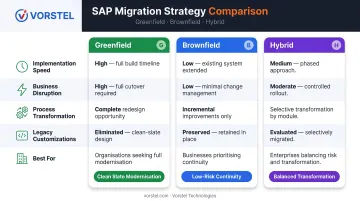
A fit-gap analysis — mapping current ECC processes against S/4HANA standard capabilities — is typically the starting point for making this call. It surfaces which processes translate cleanly, which need rework, and whether the effort justifies a Greenfield rebuild or a faster conversion path.
Key Phases of the SAP S/4HANA Migration Process
The phases below apply regardless of which strategy is chosen. Scope and intensity vary, but the sequence holds.
Phase 1: Assessment and Readiness Check
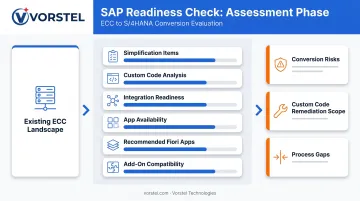
The SAP Readiness Check is the starting point for any migration. It evaluates the existing ECC landscape across several dimensions: Simplification Items, Custom Code Analysis, Integration readiness, App Availability, Recommended Fiori Apps, and Add-On Compatibility.
The output tells you what will break during conversion, how much custom code needs remediation, and which business processes have no direct S/4HANA equivalent. A fit-gap analysis runs alongside this, mapping current processes to S/4HANA standard capabilities and surfacing gaps that require design decisions before conversion begins.
Teams that skip or compress this phase typically encounter conversion failures, scope creep, and unbudgeted remediation work mid-project.
Phase 2: Data Analysis, Classification, and Cleansing
Three-quarters of respondents in a 2024 TechTarget survey named data management as their top migration challenge, citing duplication, siloing, and insufficient data skills as compounding factors.
Data must be categorized before migration begins:
- Hot data — active transactional and master data; migrates to S/4HANA
- Warm data — historical data needed for reporting; may migrate or be retained in archives
- Cold data — archival and compliance data; typically does not migrate into the live system
Cleansing covers duplicate removal, standardization, validation, and error correction. SAP Data Services handles data integration and quality processing; SAP Information Steward supports profiling, metadata management, and data quality monitoring specifically designed to support S/4HANA migration planning.
Data archiving belongs in this phase — not after migration. Carrying full, unarchived ECC data volumes into S/4HANA inflates infrastructure costs and degrades initial system performance.
Phase 3: Technical Conversion and Custom Code Adaptation
This phase translates the conversion approach into execution. For Brownfield migrations, SAP's Software Update Manager runs the system conversion; for Greenfield and Hybrid, it covers new system build-out and data load.
Custom code is the variable that most consistently surprises organizations. ECC systems often carry years of undocumented ABAP developments. SAP's Custom Code Migration Guide for S/4HANA 2025 recommends running the ABAP Test Cockpit (ATC) with S/4HANA-specific checks to identify incompatibilities.
Each flagged development then falls into one of two outcomes:
- Adapt — code is refactored to align with S/4HANA APIs and data models
- Retire — functionality already exists in standard S/4HANA and the custom development is decommissioned
The output of this phase should be a prioritized remediation plan — not a promise to "fix it after go-live."
Phase 4: Testing, Cutover, and Go-Live
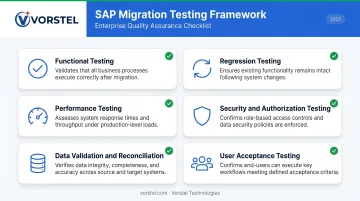
Testing in SAP migrations covers six distinct areas:
- Functional testing — processes work correctly in S/4HANA
- Regression testing — existing functionality hasn't broken
- Performance testing — system handles expected transaction volumes
- Security and authorization testing — roles and permissions are correct
- Data validation and reconciliation — migrated data matches source records
- User Acceptance Testing (UAT) — business stakeholders sign off before go-live
The cutover plan must document every task, sequence, time estimate, and owner. SAP Community guidance recommends basing the plan on rehearsals executed in the QA environment, covering infrastructure, master data migration, security, training, and organizational readiness.
A validated rollback strategy must be in place before go-live. Without one, the team has no clear path back if a critical issue surfaces during cutover.
Post-go-live hyper-care (proactive monitoring, issue tracking, rapid-response support) stabilizes the new environment during the critical first weeks when user adoption and system behavior are still settling.
Best Practices, Key Factors, and Common Pitfalls
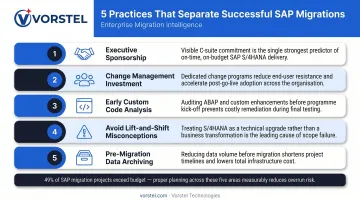
ASUG's 2024 research found that 49% of SAP migration projects exceeded their original budget — up 17 percentage points from 2023. Most of that overrun traces back to predictable, avoidable mistakes. The five practices below address the gaps that most commonly derail projects before they reach go-live.
What separates successful migrations:
Secure executive sponsorship before the project starts. S/4HANA migration is a business transformation. Without senior leadership driving scope decisions and resolving cross-functional conflicts, projects stall on governance issues that technical teams can't resolve alone.
Invest in change management alongside technical delivery. User training, communication plans, and process documentation aren't soft extras — underinvesting here consistently leads to lower adoption and higher post-go-live support costs.
Take custom code seriously in Phase 1. Many organizations discover during their first readiness check that their ECC system carries far more undocumented custom code than anyone realized. Catching this late adds weeks or months that can't be clawed back from the project schedule.
Don't treat Brownfield as a "no change" migration. The most common misconception is that system conversion means no process work required. Lift-and-shift without addressing process inefficiencies typically leads to a second transformation project within a few years.
Archive data before migration, not after. Data volume management belongs in Phase 1 — treating it as a post-go-live cleanup task routinely inflates conversion timelines and system sizing costs.
Conclusion
The 2027 ECC deadline is a compliance forcing function, but the stronger case for migrating is what S/4HANA actually enables: real-time data processing, embedded AI, a modern user experience, and a platform SAP has committed to support through 2040.
That scope — data, custom code, integrations, process design, and organizational change — is why the right partner makes a measurable difference. Vorstel Technologies brings 200+ SAP project engagements and can step in at any stage, from initial planning through go-live.
Their Zero-Fee Solution Evaluation gives organizations a concrete starting point:
- Expert consultation on IT strategy and migration readiness
- Assessment of the right approach for your specific landscape
- No-cost engagement with no obligation to proceed
Whether a migration is still in planning or already in flight, the team can accelerate delivery and reduce risk from day one.
Frequently Asked Questions
What is SAP HANA migration?
SAP HANA migration refers to moving SAP workloads — including the ERP database and application layer — to SAP's proprietary in-memory database platform. It is a mandatory component of S/4HANA adoption, replacing legacy databases like Oracle, IBM DB2, and Microsoft SQL Server.
What are the different types of SAP S/4HANA migration?
The three main approaches are Greenfield (new S/4HANA implementation with selective data migration), Brownfield (technical in-place conversion of the existing ECC system), and Hybrid (selective data transition combining elements of both). Each suits different transformation ambitions and organizational contexts.
What is the deadline for migrating to SAP S/4HANA?
SAP has set the end of 2027 as the mainstream maintenance cutoff for SAP ECC. After that date, standard security patches and compliance updates stop. Extended support runs through 2030 at an additional premium, after which only customer-specific maintenance applies.
Why are organizations transitioning from SAP ECC to SAP S/4HANA now?
The 2027 support deadline makes continued ECC use a compliance and security risk. Beyond that, S/4HANA delivers capabilities ECC simply cannot match: real-time analytics, embedded AI/ML, a simplified data model, and flexible cloud deployment.
What are the biggest challenges in SAP S/4HANA migration?
Custom code volume and compatibility gaps, data quality issues uncovered during cleansing, underestimated change management requirements, and the complexity of coordinating technical conversion with business process redesign — particularly in large or multi-entity organizations.
How long does an SAP S/4HANA migration typically take?
Industry research puts the average migration at 1.5 years, with a range from 4 months to 6 years depending on organization size, system complexity, data volume, and chosen strategy. Brownfield conversions are generally faster than Greenfield implementations; Hybrid falls in between based on scope.