Introduction
Modern enterprises run hundreds of systems simultaneously. According to a 2022 MuleSoft survey of 1,050 CIOs, the average enterprise uses 976 applications — with only 28% integrated. The same study found 90% of organizations cite data silos as a challenge, and 88% say integration gaps slow digital transformation.
The result? The same customer exists in your CRM with one address and in your ERP with another. Your product catalog shows different pricing depending on which system you query. Your supplier records haven't been reconciled since last year's acquisition.
The cost is concrete. Gartner research found poor data quality costs organizations at least $12.9 million per year on average: through bad decisions, operational failures, and compliance exposure.
Master Data Management (MDM) is the combination of technology, processes, and governance frameworks that creates a single, authoritative source of truth — a "golden record" — for your most critical business data. Getting it right is increasingly the difference between AI initiatives that deliver and ones that stall on dirty inputs.
Key Takeaways
- MDM creates and maintains a single "golden record" for critical business entities — customers, products, suppliers, and locations — shared across all enterprise systems.
- Master data covers the core "nouns" of a business; all transactions and analytics depend on it.
- Four implementation styles exist: Registry, Consolidation, Coexistence, and Centralized — each suited to different governance maturity levels.
- Key benefits include better decisions, fewer errors, regulatory compliance, and AI/analytics readiness.
- MDM is an ongoing program — not a one-time project — requiring governance, data stewardship, and sustained investment.
What Is Master Data Management?
MDM is a discipline — and a technology — that coordinates how critical business data is defined, maintained, and shared across an enterprise. At its operational core, MDM delivers a unified master data service: accurate, consistent, and complete data fed to all systems and business partners.
The Golden Record
The concept central to every MDM program is the golden record — a single master record for each business entity, created by de-duplicating, reconciling, and enriching data from multiple source systems.
A practical example: a customer named "Acme Corp" exists in your CRM as "Acme Corporation, 100 Main St" and in your ERP as "ACME CORP, 100 Main Street, Suite 5." MDM matches these two records, resolves the conflict using defined rules, and produces one trusted record that every downstream system consumes.
MDM as Discipline vs. Technology
MDM is frequently misunderstood as purely a software purchase. It's both:
- Discipline: Relies on data governance principles, organizational roles (data stewards, governance councils), and defined policies for how master data is created and changed.
- Technology: Automates data matching, deduplication, cleansing, reconciliation, and enrichment across source systems.
Without governance, even well-configured MDM software degrades into another siloed data store. The technology enables the program; governance is what makes it last.
What MDM Is Not
A common point of confusion is the boundary between MDM and ETL (Extract, Transform, Load). They serve different purposes:
| ETL | MDM | |
|---|---|---|
| Primary function | Move and transform data between systems | Create and govern trusted master records |
| Output | Data in a warehouse or repository | Persistent, authoritative master entity |
| Persistence | Data loaded for analysis | Record maintained over its full lifecycle |
| Governance | Minimal | Central to the program |
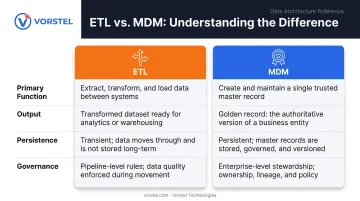
MDM also sits outside the scope of data warehouses, backup tools, and integration middleware — each solves a different part of the data infrastructure puzzle.
What Is Master Data? Types and Key Domains
Master data is the shared, stable information that underpins every transaction and process in a business — records like customers, products, locations, and suppliers that dozens of systems depend on simultaneously.
Contrast it with:
- Transactional data — captures events (an invoice, a sales order, a shipment)
- Reference data — used to categorize other data (country codes, currency codes, product categories)
Unlike transactional data, master data changes slowly — but when it's wrong or inconsistent across systems, the downstream damage compounds fast.
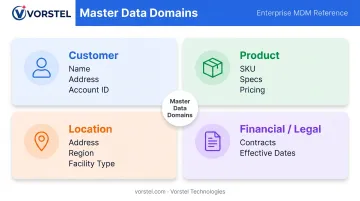
The Four Primary Master Data Domains
| Domain | What It Covers | Example Record |
|---|---|---|
| Customer | Customers, employees, patients, citizens, suppliers as parties | Name, billing address, account ID, contact details |
| Product | Products, parts, materials, assets | SKU, specifications, pricing, product hierarchy |
| Location | Offices, warehouses, distribution centers, stores | Address, region, timezone, facility type |
| Financial/Legal | Contracts, warranties, licenses, financial instruments | Contract terms, effective dates, counterparties |
What Qualifies as Master Data?
Not every data entity needs a full MDM program. The key criteria for prioritization:
- Reuse: Data referenced across multiple systems — ERP, CRM, supply chain — warrants centralized management
- Stability: Records that change infrequently are practical to maintain as a single authoritative source
- Business impact: If duplicate or conflicting records cause invoicing errors, failed shipments, or compliance gaps, it qualifies
- Structural complexity: Data requiring deduplication, hierarchy management, or third-party enrichment justifies dedicated governance
If a data entity fails more than one of these tests, it's a strong candidate for MDM governance.
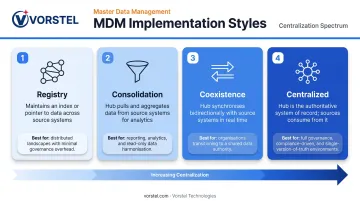
The 4 MDM Implementation Styles
Organizations don't implement MDM identically. The right architecture depends on governance maturity, IT landscape, and how much operational disruption an organization can absorb.
These four styles form a spectrum — from minimal centralization to full hub ownership of master data. Understanding where your organization sits on that spectrum is the first step toward choosing the right approach.
Registry Style
The hub creates an index — a cross-reference that maps related records across source systems — without physically centralizing or moving the underlying data.
- Source systems retain full ownership of their data
- The registry resolves identity across systems (matching and linking)
- No active data cleansing at the hub level
- Best for: Organizations with strict data residency requirements or limited system consolidation authority
- Limitation: Data quality depends entirely on source systems; the hub doesn't improve it
Consolidation Style
Source data is pulled into a central hub for cleansing, deduplication, and golden record creation — but corrected data is not pushed back to source systems.
- The golden record lives in the hub for reporting and analytics
- Operational source systems continue running independently
- Effectively a "read" hub for downstream consumers
- Best for: BI, analytics, customer/product 360° reporting use cases
Coexistence Style
A hub maintains the golden record and synchronizes it bidirectionally with operational source systems. Updates can flow from sources to the hub and from the hub back to sources.
- Most common in large enterprises with multiple operational systems
- Requires conflict resolution logic (what wins when two systems disagree?)
- More complex to govern than consolidation
- Ideal when: Trusted master data needs to reach operational workflows, not just analytics dashboards
Centralized Style
The MDM hub is the system of record for master data. All source systems must create, update, or reference master data through the hub.
- Highest data quality and consistency
- Requires the most organizational change, application refactoring, and governance discipline
- Best for: Greenfield implementations (new builds with no legacy constraints) or organizations with strong governance maturity and executive mandate
Matching style to governance maturity is the critical decision here. The centralized approach delivers the strongest data quality, but organizations that attempt it before they're ready consistently stall. Start where your current capabilities can sustain, then evolve the architecture as governance matures.
Key Benefits of Master Data Management
Better Decisions and Analytics Quality
Analytics tools and AI/ML models are only as trustworthy as the data feeding them. When customer records are duplicated, product hierarchies are inconsistent, or supplier data varies by system, every downstream report and model inherits those errors.
The "garbage in, garbage out" principle operates at scale in data-rich enterprises. MDM ensures that the foundational data feeding your BI platform, data warehouse, and AI initiatives is consistent and complete.
Reduced Errors and Operational Costs
Fragmented master data creates real operational failures:
- Invoices sent to outdated addresses because CRM and ERP records weren't synchronized
- Duplicate marketing outreach to the same customer under different account IDs
- Procurement orders placed with a supplier under two different vendor codes
- Product listings with conflicting specifications across sales channels
MDM eliminates duplicate records, enforces consistent data standards, and removes the manual reconciliation effort that teams spend patching these gaps.
Regulatory Compliance and Risk Mitigation
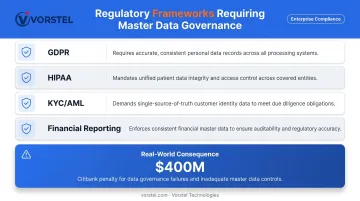
Auditable, consistent master data is a compliance requirement across multiple regulatory frameworks:
- GDPR — requires accurate, complete records of customer data and processing history
- HIPAA — demands consistent patient records across healthcare systems
- KYC/AML — financial services firms must verify and maintain accurate customer identity data before onboarding
- Financial reporting — accurate entity, cost center, and counterparty data is required for consolidated financial statements
MDM provides audit trails, data lineage, and version history: the documentation regulators require. The consequences of gaps here are severe: in 2020, the OCC assessed a $400 million civil penalty against Citibank, citing deficiencies that included data governance and internal controls.
Support for M&A and Digital Transformation
During mergers and acquisitions, organizations inherit overlapping and inconsistent data from two separate system landscapes. MDM accelerates integration by deduplicating and reconciling master data from both entities, reducing the time to achieve a unified view from years to weeks.
The same principle applies to digital transformation programs: SAP S/4HANA migrations, CRM unification on Salesforce, and cloud migrations all require clean, unified master data as a prerequisite for go-live. Dirty master data is one of the most common reasons these programs miss timelines and overshoot budgets.
How to Build an MDM Strategy
1. Start with Governance, Not Technology
Before evaluating a single vendor, define:
- Data ownership — who owns each master data domain (customer, product, location, supplier)?
- Data quality standards — what does "accurate" mean for each attribute?
- Decision rights — who approves changes to master records?
- Stewardship roles — who maintains data quality day-to-day?
Form a cross-functional Data Governance Council with representation from business and IT. Data stewards — business-side owners who review, approve, and maintain master records — are the operational core of any MDM program.
Skip governance, and even well-implemented MDM technology produces inconsistent results within months.
2. Define Scope and Pick an Implementation Style
Don't attempt to manage all master data simultaneously. Prioritize:
- The domain with the highest business impact (usually customer or product)
- The clearest, most measurable pain point (duplicate records, compliance gaps, M&A integration)
- Data that is reused across the most systems and causes the most downstream errors when wrong
Once the domain is defined, select the implementation style (Registry, Consolidation, Coexistence, or Centralized) based on your governance maturity and integration capacity. That choice directly shapes which tools will — and won't — work for your environment.
3. Select Tools That Fit Your Ecosystem
MDM platforms should support:
- Data modeling and hierarchy management
- Matching, merging, and deduplication
- Data quality management and workflow automation
- Integration with your existing systems (SAP, Salesforce, Microsoft, etc.)
Technology choice should follow strategy — not the other way around. Organizations that select an MDM tool before defining governance scope and implementation style often end up with a platform that doesn't fit how their data actually moves.
Independent evaluation helps here. Vorstel Technologies provides zero-fee solution assessments, drawing on 200+ SAP project engagements and hands-on experience across Salesforce and Microsoft ecosystems. That means organizations get platform recommendations shaped by their specific architecture, not by a vendor's sales priorities.
MDM in the Era of Digital Transformation and AI
MDM as the Foundation for AI Readiness
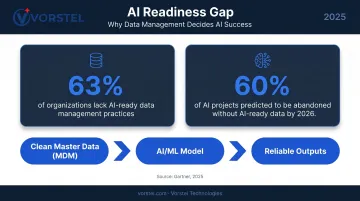
AI initiatives — customer segmentation, predictive maintenance, demand forecasting, generative AI applications — require high-quality, consistent, and comprehensive data to produce reliable outputs. Without MDM, AI is trained on fragmented, inconsistent master data, producing inaccurate predictions and eroding trust in AI programs before they scale.
A 2025 Gartner report based on a survey of 1,203 data management leaders found 63% of organizations don't have — or aren't sure they have — the right data management practices for AI. Gartner also predicts that through 2026, organizations will abandon 60% of AI projects unsupported by AI-ready data.
MDM closes this gap at the source. When customer, product, and supplier records are deduplicated and standardized before they reach a model, AI outputs reflect reality — not the noise accumulated from years of siloed systems.
MDM Enables Transformation Programs
The most common digital transformation initiatives all depend on trusted master data:
- SAP S/4HANA migrations — require clean, standardized master data in SAP Business Partner, Material, and Vendor structures before cutover
- CRM unification (Salesforce) — customer golden records must be resolved before loading into a new CRM to avoid duplicating the fragmentation in the new system
- Cloud migrations — migrating dirty data to the cloud just creates a faster, more expensive version of the same problem
- Omnichannel retail — consistent product and location data across all sales channels is required for accurate inventory and pricing
Siloed or inconsistent master data is one of the primary reasons transformation programs stall or fail to deliver expected returns.
When to Bring in Outside Expertise
Running a large-scale MDM program in parallel with an active transformation initiative is resource-intensive. Most organizations lack the bandwidth to do both without one suffering.
That's where external MDM specialists add the most value. Vorstel Technologies has delivered 200+ SAP projects across SAP, Salesforce, and Microsoft environments, and can engage at any stage — an initial MDM readiness assessment, governance framework design, or a full SAP MDG implementation — without requiring clients to start from scratch.
Frequently Asked Questions
What does master data management do?
MDM creates and maintains a single, authoritative "golden record" for each critical business entity — customer, product, location, supplier. It eliminates duplication, reconciles inconsistencies, and ensures every department works from the same trusted data source.
Is master data management an ETL tool?
No. ETL extracts, transforms, and loads data between systems — primarily for analytics. MDM creates and governs a persistent master record over time, managing data quality, deduplication, governance, and stewardship — not just data movement.
What are the 4 types of master data management?
The four MDM implementation styles are Registry, Consolidation, Coexistence, and Centralized. They differ in how much data is centralized, whether golden records are written back to source systems, and how much organizational change is required.
What is the difference between MDM and data governance?
Data governance defines the policies, rules, and accountability structures for how data is managed. MDM is the operational practice and technology that puts those governance rules into action for critical master data entities. Without MDM, governance remains a set of rules with no consistent enforcement behind them.
What are common examples of master data?
Common master data examples include:
- Customer records: name, address, account ID
- Product records: SKU, specifications, pricing
- Supplier records: contract terms, payment details
- Location records: address, region, facility type
Who is responsible for master data management in an organization?
MDM is a shared responsibility. A Data Governance Council sets policies, Data Stewards maintain quality day-to-day, IT Administrators configure the platform, and executive sponsors provide mandate and funding. Business and IT must own it together.