According to Gartner, poor data quality costs organisations at least $12.9 million per year on average. For enterprises running SAP across multiple departments and geographies, inconsistent master data is often the silent driver behind that number.
This article explains what Master Data Management (MDM) means in an SAP context, how it works across SAP's modular architecture, the difference between the legacy SAP MDM product and the current SAP MDG solution, and what organisations need to know to get their master data strategy right — especially ahead of an S/4HANA migration.
Key Takeaways
- MDM in SAP creates and maintains one accurate record for every critical business entity across your SAP landscape
- SAP MDM (legacy) and SAP MDG (Master Data Governance) are different products — MDG is SAP's current solution for S/4HANA environments
- Core master data domains include materials, customers, vendors/suppliers, and employees
- Poor master data quality undermines operations, analytics, compliance, and AI initiatives
- Organizations planning S/4HANA migrations should treat master data cleanup as a pre-migration priority
What is Master Data Management (MDM) in SAP?
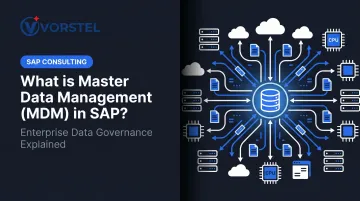
As SAP itself defines it, MDM is the practice of creating and maintaining a single master record — a "single source of truth" — for every person, place, and thing in a business. Within an SAP environment specifically, this means governing the accuracy, consistency, and accessibility of critical reference data across all SAP modules and connected systems.
Master Data vs. Transactional Data
These two terms are often conflated, but the distinction matters.
- Master data is stable reference information: a vendor's name, bank details, and payment terms; a product's unit of measure and procurement data; a customer's billing address
- Transactional data is event-driven: a purchase order, an invoice, a goods receipt
Master data underpins every transaction. If a vendor's payment terms are recorded incorrectly in your finance module, every invoice processed against that record carries the error forward. Errors in master data don't stay contained — they cascade.
Why SAP Specifically Requires MDM
SAP is a multi-module ERP platform where data flows continuously between Finance (FI), Materials Management (MM), Sales & Distribution (SD), Production Planning (PP), Human Resources (HCM), and more. The same vendor record exists simultaneously in MM (for procurement) and FI (for payment processing). Without centralized governance, these records quietly diverge, causing:
- Payment errors when vendor terms differ between modules
- Compliance flags from inconsistent financial records
- Duplicate orders generated by unreconciled procurement data
Consider a large enterprise where three regional teams enter the same customer under slightly different names. SAP has no built-in mechanism to reconcile those records into one authoritative version — that's precisely the gap MDM fills.
SAP introduced a standalone MDM product in the early 2000s to address this problem. It has since repositioned SAP Master Data Governance (MDG) as its primary MDM solution, especially within S/4HANA environments. That distinction is covered in detail in the next section.
Types of Master Data SAP Manages
SAP organises master data into data domains — categories of records that serve specific modules and business processes. Managing these domains consistently across the SAP landscape is the core challenge MDM is designed to solve.
| Domain | Primary SAP Modules | What It Contains |
|---|---|---|
| Material Master | MM, PP, SD | Product descriptions, units of measure, procurement data, pricing |
| Customer Master | SD, FI | Contact details, payment terms, sales history (uses Business Partner in S/4HANA) |
| Vendor/Supplier Master | MM, FI | Supplier details, contracts, banking information (uses Business Partner in S/4HANA) |
| Employee Master | SAP HCM | Payroll data, benefits, organisational structure |
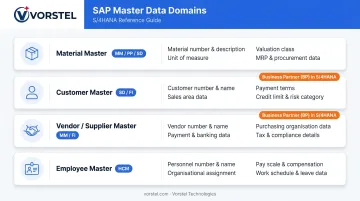
In S/4HANA, the Business Partner object serves as the leading record for both customer and supplier master data, consolidating what were previously separate records into a single unified entity. Organisations migrating from ECC need to account for this structural shift when defining their master data strategy.
How SAP Handles Master Data: Modules and Key Tools
SAP MDM (The Legacy Product)
The original SAP NetWeaver Master Data Management product (documented as SAP NetWeaver MDM 7.1) was a standalone technical repository. Its core functions included:
- Consolidating master data from multiple source systems into a central store
- De-duplicating and cleansing records
- Harmonizing naming conventions and field values
- Distributing clean records back to connected SAP and non-SAP systems
It worked — but it was primarily a data repository, not a governance tool. It didn't natively control how records were created, approved, or modified going forward.
SAP Master Data Governance (SAP MDG)
That's the gap SAP MDG was built to fill. Where the legacy product focused on consolidating what already existed, MDG focuses on governing what gets created and changed going forward — built directly on SAP ERP and S/4HANA.
SAP Help describes MDG as a natural extension of business processes that provides domain-specific governance to centrally create, change, and distribute master data. The key capabilities include:
- Change request workflows — BRFplus-based approval processes controlling who can create or modify a master record
- Duplicate detection via SAP HANA fuzzy search, flagging potential matches at the point of entry — not after the fact
- Data quality rules and monitoring — configurable validation rules with dashboards tracking completeness, accuracy, and timeliness
- Pre-built governance models covering financial master data, material master, business partners, customers, and suppliers
- Fiori-based interface replacing legacy SAP GUI screens
Vorstel Technologies' SAP consulting practice helps organizations configure and implement these MDG capabilities. With 200+ SAP projects completed, the team's focus is ensuring clean, governed master data is in place from go-live — so the new system doesn't inherit the same data quality issues as the old one.
SAP MDM vs. SAP MDG: What's the Difference?
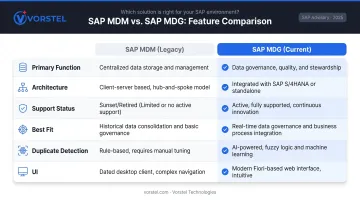
The terminology here causes genuine confusion. "SAP MDM" can refer to both the legacy product and the broader practice of managing master data in SAP. Here's how the two products compare:
| Dimension | SAP MDM (Legacy) | SAP MDG (Current) |
|---|---|---|
| Primary function | Central data repository | Governance-first workflow platform |
| Architecture | SAP NetWeaver (standalone) | Native to SAP ERP / S/4HANA |
| Support status | Limited, largely phased out | Actively developed with S/4HANA roadmap |
| Best fit | Older ECC landscapes | Modern S/4HANA environments |
| Duplicate detection | Not HANA-native | Real-time HANA-based fuzzy search |
| UI | Legacy interfaces | SAP Fiori / Web Dynpro ABAP |
What This Means for Organizations Today
ASUG reported in 2024 that 58% of CEOs are concerned their data quality can't support advanced automation in SAP S/4HANA.
This reflects a pattern most SAP consultants encounter in practice: organizations that deferred master data governance for years are now absorbing that cost mid-migration, when it's hardest to absorb.
For companies on SAP ECC planning an S/4HANA move:
- Treat master data cleanup as pre-migration work, not a post-go-live cleanup task
- Plan to adopt MDG as your governance layer after migration — the legacy MDM product is not a viable long-term option in an S/4HANA landscape
- Account for the Business Partner transition if your current landscape uses separate customer and vendor master records
Key Benefits of MDM in SAP for Enterprises
Operational Efficiency
Consistent master data eliminates a category of errors that are difficult to trace but expensive to fix:
- Duplicate vendor records leading to duplicate payments
- Incorrect pricing in material master causing billing disputes
- Misrouted transactions due to inconsistent customer records
- Manual rework by finance and procurement teams reconciling conflicting data
Clean, governed master data removes this friction before it enters the transaction layer. That operational foundation also determines how much you can trust the insights built on top of it.
Analytics and AI Readiness
SAP's analytics tools (SAP Analytics Cloud, embedded S/4HANA analytics) are only as reliable as the master data feeding them. The same applies to any AI or automation initiative built on SAP data.
A 2025 Harvard Business Review survey found that only 37% of companies reported their data quality improvement efforts had been successful in the prior year. For organizations investing in S/4HANA automation, that number is a warning: the AI layer cannot compensate for what the data layer gets wrong.
Compliance and Auditability
SAP MDG maintains a complete audit trail of all change request activity: who proposed a change, who approved it, when it was activated, and what changed. Combined with role-based authorization objects covering both change request and master data access, MDG supports GDPR-relevant data transparency and the traceability that regulated industries require.
That said, MDG doesn't guarantee compliance (no software does). What it provides are the structural controls that compliance frameworks expect to see.
Common MDM Challenges in SAP and How to Overcome Them
Most MDM failures in SAP environments trace back to the same recurring problems:
- No naming conventions — different teams enter the same entity differently, generating duplicates that propagate across modules
- Incomplete records — unstructured data entry leaves required fields blank, breaking downstream processes
- No governance workflows — anyone can create or edit a master record without approval, removing accountability
- Resistance to change — new governance processes require behavioral change, which teams without proper training often circumvent
Practical Steps to Address These
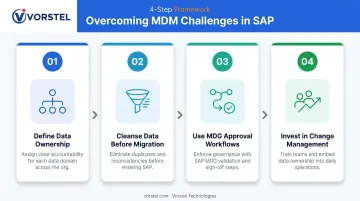
- Define data ownership before implementation — establish who is responsible for each data domain and what the approval chain looks like
- Cleanse data before migration — migrating dirty data into S/4HANA multiplies the problem; clean it at source first
- Use MDG's approval workflows — configure change request processes and role-based access controls to enforce governance at the point of entry
- Invest in change management — technical configuration alone won't drive adoption; training and communication are non-negotiable
MDM configuration in SAP demands both technical depth and module-level knowledge of how master data flows across the system. Vorstel Technologies has delivered 200+ SAP projects with a 97% client satisfaction rate, supporting global enterprises through every phase of their MDM or MDG implementation.
Frequently Asked Questions
What is SAP MDM used for?
SAP MDM is used to create, maintain, and govern a single accurate record for critical business entities — customers, vendors, materials, and employees — across all SAP modules. Its successor, SAP MDG, extends this with structured governance workflows. Both ensure data consistency across the enterprise and support better decision-making by eliminating conflicting records.
Is SAP MDM the same as MDG?
No. SAP MDM is a legacy standalone product that has been largely phased out, while SAP MDG (Master Data Governance) is SAP's current, actively supported solution. MDG is natively integrated with S/4HANA and offers governance workflow capabilities that the original MDM product did not provide.
Is SAP MDM part of S/4HANA?
The original SAP MDM product is not natively part of S/4HANA and has limited support in that landscape. SAP MDG, however, is tightly integrated with S/4HANA and is SAP's current approach for managing master data in any S/4HANA environment.
What types of master data does SAP manage?
SAP manages four core domains: material master data, customer master data, vendor/supplier master data, and employee master data. Each is shared across multiple SAP modules and must be governed consistently. In S/4HANA, customer and supplier records are unified under the Business Partner object.
What is the difference between MDM and data governance in SAP?
MDM focuses on creating and maintaining the actual master records — the data itself. Data governance defines the rules, policies, and ownership structures that determine how that data is managed, approved, and protected. SAP MDG combines both functions: it governs the data through structured workflows while maintaining the records centrally.
What are the main challenges of implementing MDM in SAP?
The most common obstacles are high implementation complexity, data quality issues in legacy systems, missing standardized naming conventions, and resistance to new governance workflows. Upfront data cleansing, clearly defined data ownership, and proper MDG configuration address most of these challenges before they escalate.