A master data management (MDM) strategy is how organizations fix this—not by buying a tool, but by building a deliberate, organization-wide discipline for governing critical data. This article covers what an MDM strategy actually is, why the business case is urgent, the five key steps to build one, and the components that separate strategies that last from those that quietly collapse.
One critical distinction before diving in: most organizations approach MDM as an IT project. That framing is why so many fail.
Key Takeaways
- An MDM strategy governs, unifies, and maintains critical data entities—customers, products, suppliers—across all enterprise systems
- Without one, organizations face duplicate records, failed analytics, compliance exposure, and unreliable decision-making
- Effective MDM requires clear objectives, governance structures, data quality standards, and the right integration architecture
- MDM is not a one-time implementation—it requires ongoing stewardship and adaptation
- ERP, CRM, and AI investments only perform reliably when built on a solid MDM foundation
What Is a Master Data Management Strategy?
An MDM strategy is a comprehensive, organization-wide approach to managing critical data entities—customers, products, suppliers, employees, assets, locations—ensuring they are accurate, consistent, and accessible across all systems and business units.
The central concept is the golden record: a single, authoritative version of each core data entity that every system and team relies on. When the CRM, ERP, and analytics platform all reference the same customer record with the same attributes, contradictory data stops being a daily operational problem.
Two distinctions shape how organizations approach this work:
- Conflating strategy with implementation is how teams end up with expensive tools and no actual data discipline. Strategy defines what to achieve and how to govern data; implementation is the execution of that plan.
- Data governance is a component of MDM—not a synonym. Governance sets the policies and accountability structures. MDM is the broader operational system that includes technology, integration, quality processes, and stewardship workflows.
Why Enterprises Need a Master Data Management Strategy
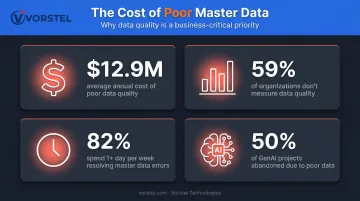
The business case isn't abstract. Gartner research puts the average annual cost of poor data quality at $12.9M per organization—and notes that 59% of organizations don't even measure data quality, meaning most don't know how much they're losing.
The operational consequences are concrete:
- GDPR, CCPA, and HIPAA all require accurate, traceable data. Fragmented records make audit-readiness nearly impossible.
- Gartner reported that at least 50% of GenAI projects were abandoned after proof of concept—poor data quality was the primary cause, not model capability.
- Duplicate or conflicting customer records produce inconsistent service experiences and damaged trust—problems that compound silently across every touchpoint.
- Target Canada's ERP collapse is the most cited cautionary tale: CIO reported that only 30% of the data in their system was actually correct, contributing to a failure that cost billions.
A 2024 McKinsey survey of 80+ large global organizations found that 82% of respondents spent at least one day per week resolving master data errors, and 62% had no well-defined process for integrating new and existing data sources. For most enterprises, that's not a crisis—it's just Tuesday. An MDM strategy changes what "normal" looks like.
Key Steps to Build a Successful MDM Strategy
Building an MDM strategy is a phased, iterative process with no single finish line. It must align people, processes, and technology across five key steps.
Step 1: Define Objectives and Identify Master Data Domains
Start with business outcomes, not technology. Clear, measurable objectives might include:
- Reduce duplicate customer records by 80% within 12 months
- Achieve a unified Customer 360 view across CRM and ERP
- Meet GDPR audit requirements for all customer data by a specific date
Only after objectives are defined should the team identify which master data domains the strategy will address. Master data is the core reference data that describes business entities—it doesn't change with every transaction:
| Master Data | Transactional Data |
|---|---|
| Customer profiles | Sales orders |
| Product catalog | Purchase invoices |
| Supplier records | Shipment records |
| Employee data | Payroll runs |
| Location/site data | Inventory movements |
For manufacturing organizations, product and supplier domains are often the highest priority. For retail and e-commerce, customer and product data consistency across ERP and online channels typically drives the most value.
Step 2: Establish Data Governance and Assign Stewardship
Governance is the backbone. Without defined ownership, even well-designed technology produces unreliable results. A governance framework must cover:
- Data ownership: Which business unit owns each domain
- Data stewardship: Named individuals responsible for quality within each domain
- Approval workflows: How new or changed records are reviewed and approved
- Conflict resolution: Escalation paths when systems disagree on a record's attributes
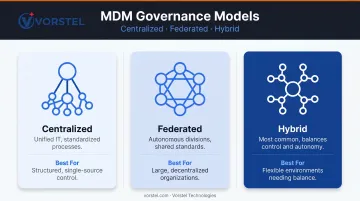
Organizations must also choose a governance structure:
- Centralized: One team controls all domains — best where IT is unified and processes are standardized across business units.
- Federated: Each business unit governs its own domains under shared standards — suited for large enterprises with autonomous divisions.
- Hybrid: Central standards with distributed execution — the most common model for mid-to-large organizations balancing control with operational autonomy.
Step 3: Assess Current Data Quality and Set Standards
Start with an audit of what exists. Data profiling across systems surfaces:
- Duplicate records (exact and near-match)
- Missing required attributes
- Inconsistent formats (date formats, country codes, naming conventions)
- Stale or outdated records
From the audit, establish measurable quality thresholds for each domain across four dimensions: accuracy, completeness, consistency, and timeliness. These thresholds trigger remediation workflows rather than serving as aspirational goals.
Ongoing quality maintenance must be built into the strategy from day one:
- Automated deduplication using fuzzy and exact matching logic
- Enrichment from internal and third-party data sources
- Validation rules that reject non-conforming records before they enter production systems
- Scheduled quality audits tied to governance review cycles
Step 4: Choose the Right MDM Architecture and Technology
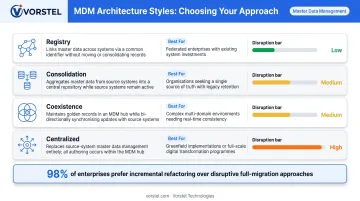
Four implementation styles exist, each with distinct trade-offs:
| Style | How It Works | Best For |
|---|---|---|
| Registry | Virtual golden record; source systems unchanged | Low disruption, read-heavy use cases |
| Consolidation | Data extracted and cleansed into a central hub | Analytics and reporting consolidation |
| Coexistence | Bidirectional sync between hub and source systems | Organizations needing gradual migration |
| Centralized | Hub is the single system of record | Digital transformation, cloud-first strategies |
Centralized delivers the strongest consistency but requires the most process change. Registry is lighter to deploy but slower for integrated queries. Informatica reports that among 300+ MDM customers, 98% prefer incremental refactoring over total system rebuilds, which makes coexistence or consolidation the most practical entry points for most enterprises.
Technology selection must align with the existing systems landscape. Organizations running SAP ecosystems need MDM solutions that integrate natively, and SAP MDG (Master Data Governance) is the purpose-built option for that environment.
Vorstel Technologies, with 200+ SAP project implementations, implements SAP MDG to deliver enterprise-wide data consistency, accuracy, and compliance within SAP-centric environments. This reduces the integration complexity and timeline risk that comes with mismatched tooling.
Step 5: Integrate Across Systems and Build for Continuous Improvement
Integration is where MDM strategies most frequently stall. A Salesforce/MuleSoft 2024 survey of 1,050 IT leaders found that 95% say integration issues impede AI adoption, and only 28% of applications within organizations are actually connected.
The MDM strategy must specify how master data flows between systems:
- Batch ETL: Appropriate for non-time-sensitive synchronization; lower infrastructure cost
- Real-time change data capture (CDC): Enables near-instant propagation of record updates across systems; critical for customer-facing operations
- API-based integration: Flexible and scalable; well-suited for cloud-native and hybrid environments
Continuous improvement is not a phase — it's an ongoing operating model. Build it in from the start:
- Define KPIs for data quality per domain (completeness %, deduplication rate, steward resolution time)
- Schedule quarterly governance reviews
- Create feedback loops between business stewards and technical teams
- Plan explicitly for strategy updates as the organization grows, acquires systems, or faces new regulatory requirements
Core Components Every MDM Strategy Must Include
A well-structured MDM strategy is only as strong as its foundational components. Each element below must be explicitly scoped—not assumed—during planning:
- Data governance: Defines data ownership, applicable standards, and compliance enforcement. Mature governance programs consistently outperform peers in audit readiness and data reliability.
- Data quality management: Quality must be measurable and monitored continuously—specify dimensions, measurement frequency, and the thresholds that trigger remediation.
- Security and access control: Role-based controls determine who can view, modify, and approve master data. Audit logs must satisfy regulatory requirements across regulated industries.
- Scalability: Address how the architecture handles record volume growth, new domain additions, geographic expansion, and mergers. Cloud-native and hybrid deployment models both factor into this planning.
- AI-readiness and DataOps alignment: As AI and ML programs scale, training data quality becomes a direct risk factor.
Informatica's 2024 research found that 42% of data leaders cited data quality as the main obstacle to generative AI adoption. The MDM strategy must define how data lineage is maintained, how bias in training data is identified, and how governance processes stay agile enough to support fast-moving AI initiatives.
Common MDM Strategy Challenges and How to Avoid Them
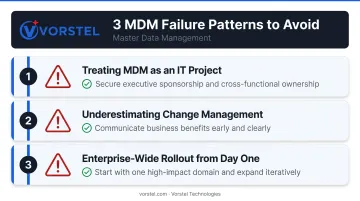
Three patterns appear consistently in failed MDM initiatives:
Treating MDM as a pure IT project: Without executive sponsorship and cross-functional ownership, MDM programs get scoped as infrastructure upgrades. McKinsey found that only 16% of MDM programs are funded as organization-wide strategic initiatives—which explains why so many underdeliver.
Underestimating change management: Data stewardship requires employees to adopt new entry standards and quality responsibilities. Without clear communication of the business benefits, resistance is the default response.
Attempting enterprise-wide rollout from day one: Start with one or two high-impact domains—typically customer or product master data—and expand iteratively. The complexity and organizational disruption of a simultaneous enterprise rollout is one of the most common causes of project failure.
The most persistent structural challenge is inconsistent data definitions across business units. The fix is simple in concept but routinely skipped: document agreed-upon definitions for each master data entity before deploying any tools, then enforce them through governance policy rather than relying on manual policing.
MDM is not a project with a finish line. Organizations that treat go-live as the endpoint typically see data quality deteriorate within months.
Sustained success requires ongoing commitment across three areas:
- Active stewardship — dedicated owners who monitor and enforce data standards
- Regular audits — scheduled reviews that catch quality drift before it compounds
- Accountability culture — team-level ownership of data quality, not just an IT responsibility
Frequently Asked Questions
What does MDM mean in business?
MDM (Master Data Management) refers to the processes, governance policies, and technologies used to maintain a single, accurate, and consistent version of core business entities—such as customers, products, and suppliers—across all enterprise systems. This shared data foundation supports reliable reporting, compliance, and strategic decision-making.
What are the 7 building blocks of MDM?
The commonly cited building blocks are:
- Data governance
- Data quality
- Data integration
- Data stewardship
- Data security
- Technology infrastructure
- Continuous improvement
Some frameworks add AI-readiness and scalability as additional pillars, depending on organizational maturity.
What is the difference between data governance and master data management?
Data governance is a component within the broader MDM strategy: it defines the policies, roles, and accountability structures for how data is managed. MDM encompasses the full operational system, including technology, integration, quality processes, and stewardship workflows.
How long does it take to implement an MDM strategy?
Timelines vary widely. Vendor benchmarks suggest phased pilots for a single high-value domain can deliver measurable results in 60–90 days, while full enterprise MDM modernization typically spans one to three years. Starting with one domain reduces both timeline and organizational disruption significantly.
What types of organizations benefit most from an MDM strategy?
Any organization running multiple systems with overlapping data (ERP, CRM, e-commerce, supply chain) benefits substantially. Manufacturing, retail, financial services, and healthcare see the most direct impact, since data consistency in those sectors directly affects operations, regulatory compliance, and customer experience.