Data Governance (DG) and Master Data Management (MDM) are both cited as the fix — but they address fundamentally different problems. Conflating them, or implementing only one, leaves the underlying issue intact. According to research by Precisely and Drexel LeBow, 71% of organizations now have a data governance program — up from 60% in 2023 — yet data quality and governance remain the top obstacles to AI readiness. Programs are being created, but they're not delivering.
This article breaks down what DG and MDM each do, where they differ, and how to sequence them based on your organization's actual pain points.
Key Takeaways
- Data Governance sets the policies governing how all organizational data is created, used, and protected
- MDM creates a single, accurate "golden record" for critical business entities — customers, products, and suppliers
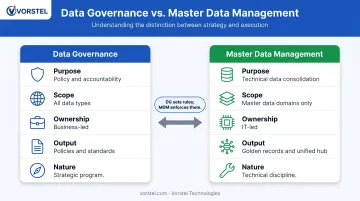
- DG sets the rules; MDM enforces them — specifically for master data
- Neither program reaches its potential without the other
- Your starting point depends on whether your primary pain is compliance gaps (start with DG) or data inconsistency across systems (start with MDM)
Data Governance vs. MDM: Quick Comparison
| Dimension | Data Governance | Master Data Management |
|---|---|---|
| Purpose | Policy, accountability, and framework for all data | Technical consolidation of critical master data entities |
| Scope | All data types: transactional, metadata, reference, master | Master data domains only: customer, product, supplier, location |
| Ownership | Business-led: data stewards, governance councils, C-suite | IT-led: data engineers, architects, integration specialists |
| Primary Output | Policies, quality standards, compliance frameworks, business glossary | Golden records, unified master data hub, consistent cross-system entities |
| Nature | Strategic program | Technical discipline |
These are not alternatives — DG provides the governance rules that MDM enforces. Organizations that treat them as either/or tend to build programs that either stall in committee or lose consistency the moment a new system comes online.
What Is Data Governance?
Gartner defines data governance as "the specification of decision rights and an accountability framework" to ensure appropriate behavior in the valuation, creation, consumption, and control of data and analytics. Note what that definition doesn't include: technology. Data governance is a business program first.
Core Pillars of a DG Program
A mature data governance framework typically covers:
- Data quality standards — agreed definitions of what "good data" looks like for each domain
- Data stewardship — named ownership of data assets, with accountability for quality
- Regulatory compliance — mapping to GDPR, HIPAA, CCPA, or sector-specific requirements
- Metadata management — tracking data lineage, definitions, and classifications
- Business glossary — a shared vocabulary so "customer" means the same thing in finance, sales, and operations
What Happens Without It
When governance policies don't exist upstream of your ERP or CRM, the symptoms are predictable: SAP and Salesforce produce conflicting outputs because no one agreed on definitions to begin with. Finance reports revenue one way; sales reports it another. Neither is wrong by their own logic — but there's no common standard to resolve the conflict.
What governance does not do: it won't cleanse your data, deduplicate records, or physically integrate disparate source systems. Governance creates the policy environment; MDM does the technical work.
Where DG Is the Right Starting Point
Data governance is typically the essential first move for:
- Finance, healthcare, and manufacturing teams facing audit and reporting obligations — DG creates the accountability trail compliance teams need
- Organizations running mergers, cloud migrations, or AI readiness programs — without governance policies in place, each new data source becomes a new silo
What Is Master Data Management?
MDM is a business discipline where IT and business teams collaborate to ensure enterprise master data is accurate, consistent, and accountable. The practical output is a golden record — as IBM describes it, a single trusted source that integrates data from multiple systems so every team works from the same information.
Core Master Data Domains
Master data is state-driven, slowly changing, and shared across multiple systems. The primary domains are:
- Customer — the foundation of Customer 360 initiatives
- Product — specifications, pricing, classifications across ERP and PIM systems
- Supplier — vendor records, payment terms, approved supplier lists
- Location — site hierarchies, delivery addresses, tax jurisdictions
- Employee — organizational structures, HR data shared across systems
- Financial hierarchies — cost centers, profit centers, GL account structures
Key MDM Capabilities
A functioning MDM program delivers:
- Data integration across disparate sources: ERP, CRM, and supply chain platforms
- Deduplication and survivorship rules that define which record "wins" when conflicts arise
- Data enrichment by supplementing internal records with validated external data
- Hierarchy management to maintain parent-child relationships across business entities
- Audit and version control — tracking who changed what, and when
Without these capabilities, problems like duplicate customer records, misrouted invoices, and inconsistent product catalogs persist regardless of how many governance policies exist on paper. Experian's research found that organizations estimate approximately one-third of their customer and prospect data is inaccurate — and only 51% of businesses believe their CRM data is clean enough to generate reliable insights.
Where MDM Delivers Direct Business Value
Retail and e-commerce: Fragmented customer records across online platforms, physical stores, and customer service systems directly cause personalization gaps and revenue leakage. MDM consolidates those records into a Customer 360 view that makes cross-channel personalization possible.
Manufacturing and supply chain: Product and materials master data inconsistencies across SAP ERP systems create downstream failures: incorrect specifications reach suppliers, pricing discrepancies appear on invoices, and procurement decisions rely on stale data. In practice, master data integrity is almost always a prerequisite before ERP optimization efforts deliver sustainable results — a pattern Vorstel Technologies encounters consistently across its 200+ SAP project engagements.
Data Governance vs. MDM: What Should You Prioritize?
Most organizations eventually ask this question, and there's no universal answer. The real decision isn't which to choose — it's which to sequence first.
The Co-Dependency Problem
You cannot fully succeed with one without the other:
- DG without MDM produces policies that are never technically enforced. Quality standards exist in a document; the actual data in your systems remains messy.
- MDM without DG produces technically clean data that drifts back into inconsistency. Without accountability structures and enforced standards, no one maintains what was built.
Gartner's forecast makes the stakes clear: by 2027, 60% of organizations will fail to realize anticipated AI value because of incohesive data governance frameworks. For enterprises investing in AI initiatives, a weak data foundation doesn't just slow results — it invalidates them.
Sequencing Decision Guide
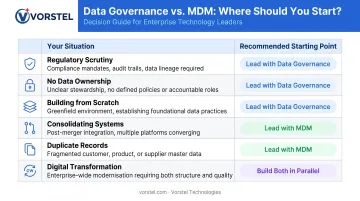
| Situation | Recommended Starting Point |
|---|---|
| Regulatory scrutiny, compliance gaps, or audit pressure | Lead with Data Governance |
| No clear data ownership or accountability structure | Lead with Data Governance |
| Building a data strategy from scratch | Lead with Data Governance |
| Consolidating systems or migrating to a new ERP | Lead with MDM |
| Duplicate records causing operational failures | Lead with MDM |
| Large-scale digital transformation with new platforms | Build both in parallel |
The Architecture Alignment Factor
For organizations running SAP, Microsoft, or Salesforce environments, aligning both programs to existing system architecture from the start often matters more than sequencing alone.
Bolting governance onto an MDM implementation mid-project, or scoping an MDM data model without governance input, creates rework that's expensive and disruptive. In SAP MDG implementations specifically, treating governance and master data design as parallel workstreams from day one avoids the retrofitting costs that derail timelines and budgets later.
How Data Governance and MDM Work Together in Practice
In practice, DG operates as the policy layer and MDM as the execution layer — each one depends on the other to deliver real business value.
The Operational Handoff
Governance defines what "good data" looks like — quality thresholds, acceptable values, field definitions, and ownership rules. MDM enforces those definitions through technical processes: matching, merging, survivorship, and enrichment. When MDM encounters a conflict it can't resolve automatically, that exception surfaces back into the governance process for a human decision.
A Practical Implementation Sequence
- Business stakeholders define governance principles — identify critical data entities, agree on definitions, assign data stewards, and document quality standards
- IT architects use those definitions to scope the MDM data model — domains, attributes, hierarchies, and integration touchpoints are designed against the governance spec
- MDM systems enforce governance rules operationally — matching and deduplication run against defined standards; enrichment fills gaps identified by quality rules
- Exceptions surface back to governance — unresolvable conflicts, new entity types, or definition gaps trigger governance review and policy updates
The Compounding Business Value
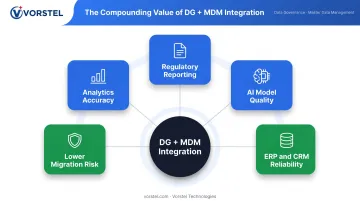
Organizations that integrate DG and MDM see improvements across multiple outcomes simultaneously:
- Analytics accuracy improves — reports draw from governed, deduplicated data rather than conflicting source records
- Regulatory reporting speeds up with documented data lineage and clear ownership chains
- AI model quality increases when training data is clean and consistently defined across domains
- ERP and CRM outputs stay reliable because master data is consistent across systems
- System migrations carry lower risk when master data is governed before cutover
McKinsey's 2024 analysis found that 83% of organizations consider client and product data the most critical master data domains — precisely the domains where DG and MDM integration delivers the most visible business impact.
For organizations ready to evaluate where their DG or MDM program stands, Vorstel's Zero-Fee Solution Evaluation offers a practical starting point: an expert-led assessment covering data strategy, system architecture, and implementation priorities — with clear recommendations before any engagement begins.
Frequently Asked Questions
Is data governance part of master data management?
No. Data governance is the broader strategic framework that covers all data types and policies across an organization. MDM is a specific technical discipline that operates within governance — guided by its rules but focused exclusively on master data entities.
What is the main difference between data governance and MDM?
DG is a business-led, policy-driven program covering all organizational data. MDM is a technically-led program focused specifically on managing master data domains to produce consistent golden records across systems.
Which should you implement first — data governance or MDM?
Neither definitively comes first. If your primary pain is compliance or missing data ownership, start with DG; if it's duplicate records and system inconsistency, start with MDM. Both programs ultimately need to be built in tandem to sustain results.
Can MDM work without data governance?
Technically yes, but it underperforms over time. Without governance policies and accountable data stewards, master data drifts back into inconsistency. MDM creates clean data; governance keeps it clean.
What types of data does MDM manage?
The core master data domains: customers, products, suppliers, locations, employees, and financial hierarchies. These are slowly changing, widely shared across systems, and critical to business operations.
How does data governance support AI and analytics initiatives?
Governance ensures that data used for analytics and AI training is accurate, consistently defined, and compliant — and MDM provides the clean, unified foundation that makes AI models and BI dashboards reliable. Gartner estimates 60% of organizations will fail to realize AI value by 2027 due to weak governance frameworks.
Getting the Sequencing Right
The choice between DG and MDM isn't binary — it's about understanding which program unblocks the other given where your organization stands today. Compliance obligations, system architecture, and data maturity all shape the right starting point.
Organizations that build both programs in alignment — rather than treating them as sequential phases or separate initiatives — consistently see stronger outcomes. The compounding value shows up when:
- Governance policies are actively enforced, not just documented
- MDM's golden records reflect standards the business has genuinely agreed on
- Reporting and AI initiatives draw from a single, trusted data layer
This alignment doesn't happen automatically. It requires deliberate coordination between the teams, tools, and platforms involved.
For organizations navigating this within SAP, Salesforce, or Microsoft environments, the architecture conversation typically surfaces the real constraints — which system owns the master record, where governance rules get enforced, and how data flows across platforms.