Yet despite this urgency, RISE with SAP migration remains widely misunderstood. Many organizations treat it as a technical upgrade — a lift-and-shift to a newer platform. It isn't. It's a full transformation covering infrastructure ownership, process architecture, integration patterns, and how your teams operate day-to-day.
This guide covers what RISE with SAP migration actually is, why the 2027 deadline has teeth, how to choose between the three migration paths, and what technical decisions separate successful projects from expensive rollbacks.
Key Takeaways
- RISE with SAP bundles S/4HANA Cloud Private Edition, SAP BTP, Signavio, and cloud infrastructure under a single SAP-managed contract
- Three migration paths — Brownfield, Greenfield, and Bluefield — suit different goals and system conditions; picking the wrong one wastes months
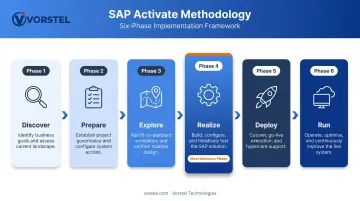
- SAP Activate structures migrations across six phases: Discover, Prepare, Explore, Realize, Deploy, and Run
- Resolve custom code, data quality, network specs, and integration architecture before the Realize phase begins
- Starting 12–18 months before go-live gives teams the runway to avoid compressing testing cycles
What Is SAP RISE Migration?
RISE with SAP, introduced by SAP in 2021 as "Business Transformation as a Service," is a subscription bundle that packages:
- SAP S/4HANA Cloud Private Edition — the core ERP
- SAP Business Technology Platform (BTP) — for extensions, integrations, and custom applications
- SAP Signavio — for process intelligence and mining
- SAP Business Network tools — for supplier and partner connectivity
- Cloud infrastructure — managed by SAP or hyperscalers (AWS, Azure, or Google Cloud)
All of this sits under a single contract and SLA — one agreement covering infrastructure, platform, and ERP.
What "RISE Migration" Specifically Means
RISE migration is the act of moving an existing SAP ECC or on-premise S/4HANA environment into the RISE with SAP Private Cloud Edition. Depending on the approach chosen, this happens via system conversion, new implementation, or selective data transition.
This is distinct from a standard ECC-to-S/4HANA upgrade. A standard upgrade is a technical project — RISE migration does that and transfers infrastructure management responsibility to SAP, enforces a clean core architecture, and changes how every future integration and extension gets built.
SAP also distinguishes between RISE and GROW with SAP: RISE serves existing SAP customers migrating to Private Edition, while GROW targets net-new customers adopting the Public Edition. If your organization is already on ECC, RISE is the relevant path.
Why Organizations Are Migrating to RISE with SAP Before 2027
The Hard Deadline
SAP's official maintenance timeline confirms mainstream support for ECC ends December 31, 2027. Extended maintenance runs through 2030, but carries a two-percentage-point premium on the maintenance basis.
SAP has introduced a 2031–2033 transition option, but the conditions are restrictive:
- Requires moving to SAP ERP Private Edition on HANA by December 31, 2030
- Carries a 20% pricing uplift unless contracts are signed by end of 2025
- Available only to the largest, most complex customers
For most organizations, the practical deadline remains 2027.
Migration progress is slower than the calendar suggests. SAPinsider's 2025 benchmark report found only 32% of respondents had fully transitioned to S/4HANA — up 10 points from 2024, but still leaving a large share of the installed base with limited runway.
What RISE Actually Delivers Over ECC
Moving to RISE isn't just about avoiding end-of-support risk. The platform differences translate directly into operational and financial outcomes:
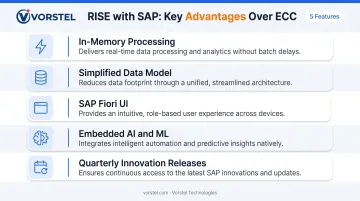
- In-memory processing via SAP HANA eliminates batch reporting delays and enables real-time analytics
- A simplified data model with no indexes, aggregates, or redundant tables reduces both storage and query complexity
- SAP Fiori replaces the legacy SAP GUI across all business processes with a modern, role-based interface
- Embedded AI and ML via BTP enables intelligent automation across procurement, finance, and supply chain
- Quarterly innovation releases are applied automatically in the cloud model — no manual upgrade projects
A 2025 Forrester TEI study for SAP Cloud ERP Private on AWS reported 45% ROI, $6.1M in savings from phasing out on-premises data centers, and 53,000 recovered user hours per year for the composite organization.
Those savings reflect a broader operational shift. When IT teams stop managing hardware, OS patching, and database administration, that capacity moves toward process improvement and innovation instead.
The Three SAP RISE Migration Paths
Choosing the right path is one of the most consequential decisions in the project. It determines timeline, budget, how much of your existing system carries forward, and what technical risk looks like at go-live.
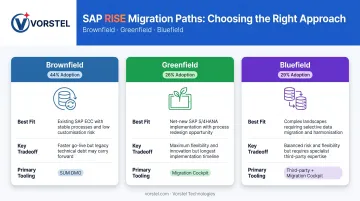
ASUG's 2025 research shows 44% of migrating organizations choose Brownfield, 29% choose selective data transition, and 26% go Greenfield.
Brownfield Migration (System Conversion)
Brownfield converts the existing ECC system to run within RISE Private Cloud Edition. Configurations, historical transactional data, and custom code all carry forward — with the primary tool being SAP Software Update Manager (SUM) with the Database Migration Option, specifically the DMOVE2S4 variant for cloud migrations.
Best for: Organizations with a well-maintained ECC system that closely aligns with their future operating model and want minimal process disruption.
Technical requirements to verify upfront:
- Network bandwidth above 400 Mbps
- Latency below 20 ms to the RISE target environment
- If these can't be met, the DMO with System Move variant applies instead
SAP provisions the RISE target environment; the migration partner manages the backup, restore, and SUM-based conversion using a dedicated Migration Server — a Linux VM that SAP provides instead of granting direct OS-level access to the production environment.
The tradeoff: Brownfield is the fastest path to go-live, but carries forward every piece of technical debt in the source system.
Greenfield Migration (New Implementation)
Greenfield deploys a fresh S/4HANA system in RISE and migrates only validated master and transactional data from the legacy environment. Everything else starts clean.
Best for: Organizations with heavily customized ECC systems misaligned with standard processes, or those using migration as an opportunity for full business transformation.
Key considerations:
- Requires significant investment in business process redesign
- Change management demands are higher than Brownfield
- Result is a cleaner system with less ongoing maintenance complexity
The longer timeline and higher upfront investment are real — but so is the payoff: organizations that go Greenfield typically emerge with fewer customizations to maintain and a system that fits their target operating model from day one.
Bluefield Migration (Selective Data Transition)
Bluefield (officially called Selective Data Transition) deploys a new S/4HANA shell in RISE and selectively migrates specific company codes, business units, or datasets from the source system.
Best for:
- Organizations with multiple ECC instances
- Companies going through mergers or acquisitions
- Situations where standardizing processes matters but specific historical records must be preserved
This approach typically requires third-party tooling alongside SAP's Migration Cockpit to handle selective extraction and transformation.
Selecting the right path depends on system complexity, data volume, and how much process change the business can absorb. Vorstel Technologies has guided this decision across 200+ SAP engagements — conducting readiness assessments that map migration path to actual technical constraints and business objectives, not just default recommendations.
How RISE Migration Works: The SAP Activate Phases
SAP Activate is the standard methodology for all S/4HANA and RISE projects. It provides six phases with defined entry and exit criteria, templates, and best practices.
Discover Phase
The Discover phase is where organizations understand what they're working with. The SAP Readiness Check analyzes:
- Custom code compatibility
- Simplification items affected
- Data volume profile
- Business process coverage gaps
Signavio process mining can run alongside this to surface current-state inefficiencies. The output is a business case and a high-level migration strategy recommendation. Skipping this phase, or rushing through it, is one of the most reliable ways to encounter expensive surprises in Realize.
Prepare Phase
Prepare covers project governance, team formation, system scoping, and infrastructure planning — including verifying bandwidth and latency requirements for DMOVE2S4. SID planning and RISE environment provisioning timelines get confirmed here.
Explore Phase
Explore runs fit-to-standard workshops that map business requirements against S/4HANA standard capabilities, identify gaps, and produce a custom code adaptation plan. The goal is committing to a clean core approach and minimizing the volume of customizations carried into Realize.
Realize Phase
This is where the system gets built. Key activities:
- Custom code remediation — ABAP Test Cockpit and Custom Code Migration App identify incompatible objects; code is categorized as adapt, retire, or redevelop as a BTP extension
- Data migration — Migration Cockpit for Greenfield; SUM DMO for Brownfield
- Integration development — SAP Integration Suite and BTP services replace point-to-point ECC connections
- Testing cycles — functional, performance, and security testing run in multiple iterations
Custom code analysis discovered during Realize — rather than in Discover or Explore — is a leading cause of budget overruns. Front-loading that analysis is what keeps costs predictable.
Deploy and Run Phases
Deploy covers cutover planning, go-live rehearsals, user training, and the production cutover itself. A defined rollback plan must exist before cutover begins.
Run transitions into steady-state operations. SAP applies quarterly updates automatically in the cloud model, while SAP Cloud ALM handles performance monitoring. From here, the organization's focus shifts to continuous innovation adoption on BTP — an operating model fundamentally different from the traditional ECC upgrade cycle.
Key Technical Considerations
Custom Code Analysis
Most ECC systems carry custom ABAP code built on data structures or technologies that don't exist in S/4HANA. Running the ABAP Test Cockpit and Custom Code Migration App early produces three categories:
- Adapt — still needed, compatible with remediation
- Retire — obsolete, safe to decommission
- Redevelop — needed functionality, but must live outside the clean core as a BTP extension
Complete this analysis before the Realize phase. Incompatible objects discovered during build drive costly rework — discovered after go-live, they can derail production operations entirely.
Data Quality and Migration Strategy
Data preparation depends on the migration path chosen:
- Brownfield (SUM DMO): All data migrates in-place — bad data migrates too
- Greenfield (Migration Cockpit): Only clean, validated data should move
Before Realize, classify data as:
- Hot — active and business-critical, migrates fully
- Warm — historical or reporting use, migrates selectively
- Cold — archival, consider leaving in a data store or archiving before migration
Deduplication, standardization, and validation must happen before migration begins. KPMG recommends archiving legacy ERP data before migration to reduce volume and cost.
Infrastructure and Network Requirements
In RISE, SAP or a hyperscaler manages servers, OS, databases, and backups. That still leaves the partner and customer team responsible for connectivity and performance planning:
- Secure connectivity (VPN tunnels or private cloud interconnects) between on-premise systems and the RISE environment
- Network verification for DMOVE2S4 migrations: >400 Mbps bandwidth, <20 ms latency
- If thresholds can't be met, the System Move variant applies
Integration and Clean Core Architecture
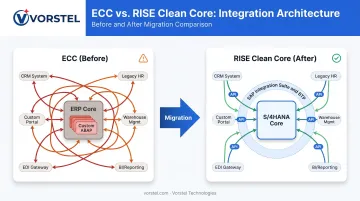
ECC integrations built directly into the core must move out. Clean core requires all custom logic and third-party integrations to be externalized — using SAP Integration Suite, BTP Build Apps, or the Cloud Application Programming (CAP) model.
This is an architectural shift, not just a technical one. Before go-live, every point-to-point connection needs to be:
- Mapped and inventoried across the integration landscape
- Assessed for clean core compatibility
- Rearchitected or externalized as needed
The long-term benefit: quarterly SAP updates no longer trigger regression testing across a tangled custom layer.
Common Misconceptions in SAP RISE Migration
Several assumptions consistently derail RISE projects before they gain momentum. These three come up most often — and cause the most damage.
"RISE migration is just a technical upgrade" Organizations that treat it this way skip fit-to-standard workshops and process analysis, then go live with the same inefficiencies that plagued ECC — just on a newer platform. RISE changes operational models, infrastructure ownership, and integration architecture. It requires process rethinking, not just a platform move.
"Brownfield is always faster and cheaper" Brownfield carries forward all technical debt. Organizations with heavily customized or degraded ECC environments sometimes find remediation effort in Brownfield exceeds the build effort in a targeted Greenfield approach. The right path depends on a readiness assessment, not assumptions.
"Migration can start without a readiness check" SAPinsider's 2025 research identifies adapting custom code as one of the biggest migration challenges — and 62% of organizations cite high project cost as a primary barrier. Both problems get worse when the Readiness Check is skipped.
Starting without one typically means:
- Custom code conflicts surface mid-project, compressing test cycles
- Cost overruns that could have been scoped and budgeted upfront
- Go-live delays from issues that a 12–18 month runway would have resolved
Frequently Asked Questions
What is RISE migration in SAP?
RISE with SAP migration moves an existing SAP ECC or S/4HANA environment into SAP's "Business Transformation as a Service" offering. It bundles S/4HANA Cloud Private Edition, SAP BTP, Signavio, and managed cloud infrastructure under a single contract and SLA, replacing both the ERP system and the infrastructure management model at once.
What are the 5 R's of migration?
The 5 R's (Rehost, Replatform, Repurchase, Refactor, Retire) are general cloud migration strategies. In the SAP RISE context: Brownfield aligns with Replatform (same system, new infrastructure), Greenfield aligns with Refactor/Repurchase (new implementation), and Retire applies to decommissioning obsolete custom code identified during migration.
What is the difference between Brownfield and Greenfield RISE migration?
Brownfield converts the existing ECC system into RISE, preserving data, configurations, and custom code. Greenfield deploys a fresh S/4HANA instance and migrates only validated data. Brownfield is faster but carries technical debt forward; Greenfield is more disruptive upfront but delivers a cleaner, easier-to-maintain system.
Can you migrate directly from SAP ECC to RISE with SAP?
Yes — RISE with SAP supports direct ECC migration, provided the source system is Unicode-compliant. The Brownfield path using SUM DMO (DMOVE2S4) is the most common approach for direct ECC-to-RISE conversions.
What tools does SAP provide to support RISE migration?
Key tools include:
- SAP Readiness Check — landscape assessment
- SUM/DMOVE2S4 — technical conversion
- SAP Migration Cockpit — data migration for Greenfield
- ABAP Test Cockpit and Custom Code Migration App — code remediation
- SAP Signavio — process analysis
- SAP Cloud ALM — post-go-live monitoring
How long does a SAP RISE migration typically take?
SAP's 2024 Transformation Pocket Guide estimates Brownfield at 12–15 months and Greenfield at 15–21 months for a single wave. Timelines vary significantly by system complexity, data volume, and organizational readiness — starting the Readiness Check early and working with an experienced partner are the most reliable ways to stay on schedule.