Introduction
Over 90% of Fortune 500 companies run SAP — and yet many of them are still operating on legacy systems that were never designed for today's speed of business. With the worldwide ERP market hitting $66 billion in 2024, up 11.3% from the prior year, the pressure to modernize isn't theoretical. It's a board-level conversation happening right now.
But SAP digital transformation isn't simply an IT upgrade. It's a strategic and cultural shift in how an organization operates — affecting finance, supply chain, HR, procurement, and customer experience simultaneously. Organizations that treat it as a software swap consistently underestimate the scope. The ones that succeed approach it as a business-wide transformation — with technology as the enabler, not the goal.
This guide breaks down everything you need to know:
- What SAP digital transformation actually means
- The technologies that power it
- The four stages of the journey
- Core benefits and measurable outcomes
- Common pitfalls to avoid
- How to take the first step — whether you're starting fresh or picking up a stalled initiative
Key Takeaways
- SAP digital transformation integrates S/4HANA, BTP, AI, and cloud across all business operations — a strategic business shift, not a one-time IT project
- The journey follows four stages: Assessment, Design, Build & Test, and Go-Live & Continuous Improvement
- SAP ECC mainstream maintenance ends in 2027, making migration a time-sensitive decision
- Benefits include real-time decision-making, lower TCO, and better employee and customer experiences
- Most SAP transformations fail not from bad technology, but from poor change management and user adoption
What Is SAP Digital Transformation?
SAP digital transformation is the strategic process of integrating SAP's suite of intelligent enterprise technologies (ERP, cloud platforms, AI, and analytics) across all business operations to modernize processes, unify data, and enable real-time decision-making.
That definition matters because the word "transformation" gets overused. SAP itself draws a useful distinction between three related concepts:
- Digitization — converting analog information into digital formats (scanning paper records, for example)
- Digitalization — applying SAP tools to existing processes to improve how they work
- Digital transformation — fundamentally rethinking business models and customer experiences using the full SAP ecosystem
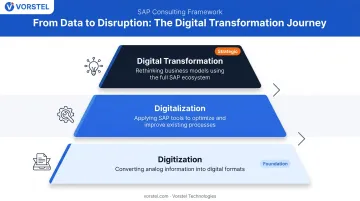
True transformation sits at the third level. The goal isn't to replicate existing processes in a new system — it's to question whether those processes should exist at all.
The Digital Core Concept
At the center of SAP's transformation architecture is SAP S/4HANA , what SAP calls the "digital core" of the intelligent enterprise. Rather than running separate systems for finance, logistics, procurement, and HR, S/4HANA connects front-end and back-end operations in a single platform built on the in-memory SAP HANA database.
Fragmented legacy systems create data silos. Decisions get made on stale exports from last Tuesday's report. S/4HANA replaces that with a single source of truth, updated in real time.
Why SAP Specifically?
SAP's integrated suite covers finance, procurement, supply chain, HR, and customer experience. That breadth is what makes it capable of driving enterprise-wide transformation, rather than solving one department's problem while leaving others behind.
Independent analysts back this up:
- Gartner named SAP among the leading ERP providers in 2024
- The IDC MarketScape placed SAP in the Leaders category for worldwide SaaS and cloud-enabled ERP applications
Cloud migration increasingly runs through RISE with SAP. This managed, subscription-based offering bundles cloud ERP, infrastructure, and support services under a single contract, removing the need to negotiate each component separately.
Key SAP Technologies Enabling Digital Transformation
Understanding what's in the SAP ecosystem helps set realistic expectations about scope, cost, and sequencing.
SAP S/4HANA
SAP's next-generation ERP is built on the in-memory HANA database, which means it processes large volumes of transactional and analytical data simultaneously — no overnight batch runs required. Key characteristics:
- Combines transactions and analytics in one system
- Delivers a modern user experience through SAP Fiori, available out of the box in S/4HANA Cloud
- Replaces SAP ECC, which faces end of mainstream maintenance at the end of 2027 (with optional extended maintenance available until 2030 at a 2% premium)
- SAP has committed to an innovation roadmap for S/4HANA through at least 2040
The implementation path decision — greenfield (clean slate, new implementation) or brownfield (technical conversion of existing ECC) — is one of the most consequential early choices. Greenfield enables process redesign but requires more effort. Brownfield moves faster but carries legacy complexity forward. A hybrid "selective data transition" approach is also increasingly common.
SAP Business Technology Platform (BTP)
BTP is the integration and innovation layer of the SAP ecosystem, supporting five capability areas: application development, automation, integration, data and analytics, and AI. In practice, BTP allows organizations to:
- Extend core SAP functionality without modifying the base system
- Build custom applications that connect to SAP and non-SAP systems
- Automate processes and surface analytics across the landscape
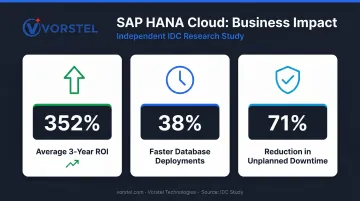
An IDC study on SAP HANA Cloud — part of the broader BTP data platform — reported a 352% average three-year ROI, 38% faster database deployments, and 71% reduction in unplanned downtime for organizations using the platform.
Vorstel Technologies maintains an active SAP BTP practice, helping clients integrate, extend, and build intelligent applications across their SAP landscape.
SAP SuccessFactors and SAP Ariba
While BTP connects the technical layer, these solutions extend transformation into specific business functions:
- SuccessFactors digitalizes HR and workforce management — from recruiting to performance to payroll
- SAP Ariba modernizes procurement, sourcing, and supplier collaboration through cloud-based tools
- SAP Concur handles travel and expense management
Vorstel's dedicated procurement practice delivers SAP Ariba implementations, typically in a 3–5 month engagement window.
Cloud, AI, and IoT
Embedded AI and machine learning within S/4HANA and BTP detect demand shifts, flag financial anomalies, and automate repetitive tasks — reducing manual overhead across supply chain, finance, and HR.
SAP's cloud infrastructure covers two primary paths: RISE with SAP for migration-led transformations and GROW with SAP for cloud-native deployments. Both support global scale and real-time IoT data processing for connected supply chains.
The 4 Stages of SAP Digital Transformation
SAP's official methodology, SAP Activate, structures implementations across six phases. For practical planning purposes, these map cleanly to four stages that reflect how most organizations actually experience the journey.
Stage 1: Assessment and Preparation
This is the discovery phase — where most transformations are won or lost before they start.
Key activities include:
- Auditing existing IT systems and data quality
- Identifying business pain points and quantifying their cost
- Defining transformation goals and realistic KPIs
- Building the business case for executive alignment
- Choosing deployment model: cloud, on-premise, or hybrid
- Deciding between greenfield, brownfield, or hybrid migration approach
A SWOT analysis here surfaces the organizational risks that derail projects later if ignored — skill gaps, budget constraints, competing priorities. Executive sponsorship isn't optional at this stage.
Stage 2: Design and Planning
Strategy becomes blueprint. This stage translates transformation goals into a detailed project plan covering:
- Process redesign (what will actually change, not just what system will change)
- Technical architecture and integration design
- Data migration approach and data quality remediation
- Compliance and security frameworks
- Testing strategy and acceptance criteria
The critical mistake at this stage is treating it as an IT exercise. Finance, operations, HR, and supply chain stakeholders all need to be in the room.
Designs built in isolation routinely fail to reflect how work actually gets done. Fixing that during build costs far more than preventing it during design.
Stage 3: Build, Configure, and Test
The system gets built per the approved blueprint: infrastructure changes, configurations, and integrations. Testing then begins in layers:
- Unit testing — individual components work as expected
- Integration testing — components work together correctly
- User acceptance testing (UAT) — real users validate real scenarios
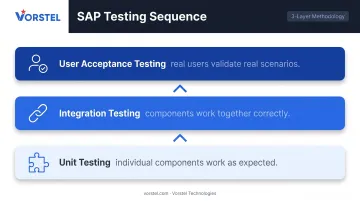
This stage almost always reveals gaps. That's the point of testing. What matters is having a scope adjustment process that doesn't balloon timelines or costs — organizations that skip thorough testing to accelerate go-live consistently pay for it in a chaotic hypercare period.
Stage 4: Go-Live, Adoption, and Continuous Improvement
That hypercare period is itself Stage 4's opening act. Go-live is a milestone, and this stage covers everything that follows:
- Data migration to production
- End-user training and enablement
- Performance monitoring against established KPIs
- Hypercare support in the weeks immediately following launch
- Ongoing optimization and periodic upgrades
Sustained value comes from treating transformation as a continuous process, not a project with a close date. Systems need tuning as business conditions change, and new SAP capabilities — especially in AI and automation — continue to emerge.
Each of these four stages carries distinct risks and decision points. Vorstel Technologies works across all of them — whether that means starting from assessment with a clean slate or stepping into a stalled build-phase project. With 200+ SAP project engagements, the ramp-up time before delivering real outcomes is minimal.
Key Benefits of SAP Digital Transformation
Operational Efficiency and Cost Reduction
Process automation, real-time data access, and consolidating legacy systems directly reduce manual effort and IT maintenance costs. A Forrester Total Economic Impact study — commissioned by SAP — reported a 30% five-year TCO reduction versus traditional on-premises solutions for RISE with SAP organizations, along with 102% ROI over three years.
These are SAP-commissioned figures, so treat them as directional rather than universal benchmarks. The underlying logic is sound though: consolidate systems, cut integration overhead, and manual workarounds disappear.
Real-Time Decision-Making and Business Agility
Unified enterprise data combined with embedded analytics means leaders make decisions based on current conditions, not last week's exports. This matters most in industries where conditions shift fast — retail inventory, manufacturing demand, e-commerce fulfillment. Organizations that can act on live data consistently outpace those still waiting on batch reports.
Improved Customer and Employee Experience
SAP transformation affects both sides of the experience equation:
- Customers benefit from integrated CRM and commerce tools that enable personalized, cross-channel interactions
- Employees get role-based, mobile-accessible interfaces through SAP Fiori — reducing training time and removing friction from daily work
The Fiori UX is available out of the box in S/4HANA Cloud, which means this isn't a customization project — it's a deployment decision.
Common Challenges in SAP Digital Transformation
Legacy System Complexity and Custom Code Debt
Organizations that have run SAP ECC for a decade or more have typically accumulated significant custom code — modifications built to handle edge cases that standard SAP didn't support at the time. Before migrating to S/4HANA, every piece of that custom code needs to be assessed: keep it, adapt it, or retire it.
ASUG research identifies customizations within existing instances as a top migration challenge. The real risk is finding it late. A thorough custom code analysis belongs in Stage 1, not Stage 3.
Key action: Run a custom code impact assessment before finalizing your migration roadmap — not during the build phase.
Change Management and User Adoption
Most SAP transformations stall for organizational reasons, not technical ones. Resistance to new workflows, inadequate training, and poor communication about the purpose of change lead to low adoption — and a transformation that never delivers its intended value.
Non-negotiable success factors:
- Executive sponsorship that's visible and consistent, not just a memo
- Early stakeholder engagement before decisions are finalized
- Communication that explains the "why" for end users, not only the "what"
- Training that's role-specific, not a generic walkthrough of new screens
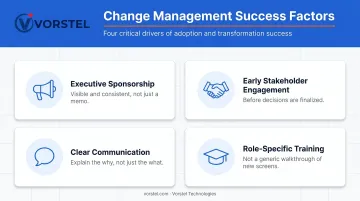
When change management is addressed early, teams can turn their focus to the project risk that derails even well-organized transformations: scope creep.
Scope Creep and Budget Risk
Misidentified requirements in Stage 1 expand into unplanned work in Stage 3. Every added requirement after the blueprint is approved adds cost and schedule risk. The pattern is predictable: unclear business case → scope ambiguity → stakeholder requests during build → timeline pressure → rushed go-live.
The fixes are straightforward: define KPIs early, use a proven methodology, and work with implementation partners experienced enough to flag scope risks before they become cost overruns.
How to Begin Your SAP Digital Transformation Journey
Starting doesn't require having everything figured out. It requires taking the right first steps.
A practical starting checklist:
- Audit current systems — what's running, what's customized, what's redundant
- Assess data quality — migration failures are often data failures in disguise
- Align leadership — define what success looks like before selecting technology
- Identify early wins — which processes, if transformed first, would deliver visible ROI quickly
- Select a partner — not just for technical delivery, but for strategic guidance through ambiguity
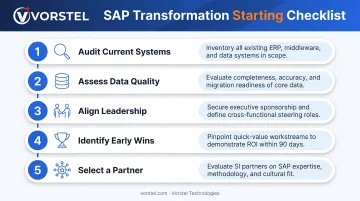
Transformation unfolds across multiple phases. Organizations need a clear starting point and a partner who can adapt as priorities shift — not a perfect roadmap before the first step is taken.
That kind of partner is what Vorstel Technologies is built to be. Their Zero-Fee Solution Evaluation is a no-cost expert consultation covering IT strategy, cloud solutions, automation, and SAP transformation priorities. With 200+ SAP project experiences and a global delivery model spanning India, Germany, Singapore, Finland, and Hungary, Vorstel works with enterprises that need both a clear strategy and fast execution, whether they're starting from scratch or accelerating a transformation already underway.
SAP itself keeps evolving. AI-driven automation and real-time process intelligence are already embedded in current releases, not waiting on a future roadmap. Organizations that build on a solid foundation now will be able to adopt these capabilities as standard practice, not as catch-up projects.
The decision to start — and to start well — shapes every phase that follows.
Frequently Asked Questions
What is digital transformation in SAP?
SAP digital transformation is the process of using SAP's suite of technologies — including S/4HANA, BTP, and cloud solutions — to modernize business operations, unify enterprise data, and enable intelligent, real-time decision-making. It requires both technology adoption and organizational change — not just a software upgrade.
What are the 4 stages of SAP digital transformation?
The four stages are Assessment & Preparation, Design & Planning, Build & Test, and Go-Live & Continuous Improvement. Each stage builds on the last, and organizations can engage an implementation partner at any point in the journey — including mid-project.
What are the pillars of SAP BTP?
SAP Business Technology Platform currently covers five capability areas: application development, automation, integration, data and analytics, and AI. Together, these allow businesses to extend SAP, connect non-SAP systems, and build intelligent applications across their entire landscape.
How long does SAP digital transformation typically take?
Timelines vary by scope, approach, and organization size. Focused S/4HANA deployments can go live in six months; large, complex global rollouts often take two years or more. Greenfield implementations generally require more time than brownfield conversions.
What is the difference between SAP ECC and SAP S/4HANA?
SAP ECC is the legacy ERP platform facing end of mainstream maintenance in 2027. SAP S/4HANA is the successor, built on the in-memory HANA database with real-time analytics, a simplified data model, and the modern Fiori UX. SAP has committed to S/4HANA's roadmap through at least 2040.