Many organizations underestimate what's ahead. SAPinsider's 2025 benchmark report found that 62% of SAP users cite high project costs as their primary barrier, and 55% flag project duration as a close second. With SAP ending mainstream maintenance for ECC at the end of 2027, the window to plan and execute properly is narrowing fast.
This guide walks through every phase of the migration — from choosing the right approach to post-go-live stabilization — with the detail needed to avoid the most common and costly mistakes.
Key Takeaways
- SAP ends mainstream ECC support in 2027; extended maintenance runs to 2030 at added cost
- Three migration paths exist: Greenfield (new build), Brownfield (system conversion), and Hybrid — each suited to different business needs
- Migration follows six structured phases — from readiness check through cutover — each with distinct technical requirements
- CVI conversion, custom code remediation, and data quality issues are the most common migration failure points
What Is SAP ECC to S/4HANA Migration?
SAP ECC (Enterprise Central Component) has been the backbone of enterprise operations since the mid-1990s. SAP S/4HANA is its successor: a simplified, in-memory ERP that runs exclusively on the SAP HANA database.
Migration isn't a file transfer. It's a platform transformation across four dimensions:
- Database layer — the legacy database (Oracle, IBM DB2, or SQL Server) is replaced by SAP HANA
- Data model — multiple FI/CO tables are consolidated into the Universal Journal (table ACDOCA), as confirmed by SAP Help documentation
- User interface — SAP GUI transactions transition to role-based SAP Fiori apps
- Analytics — batch reporting is replaced by embedded real-time analytics
Every migration also involves custom code adaptation, data cleansing, and post-migration validation. The scope depends on how the organization's ECC system has been configured and customized. Organizations typically choose one of three approaches:
- System Conversion — existing ECC system converted in-place to S/4HANA
- New Implementation — greenfield build with clean configuration
- Selective Data Transition — targeted data migration combining elements of both
Why Organizations Must Act Before SAP's 2027 ECC Support Deadline
The Support Timeline
SAP's official maintenance strategy sets clear milestones that every ECC customer needs to plan around:
| Phase | End Date | Notes |
|---|---|---|
| Mainstream maintenance | End of 2027 | Standard support, patches, regulatory updates |
| Extended maintenance | End of 2030 | Available at +2 percentage points on maintenance base |
| Customer-specific maintenance | After 2030 | Limited scope, no new support packages or legal changes |
| SAP S/4HANA commitment | At least 2040 | Full innovation roadmap |
Organizations that remain on ECC past 2027 without paying for extended maintenance will stop receiving security patches and legal/regulatory updates, creating real compliance and cybersecurity exposure. The paid extended maintenance option through 2030 costs more and provides narrowing coverage. It's a buffer, not a migration strategy.
The Business Case for Moving Now
Risk avoidance is only part of the story. The data on post-migration outcomes is compelling:
- 53% of organizations reported improved integrations with SAP and line-of-business tools after migrating, per SAPinsider research
- 53% reported enhanced system performance compared to their previous ERP environment
- IBM's 2024 S/4HANA migration delivered a 30% reduction in infrastructure-related operational costs, per CIO reporting
The longer an organization waits, the shorter its planning and execution runway. SAPinsider found 18% of respondents didn't expect to complete migration before 2027, and 7% had no deployment plans at all — numbers that translate directly into financial and operational exposure as the deadline approaches.
Choosing the Right Migration Strategy: Greenfield, Brownfield, or Hybrid
Selecting the wrong approach creates budget overruns, extended timelines, or excessive disruption. This decision deserves careful analysis before any technical work begins.
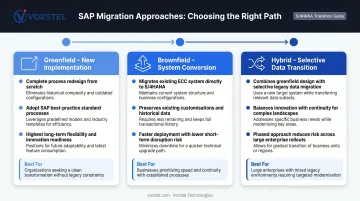
Greenfield (New Implementation)
A new S/4HANA system is built from scratch, configured to SAP best practices, and only the data you need is migrated from ECC. The existing system is not converted — it's replaced.
Best for: Organizations with heavily customized ECC environments, those undergoing significant process re-engineering, or those wanting to adopt standard SAP processes from the ground up.
Trade-off: Highest time and cost investment of the three approaches, but the cleanest result with minimal legacy technical debt carried forward.
Brownfield (System Conversion)
An in-place technical conversion of the existing ECC system to S/4HANA using SAP's Software Upgrade Manager (SUM). All existing configurations, customizations, and historical data carry over.
Best for: Organizations that need a faster path to S/4HANA with minimal disruption to current processes, and where ECC customization is manageable.
Key caveat: Custom code still requires analysis and remediation. S/4HANA simplifications — including the mandatory Business Partner merger of customer and vendor masters — must be addressed regardless of how much else carries over.
Hybrid / Selective Data Transition
A new S/4HANA system is implemented, but selective historical data and process components are carried over from ECC. SAP officially recognizes Selective Data Transition as a distinct alternative to both system conversion and new implementation.
Best for: Complex multi-entity landscapes, M&A scenarios, phased migration programs, or situations where only certain divisions are moving.
Trade-off: Maximum flexibility, but requires the most careful planning and coordination of the three.
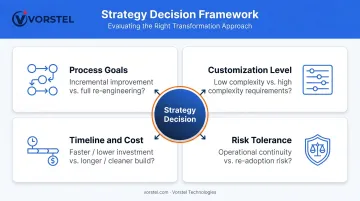
How to Choose
Evaluate these four factors before committing:
- Are you pursuing incremental improvement or full process re-engineering? Greenfield suits the latter.
- How heavily customized is your ECC environment? Greater customization shifts the case toward Greenfield or Hybrid.
- Brownfield is typically faster and lower cost; Greenfield takes longer but starts without legacy debt.
- System conversion carries operational continuity risk; new implementation carries re-adoption risk. Know which your organization can absorb.
Vorstel Technologies' SAP consulting team has delivered 200+ SAP projects across all three approaches. They work through this assessment with clients upfront — before migration begins — to avoid costly course corrections once work is underway.
Step-by-Step SAP ECC to S/4HANA Migration Process
Regardless of strategy, migrations follow a structured lifecycle. Skipping or compressing phases is the fastest route to a troubled go-live.
Step 1: Project Preparation and Readiness Check
Start with SAP's Readiness Check tool, which assesses the current ECC landscape across five areas:
- Unicode compliance status
- Simplification items required by S/4HANA
- Custom code requiring adaptation
- Add-on and business function compatibility
- Data volume management requirements
The output is a clear picture of technical debt and migration complexity, all before any financial or resource commitment is made. SAP strongly recommends running the Readiness Check before any conversion activity begins.
Step 2: Fit-Gap Analysis and Migration Planning
A Fit-Gap Analysis compares current ECC processes and configurations against S/4HANA's simplified model. Key outputs include:
- Confirmed migration strategy (Greenfield, Brownfield, or Hybrid)
- Scope of custom code remediation required
- List of business processes needing re-engineering
- Detailed project plan with timelines and resource requirements
This phase locks in the scope and surfaces risks before the technical work begins. Changes addressed here cost a fraction of what they cost during conversion.
Step 3: Data Classification, Cleansing, and Mapping
Data preparation is where migrations are won or lost. The process involves three activities:
Classification sorts data into three categories:
- Hot (actively needed for operations) → migrates to S/4HANA
- Warm (needed for reporting) → accessible but potentially archived
- Cold (archival only) → does not migrate
Cleansing corrects duplicate records, inconsistent formats, outdated master data, and undocumented Z-table content in the source system before migration begins.
Mapping aligns source ECC fields to target S/4HANA fields, accounting for structural changes like the Universal Journal consolidation. Poor mapping at this stage ripples into every downstream process.
Vorstel Technologies' SAP Master Data Governance expertise supports clients through data remediation at any stage, including mid-project rescues where data quality issues surface late.
Step 4: Technical Conversion and Custom Code Adaptation
For Brownfield: SAP's Software Upgrade Manager (SUM) handles the technical database migration from the legacy database to SAP HANA and the system conversion simultaneously. The Database Migration Option (DMO) within SUM specifically handles heterogeneous database migration, moving from Oracle or DB2 to HANA in a single operation.
For Greenfield/Hybrid: The new S/4HANA system is built and configured in parallel, with data loaded via migration tools rather than in-place conversion.
Custom code applies across all strategies. ABAP programs must be reviewed against S/4HANA's simplified data model and APIs. SAP's Custom Code Migration Guide and the Custom Code Migration Worklist, combined with ABAP Test Cockpit findings, prioritize which programs need remediation.
ASUG's 2024 research found 95% of organizations run custom code, with 55% identifying it as a direct barrier to upgrading. Early analysis is essential — not optional.
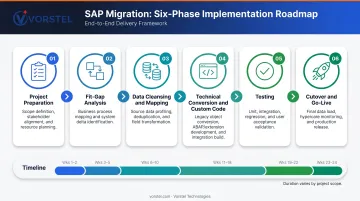
Step 5: Testing — Functional, Load, and User Acceptance
Three testing layers must all pass before cutover is approved:
- Functional Testing — Verifies that migrated data supports correct execution of business processes in S/4HANA
- Load/Performance Testing — Validates the system handles production data volumes and peak user concurrency
- User Acceptance Testing (UAT) — Business users verify data accuracy and process usability in the new environment
Dress rehearsal migration runs with production-like data volumes are essential before approving the final cutover. SAP's official conversion documentation confirms a dress rehearsal before production cutover as a prerequisite. Multiple rounds are standard practice — each run tightens the cutover window and surfaces issues that can't be found any other way.
Step 6: Cutover, Go-Live, and Post-Migration Stabilization
Cutover is the final migration window:
- Freeze the ECC system — no new transactions; cutover begins
- Execute the final productive data load in S/4HANA
- Validate against a pre-approved go-live checklist
- Open S/4HANA to users
A detailed cutover plan with sequenced task ownership and a defined rollback strategy for critical failures is essential. Post-go-live, a hypercare period begins immediately. This is when issues surface fastest and the team needs to be fully staffed and responsive.
Post-migration stabilization activities include:
- Continuous performance monitoring
- Applying SAP support packages on schedule
- Rolling back temporary migration user permissions
- Collecting user feedback for process optimization
Common Migration Challenges and How to Address Them
Business Partner (CVI) Conversion
S/4HANA replaces separate Customer and Vendor master records with a unified Business Partner model. This conversion — governed by the Customer/Vendor Integration (CVI) process — is consistently one of the most rework-intensive activities in any migration.
Common issues include duplicate records, missing Business Partner roles, and inconsistent data across customer and vendor masters. SAP's Business Partner Conversion documentation confirms that CVI must be in place before system conversion can proceed.
Fix: Validate CVI mapping logic in the source ECC system before the main migration begins. Issues caught early cost a fraction of what they cost post-go-live.
Data Quality and Legacy Data Gaps
Organizations routinely discover that ECC data contains duplicates, inconsistent formats, outdated records, and undocumented Z-table content — only when preparing for migration. Migrating that data into S/4HANA as-is means reporting errors, failed validations, and manual cleanup that stretches weeks post-go-live.
Fix: Run data profiling and cleansing in the source system before migration, not after. Vorstel's consultants can step into data remediation engagements at any stage of the migration journey, including mid-project situations where data quality issues surface late.
Custom Code and Integration Dependencies
55% of organizations say custom code is a barrier to upgrading, and 48% underestimated the remediation scope according to ASUG's research. Failing to run a comprehensive custom code impact analysis early leads to last-minute development work that delays go-live.
Fix: Run SAP's Custom Code Migration Worklist in the readiness phase. Prioritize remediation of business-critical custom programs in early project phases, well before technical conversion begins.
Change Management and User Training
Beyond the technical work, the shift from SAP GUI transactions to SAP Fiori apps is often where migrations stall operationally. Even a technically clean go-live can underdeliver if users aren't prepared.
Common adoption risks include:
- Teams reverting to workarounds because Fiori flows differ from familiar GUI transactions
- Insufficient role-based training that leaves power users and occasional users with the same generic content
- No structured communication plan, leaving business units unclear on what changes and when
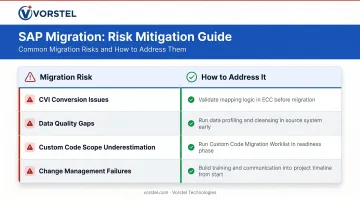
What to do: Build change management and training planning into the project timeline from the start, not as a go-live afterthought. Vorstel's SAP Fiori UX Design service delivers role-based, workflow-specific Fiori apps that reduce the learning curve for end users during migration.
Frequently Asked Questions
What is SAP migration?
SAP migration refers to moving an organization's SAP system, data, and configurations from one platform or version to another — most commonly from SAP ECC to SAP S/4HANA. This gives organizations access to newer capabilities, keeps them within SAP's support lifecycle, and improves operational performance.
What are the three ways to migrate from SAP ECC to S/4HANA?
Greenfield (new S/4HANA implementation with selective data migration), Brownfield (in-place technical conversion of ECC to S/4HANA using SUM), and Hybrid/Selective Data Transition (new system with selective carry-over of historical data). The right choice depends on business goals, customization complexity, and timeline constraints.
Is database migration mandatory when moving from SAP ECC to S/4HANA?
Yes. SAP S/4HANA runs exclusively on the SAP HANA in-memory database. If the existing ECC system runs on Oracle, IBM DB2, or another third-party database, migration to SAP HANA is a required part of the transition — not an optional step.
How long does an SAP ECC to S/4HANA migration typically take?
Timelines vary based on system complexity, data volume, custom code scope, and migration strategy. Greenfield builds typically run longer than Brownfield conversions. Project duration is cited as a top barrier by 55% of organizations, which makes realistic scoping a critical first step.
What are the biggest risks in an SAP ECC to S/4HANA migration?
The top risks are poor data quality carried into the new system, underestimation of custom code remediation effort, Business Partner conversion issues, inadequate testing coverage before go-live, and insufficient change management leading to user adoption failures post-launch.
What happens if a company stays on SAP ECC after 2027?
SAP ends mainstream maintenance at the end of 2027. Extended maintenance runs through 2030 at an added cost of +2 percentage points on the maintenance base, but organizations on customer-specific maintenance after 2030 will not receive new support packages or legal/regulatory updates — raising compliance and cybersecurity risk.