Introduction
SAP has set a firm deadline: mainstream maintenance for SAP ECC and SAP Business Suite 7 ends in 2027, with optional extended maintenance running through 2030 at an added cost premium. Yet Gartner-attributed reporting from CIO.com indicates that by end-2024, only 39% of SAP ECC customers — roughly 14,000 of 35,000 — had actually completed the move to S/4HANA. That leaves a substantial majority still running legacy systems with shrinking time to act.
The timeline pressure compounds when you look at execution: ASUG's 2024 research found average migration time runs 1.5 years, with complex landscapes stretching to six years. Nearly half of organizations that went live also exceeded their original budgets.
The organizations that close migrations on time share one consistent trait: cloud automation applied across every phase, from readiness assessment through hypercare. This post breaks down exactly where manual migrations stall, how automation resolves each bottleneck, and what to look for when choosing a partner to lead the effort.
Key Takeaways
- SAP ECC mainstream support ends in 2027, and IDC estimates 40–45% of users will still be on legacy ERP by that date
- Manual migrations average 1.5 years and frequently exceed budget — consulting fees are the primary overrun driver
- Cloud automation compresses timelines across assessment, data migration, testing, and go-live phases
- Clean core automation removes technical debt before it carries over into S/4HANA
- The right partner engages at any project stage and offers a no-cost assessment to get started
Why SAP S/4HANA Migration Is Now Urgent
The Support Deadline Is Real — and Closer Than It Looks
SAP Business Suite 7, including SAP ERP 6.0, loses mainstream maintenance at end of 2027. Optional extended maintenance runs through end of 2030, but carries a two percentage-point premium on existing maintenance fees.
Beyond that, SAP offers a limited private-edition transition option through 2033, but it requires systems to be on SAP HANA before December 31, 2030, with a minimum 2 TB system size. It is not a general ECC lifeline.
Given average migration timelines of 1.5 years, organizations that haven't started planning are already cutting it close.
The Cost of Staying Put
The deadline pressure alone is reason enough to act — but the financial case for inaction is deteriorating just as fast:
- Rising maintenance costs : extended maintenance adds an explicit price premium, and aging infrastructure demands increasing support effort
- Lost competitive ground : S/4HANA delivers real-time analytics, embedded AI, and cloud-native integration capabilities that ECC simply cannot match
- Innovation lag : SAP's innovation roadmap runs to 2040 for S/4HANA, while NetWeaver AS ABAP 7.5x is in maintenance mode only, with no new capabilities planned
ASUG's 2025 research shows adoption is accelerating : 56% of members are live or in-process, up 11% from 2024. Organizations that start now still have time to plan properly; those that wait will be competing for the same consultants, infrastructure, and testing cycles as everyone else rushing to meet the same deadline.
What's Slowing Down Traditional SAP S/4HANA Migrations
Three Bottlenecks That Kill Timelines
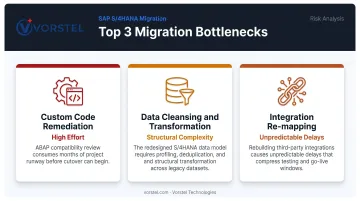
Manual migrations repeatedly run into the same three walls:
Custom code remediation — Most ECC environments carry years of custom ABAP code. Every object must be reviewed for S/4HANA compatibility, a process that can consume months of technical team time before actual migration begins.
Data cleansing and transformation — S/4HANA uses a redesigned data model. Migrating from ECC requires profiling, deduplication, format standardization, and structural transformation. Manual teams struggle to execute this at the volume and speed migrations demand.
Integration re-mapping — SAP touches a large share of business-critical transactions. Rebuilding or re-establishing third-party integrations in the new environment introduces unpredictable delays, particularly when integration owners are distributed across departments or vendors.
The Budget Reality
ASUG's 2024 research found 49% of live S/4HANA respondents exceeded their original budgets, with consulting fees as the primary unexpected expense. Migrations averaged 1.5 years — and some extended to six.
ASUG's 2025 report showed improvement: 31% reported costs above expectations and 34% came in aligned — a sign that practices are maturing. But overruns remain the norm, not the exception.
The Change Management Tax
Manual migrations pull functional teams away from operations. Business users get absorbed into testing cycles, data validation, and user acceptance work — creating organizational drag that compounds the technical delays. Every week of extended timeline is a week of disruption to business-as-usual.
Cloud automation addresses each of these friction points directly — compressing timelines, reducing manual effort, and keeping teams focused on the business rather than the migration itself.
How Cloud Automation Accelerates the Migration Timeline
Automated Readiness Assessment and Custom Code Analysis
SAP Readiness Check scans the existing SAP landscape (custom ABAP code, transaction usage, simplification item conflicts) and surfaces incompatibilities before migration work starts. Enhanced custom code analysis provides direct visibility into ABAP Test Cockpit findings for target S/4HANA versions, giving teams a prioritized action list rather than an open-ended manual review.
According to SAP, ABAP Test Cockpit quick fixes can address approximately 40–60% of typical S/4HANA simplification use cases automatically. SAP Joule for Developers extends this further with AI-based code analysis through the Custom Code Migration app. The tool flags remaining issues for targeted manual resolution — a far smaller scope than a full manual review.
Automation also enables teams to decouple business process logic from custom core code. Replacing hardwired customizations with an automation layer reduces the amount of code that must be rewritten, directly shrinking migration scope.
Automated Data Migration and Cleansing
SAP's Migration Cockpit handles data migration projects end-to-end, supporting direct transfers from SAP source systems, staging table mapping, and migration simulation. For more complex transformations, Rapid Data Migration with SAP Data Services automates ETL processes at a scale manual teams cannot match.
Automation handles:
- Data profiling and duplicate detection
- Format standardization across source systems
- Transformation rule application mapped directly to S/4HANA data models
- Migration simulation before actual load, catching errors before they reach the new system
The result is fewer post-migration data quality issues and less remediation work after go-live.
Automated Testing and Validation
Testing typically consumes a disproportionate share of migration time. Automated regression testing frameworks run thousands of scenarios in parallel: business processes, role authorizations, integration touchpoints, and custom workflow validations — replacing slow sequential execution with parallel runs.
The impact is measurable. Tricentis documented how Duke Energy cut SAP S/4HANA testing time from 1,300 hours to 32 hours, a 97.5% reduction, saving $4.3M in testing costs. Their 250 automated tests now run weekly in under 12 hours, completely unattended.
Beyond compression, continuous testing changes the model entirely: automated test plans trigger after every configuration change, catching issues early rather than batching them into a high-pressure phase at the end.
Automating Each Phase of the S/4HANA Migration Journey
Automation's value compounds when applied across the full migration lifecycle rather than at isolated points.
| Phase | Automation Capability |
|---|---|
| Assessment | IaC tools (Terraform, Ansible, AWS Launch Wizard) provision target landscapes in hours, not days |
| Design & Build | Workflow orchestration manages transport sequences, tracks object dependencies, and prevents conflicting changes |
| Data Migration | ETL automation via Migration Cockpit and SAP Data Services executes at scale with built-in validation |
| Testing | Continuous regression testing triggered after every change — not batched at project end |
| Go-Live | SAP Cloud ALM delivers real-time monitoring across business processes, integrations, and user activity from day one |
| Hypercare | Automated alerting surfaces issues faster than manual monitoring, supporting a shorter stabilization period |
| Post-Migration | Automations built during migration are repurposed for ongoing operational efficiency — not discarded after go-live |
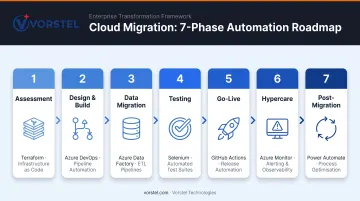
The cloud provisioning advantage is measurable. AWS documents SAP HANA environment deployments completing in under 2 hours — compared to days with manual setup. Azure's SAP Deployment Automation Framework and Google Cloud's Terraform configurations offer comparable infrastructure automation, making rapid landscape provisioning a standard expectation rather than a differentiator.
Achieving a Clean Core Through Automation
What Clean Core Actually Means
SAP defines clean core as keeping the ERP system as close as possible to its standard, vendor-provided state — handling business-specific requirements through SAP BTP extensions or standardized APIs rather than embedding customizations directly into the core. That means agile upgrades, stable operations, and an ERP built for continuous innovation.
Migration is often the only practical opportunity organisations get to reset their landscape toward this model. Carrying forward existing customizations without reviewing them means importing technical debt directly into S/4HANA.
How Automation Enables Clean Core
Automated code scanning identifies which existing customizations fall into which category:
- Business-critical — should be rebuilt as proper BTP side-by-side extensions or ABAP Cloud extensions
- Redundant or unused — should be retired
Without automation, this analysis would require manual review of every custom object — expensive, slow, and prone to conservative decisions that keep dead code alive. Automation surfaces the data needed to make these calls confidently and at scale.
Replacing embedded custom code with automation-layer orchestration preserves business process functionality without carrying forward the maintenance burden. Organisations get the outcome of customization without the upgrade risk.
The Long-Term Economics
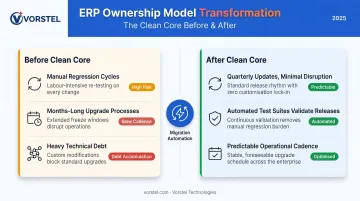
A clean core reshapes how organisations absorb future SAP releases. The practical impact:
- Quarterly updates go in with minimal disruption — no bespoke regression cycles
- Automated test suites validate each release against live business processes without manual intervention
- What once took months becomes a routine, low-risk operation — shifting ERP ownership from a project-heavy cost model to a predictable operational cadence
Choosing the Right SAP Cloud Automation Partner
Not all SAP partners are equal when it comes to automation-led migration. Four criteria separate capable partners from the rest:
- SAP-specific depth: Hands-on experience with SAP Readiness Check, Migration Cockpit, ABAP Test Cockpit, SAP BTP extensibility, and hyperscaler deployment across AWS, Azure, and GCP — not just general cloud skills
- Mid-project flexibility: Many organizations discover they need a stronger partner after kickoff. A partner who can assess an in-progress engagement and continue without restarting saves both time and budget
- Unified delivery model: Partners who combine cloud infrastructure automation, data migration tooling, testing automation, and SAP functional consulting under one engagement cut the overhead of managing multiple vendors
- Verifiable track record: Timeline and budget commitments backed by real project history across industries and geographies — not just methodology documentation
Vorstel Technologies is built around this model. With 200+ SAP project experiences and a delivery presence across India, Germany, Singapore, Finland, and Hungary, Vorstel brings the combination of SAP expertise and AI-leveraged automation that complex migrations require.
Their zero-fee solution evaluation — delivered via Teams, Zoom, or Google Meet — gives organizations a practical starting point for assessing migration readiness and scoping automation opportunities before any commitment is made.
Frequently Asked Questions
How does cloud automation actually reduce SAP S/4HANA migration time?
Automation eliminates manual bottlenecks in the phases that consume the most time — code scanning, data cleansing, regression testing, and infrastructure provisioning. Tasks that take weeks manually compress to hours or days, with testing automation alone showing reductions of over 90% in documented cases.
What is the difference between Greenfield, Brownfield, and Hybrid S/4HANA migration approaches?
Greenfield is a fresh S/4HANA implementation; Brownfield converts the existing ECC system in place; Hybrid (selective data transition) combines both by selectively migrating processes and data. Automation applies across all three but delivers the greatest impact in Brownfield and Hybrid, where existing complexity is highest.
What is a "clean core" in SAP S/4HANA and why does it matter?
Clean core means minimizing custom code embedded in the ERP and using standardised BTP extensions instead. It reduces upgrade complexity, lowers technical debt, and makes it easier to adopt new SAP capabilities — and migration is typically the best opportunity to achieve it.
Which cloud platforms support SAP S/4HANA migration?
SAP S/4HANA can be deployed on SAP's own managed cloud (RISE with SAP) and on major hyperscalers including AWS, Microsoft Azure, and Google Cloud Platform — all of which are SAP-certified and offer native automation services that integrate with SAP migration tooling.
What are the biggest risks in SAP S/4HANA migration and how does automation mitigate them?
The primary risks are data integrity loss, custom code incompatibility, integration failures, and excessive downtime. Automation addresses each one directly:
- Data validation rules enforce integrity at load
- Code scanning flags incompatibilities before they reach production
- Transport orchestration manages integration sequencing
- Parallel system operation during cutover limits business disruption
How long does an automated SAP S/4HANA migration typically take compared to a manual one?
SAP estimates 12–18 months for standard migrations, and ASUG data puts the average at 1.5 years. Cloud automation compresses this depending on landscape complexity, data quality, and the partner's accelerator toolkit — with well-prepared organizations cutting timelines by 30–50% when clean core readiness is established upfront.