Introduction
SAP's mainstream support for ECC ends in 2027 — and only 39% of approximately 35,000 ECC customers had purchased or subscribed to S/4HANA by end of 2024, according to Gartner. That means the majority of SAP's installed base is still sitting on aging infrastructure with a hard deadline approaching.
Choosing between SAP S/4HANA On-Premise and Cloud isn't just a technical preference — it directly shapes your licensing costs, how deeply you can customize the system, who manages upgrades, and how quickly you access SAP's latest AI capabilities.
Get it wrong, and you're either locked into a rigid cloud environment that can't accommodate your complex processes, or carrying unnecessary infrastructure overhead your business doesn't need.
This guide covers both deployment models — licensing structure, customization depth, upgrade control, and AI feature access — so you can match the right option to your actual requirements.
Key Takeaways
- On-Premise runs on your own servers — maximum control and customization, higher upfront CapEx
- Cloud (Public Edition) is SAP-managed via subscription, with faster go-live but standardization constraints
- Cloud Private Edition sits in the middle: cloud infrastructure with close to on-premise functional depth
- Your deployment choice shapes licensing, upgrade cadence, and which AI features you can access — and when
- SAP's cloud-first development strategy means AI tools like Joule reach Cloud editions first
SAP S/4HANA On-Premise vs Cloud: At a Glance
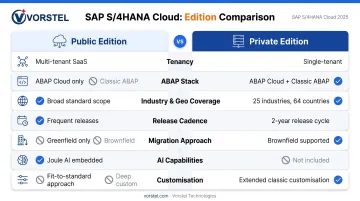
| Factor | On-Premise | Cloud (Public Edition) | Cloud Private Edition |
|---|---|---|---|
| Deployment Model | Customer-managed servers/data center | SAP-managed, multi-tenant SaaS | SAP-managed, single-tenant |
| Licensing Model | Perpetual license + maintenance | Subscription (OpEx) via RISE with SAP | Subscription (OpEx) via RISE with SAP |
| Infrastructure Owner | Customer | SAP | SAP / Hyperscaler |
| Upgrade Frequency | 2-year release cycle | Frequent releases + Hotfix Collections | Aligned to 2-year S/4HANA cycle |
| Customization Level | Full ABAP, classic extensibility | ABAP Cloud only (restricted subset) | ABAP Cloud + classic ABAP coexistence |
| Migration Approaches | Greenfield, Brownfield, Selective Data Transition | Greenfield only | Greenfield + Brownfield + Selective Data Transition |
| Best Fit | Large enterprises, regulated industries, complex custom processes | Fast-growth mid-market, standardized processes | Enterprises wanting cloud benefits without sacrificing ERP depth |
Note on "Cloud" variants: SAP currently positions two primary cloud editions — Public Edition and Private Edition. Older SAP documentation uses legacy terms like "Essentials Edition" or "Extended Edition" — these reflect prior naming conventions only. This article focuses on the primary distinction between on-premise and cloud deployment models.
What Is SAP S/4HANA On-Premise?
SAP S/4HANA On-Premise means the software is installed and operated entirely on your organization's own servers or data center, with your internal IT team managing the environment. It's the traditional enterprise ERP model, and it remains the deployment of choice for organizations that need full control over their system.
Licensing and Cost Structure
On-premise uses a perpetual licensing model, meaning you pay once for the software and then pay ongoing SAP support and maintenance fees. The upfront investment is substantial, covering hardware, software licenses, implementation services, and internal IT resources.
For large organizations with stable, predictable user growth, the per-user cost can become more favorable over a long time horizon compared to continuous subscription fees.
Customization Depth
On-premise gives developers the deepest level of extensibility available in S/4HANA. Classic ABAP lets developers use and modify SAP objects — including SAP code itself — through tools like SE80, Eclipse IDE, and Business Add-Ins (BAdIs). The full SAP Reference Implementation Guide (IMG), accessed via transaction SPRO, provides complete system configuration. Third-party and partner add-ons are also supported, provided they're released for the target S/4HANA version.
For organizations with industry-specific processes that don't fit standard SAP configurations, this depth of extensibility means the difference between a system that works and one that works the way your business actually operates.
Upgrade Cadence and Operational Requirements
SAP moved to a 2-year release cycle for S/4HANA on-premise after 2023, with Feature Pack Stacks (FPS) and Support Pack Stacks (SPS) released every six months within that cycle. Your IT team owns the planning, testing, and deployment of every upgrade.
This gives you full control over timing, but it also means slower access to new features. Running on-premise requires experienced SAP Basis administrators, dedicated infrastructure, and sustained hardware maintenance investment.
Use Cases: When On-Premise Makes Sense
On-premise dominates in scenarios where control and compliance outweigh convenience:
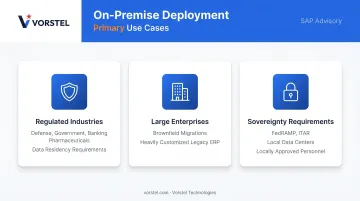
- Regulated industries — defense, government, banking, and pharmaceuticals with strict data residency or sovereignty requirements
- Large enterprises on heavily customized legacy ERP environments pursuing Brownfield (system conversion) migrations
- Organizations with sovereignty requirements — SAP's sovereign cloud materials define specific needs including local data centers, locally approved personnel, and local control planes; in some U.S. regulated contexts, FedRAMP, ITAR compliance, and U.S.-person access control may mandate on-premise or sovereign deployments
What Is SAP S/4HANA Cloud?
SAP S/4HANA Cloud is a fully hosted and managed ERP solution — infrastructure, software, and support handled entirely by SAP. Two primary editions are on offer: Public Edition (multi-tenant, standardized SaaS) and Private Edition (single-tenant, on private cloud infrastructure). Both are available through RISE with SAP, SAP's subscription-based transformation program for organizations moving off on-premises systems.
Financial Model
Cloud replaces the large upfront CapEx of on-premise with a predictable monthly or annual subscription that bundles infrastructure, software, upgrades, and support. This OpEx model reduces the need for internal IT infrastructure teams and lowers the barrier to getting started — particularly relevant for mid-market organizations that don't want to build out data center capability.
Upgrade and Innovation Access
Release cadence differs by edition:
- Public Edition: Frequent major releases plus ongoing Hotfix Collections
- Private Edition: Follows the same 2-year release cycle as on-premise; RISE customers can request one technical upgrade per year
SAP's Joule AI copilot launched in Public Edition with the November 2024 release, with supply chain coverage confirmed by December 2024. Cloud editions consistently receive AI capabilities earlier in the cycle than their on-premise counterparts.
Customization by Edition
The two editions differ meaningfully in what they allow:
- Public Edition: Uses ABAP Cloud only — a cloud-compatible subset of ABAP. Direct table SELECTs, Dynpros (classic SAP screen programs), and obsolete TABLES statements are restricted. Extensibility happens through whitelisted APIs and SAP Business Technology Platform (BTP) extensions. A "fit-to-standard" approach is the design philosophy.
- Private Edition: Allows ABAP Cloud and classic ABAP to coexist, giving a customization profile much closer to on-premise. It covers 25 industries, 64 countries/regions, and 39 languages — functional scope comparable to the on-premise edition.
Use Cases: When Cloud Makes Sense
- Mid-market companies scaling rapidly who want faster time-to-value
- Organizations implementing SAP for the first time (Greenfield) without legacy custom code to preserve
- Global enterprises standardizing processes across regions without heavy customization overhead
- Companies prioritizing continuous innovation access without internal upgrade management
American Water's implementation of SAP S/4HANA Cloud Private Edition via RISE with SAP took roughly one year, supporting approximately 550 end users. When the organization is prepared, cloud deployments can move significantly faster than traditional on-premise rollouts.
On-Premise vs Cloud: Key Differences Compared
Cost and Total Cost of Ownership
The cost comparison isn't straightforward — it depends heavily on company size, growth trajectory, and how you account for infrastructure.
- On-premise: Higher initial CapEx (hardware, perpetual licenses, implementation). Over time, per-user costs can stabilize for large, stable organizations.
- Cloud: Subscription fees accumulate continuously, but eliminate hardware investment and reduce internal IT overhead.
A Forrester Total Economic Impact study commissioned by SAP and AWS for SAP Cloud ERP Private on AWS reported a 45% ROI, $5.2M NPV, and a 20-month payback period, with $6.1M in reduced costs from phasing out on-premises data centers. This is commissioned research, not independent pricing — but it illustrates the scale of infrastructure savings that large enterprises can realize by exiting owned data centers.
Customization vs. Standardization
This is the trade-off that cuts deepest for most organizations:
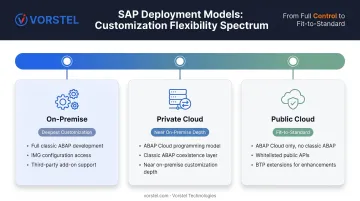
- On-premise allows deep ABAP modifications, full IMG configuration, and third-party add-on support
- Public Cloud enforces fit-to-standard — you adopt SAP's process designs rather than rebuilding them; bespoke development is restricted
- Private Cloud sits closer to on-premise in flexibility, making it viable for organizations with existing custom code
Standardization accelerates implementation and simplifies upgrades. But for businesses where differentiated processes are a competitive advantage — complex manufacturing workflows, multi-jurisdiction financial structures — standardization can create real functional gaps.
Data Security, Sovereignty, and Compliance
- On-premise gives complete control over data location, access controls, and audit trails — critical for GDPR, SOX, HIPAA, and defense-sector requirements
- Cloud deployments run on SAP-certified infrastructure with ISO/IEC security standards and SOC reporting; SAP Trust Center provides compliance materials, though certificate scope varies by product and region
- For organizations with strict data residency obligations, the real question is whether your data can legally reside on SAP or hyperscaler-managed infrastructure
Migration Approach Compatibility
Your existing SAP investment affects which migration methods are available to you:
| Migration Approach | On-Premise | Public Cloud | Private Cloud |
|---|---|---|---|
| Greenfield (new implementation) | ✅ | ✅ | ✅ |
| Brownfield (system conversion) | ✅ | ❌ | ✅ |
| Selective Data Transition | ✅ | ❌ | ✅ |
SAP has confirmed that Selective Data Transition into Public Cloud is not supported. If you're converting an existing ECC system with years of transaction history, Public Cloud may require starting fresh — a significant commitment that not every organization is positioned to make.
Speed of Innovation and AI Readiness
SAP's cloud-first development approach means AI capabilities reach Cloud editions earlier. Joule is already embedded in Public Edition and expanding to Private Edition. For organizations with AI-driven transformation roadmaps, the current capability split looks like this:
- Public Cloud: Joule AI assistant embedded; continuous feature releases; AI process automation available now
- Private Cloud: Joule expanding; more flexibility, slightly slower feature cadence
- On-premise: AI features lag; dependent on upgrade cycles and custom integration effort
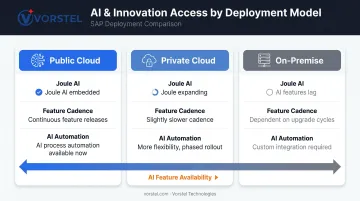
This gap will widen over time. If AI-driven process automation is on your roadmap, deployment model choice has direct consequences for your timeline.
Which SAP S/4HANA Deployment Is Right for Your Business?
There's no universal answer — but the decision framework is relatively clear once you know your constraints.
Choose On-Premise if:
- Your processes are deeply customized and cannot be standardized without losing business value
- You have strict data residency, sovereignty, or regulatory requirements (defense, government, regulated banking)
- You have a large, mature SAP Basis team capable of managing infrastructure and upgrades
- You prefer a one-time capital investment over ongoing subscription costs
- You're converting an existing ECC system via Brownfield and need to preserve existing configurations
Choose Cloud (Public Edition) if:
- You're implementing SAP for the first time and have no legacy customizations to preserve
- You're a mid-market or high-growth company prioritizing speed of deployment
- You want continuous innovation access including AI features without managing upgrade cycles
- Standardized processes across global entities is a strategic goal
Consider Private Cloud Edition if:
- You need cloud infrastructure benefits — reduced hardware overhead, SAP-managed operations — but require near on-premise functional depth
- You're an existing SAP customer moving through RISE with SAP who wants to preserve Brownfield migration options
- Your industry has compliance requirements but you're open to SAP-managed cloud infrastructure
Private Cloud Edition is the strategic middle ground: it supports Brownfield and Selective Data Transition approaches, covers 25 industries and 64 countries, and allows classic ABAP alongside ABAP Cloud extensibility — making it a realistic path for ECC customers who need to migrate without discarding existing configurations.
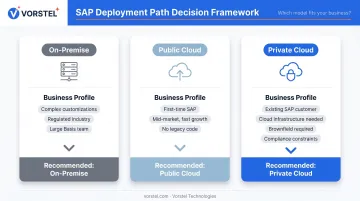
Choosing between these models carries real consequences for cost, agility, and long-term upgrade flexibility. Vorstel Technologies has navigated this decision across manufacturing, retail, and enterprise environments — with 200+ SAP projects spanning all three deployment scenarios. Their Zero-Fee Solution Evaluation lets organizations assess which deployment model fits their processes, compliance requirements, and budget before committing to a direction.
Conclusion
After walking through this comparison, one thing stands out: there is no universally correct answer. Both deployment models share the same SAP HANA in-memory core — the differences come down to how much control, flexibility, and maintenance ownership your organization actually needs.
The decision turns on a handful of factors specific to your situation:
- Company size and IT capacity — whether your team can own infrastructure or needs SAP to manage it
- Regulatory environment — data residency and compliance requirements that may mandate on-premise
- Customization depth — the scope of existing modifications and how critical they are to operations
- Growth trajectory — whether predictable scaling or rapid expansion drives your roadmap
- Total cost tolerance — upfront capital investment versus ongoing subscription commitment
What is clear is that delaying the decision carries real cost. With mainstream ECC support ending in 2027 and extended maintenance options shrinking, organizations that wait face rushed, poorly planned migrations. Starting a structured evaluation now — even if go-live is 18 months out — gives you the time to make the right choice rather than the fast one.
Frequently Asked Questions
What is on-premise in SAP?
SAP on-premise refers to SAP software — including S/4HANA — installed and operated on the organization's own servers or data center. The internal IT team manages infrastructure, customizations, and upgrade cycles, giving full control over the environment.
Can SAP be hosted on-premises?
Yes. SAP S/4HANA can run fully on-premise on your own hardware. It can also be hosted by SAP through HANA Enterprise Cloud (HEC), or on hyperscalers like AWS, Azure, or Google Cloud — while still using on-premise software and licensing.
What is the difference between SAP on-premise and SAP Cloud?
On-premise is customer-managed with full customization capability and a 2-year upgrade cycle controlled by your IT team. SAP Cloud is SAP-managed via subscription, with automatic updates and a standardized configuration model. The Public Edition enforces fit-to-standard; Private Edition offers more flexibility.
Which SAP S/4HANA deployment is best for mid-sized companies?
SAP S/4HANA Cloud Public Edition suits most mid-sized companies — lower upfront costs, faster implementation via SAP Best Practices, and minimal internal IT infrastructure demands. Companies with complex or industry-specific processes may benefit from Private Cloud Edition or on-premise deployment.
What implementation approaches are available for each deployment?
On-premise supports Greenfield, Brownfield, and Selective Data Transition. Public Cloud supports Greenfield only. Private Cloud Edition supports all three — making it the most flexible option for organizations with existing SAP systems and transaction history.
Can I migrate from SAP S/4HANA On-Premise to Cloud later?
Migration to Private Cloud Edition via system conversion is feasible. Moving to Public Cloud typically requires a Greenfield reimplementation due to its standardization requirements, so your initial deployment choice carries long-term strategic weight.