Introduction
Cloud migration has moved well past "IT initiative" status. For most enterprises today, it is a board-level decision with direct consequences for competitive positioning, cost structure, and AI readiness.
The numbers reflect the urgency. According to MarketsandMarkets' April 2026 forecast, the global cloud professional services market is projected to grow from USD 53.15 billion in 2026 to USD 109.39 billion by 2031 — a 16.2% CAGR. That growth is driven by real enterprise pressure to modernize, not speculative investment cycles.
But spend doesn't equal success. A McKinsey survey of nearly 450 CIOs and IT decision-makers found migration inefficiencies cost the average company 14% more than planned annually, with wasted spend exceeding USD 100 billion globally over three years.
The gap between a smooth migration and a costly one usually comes down to provider fit — specifically, whether a provider's methodology, industry experience, and post-migration support align with your environment.
This guide evaluates 10 cloud migration service providers across those dimensions, so decision-makers can shortlist with confidence.
Key Takeaways
- Cloud migration moves applications, data, and workloads from on-premises or legacy systems to cloud environments (AWS, Azure, GCP, or hybrid setups)
- Migration failures are expensive — the wrong provider causes budget overruns, extended downtime, and stalled transformation timelines
- The 6 R's framework (Rehost, Replatform, Refactor, Repurchase, Retire, Retain) governs workload strategy; top providers apply all six
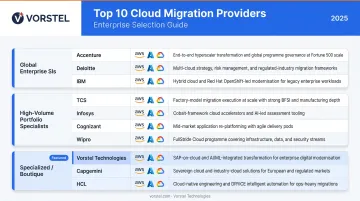
- Top providers in 2026 range from global systems integrators like Accenture and TCS to agile boutique specialists like Vorstel Technologies
- Provider fit depends on project complexity, regulatory environment, and business goals — not just brand recognition
What Is Cloud Migration and Why It Matters in 2026
Cloud migration is the process of moving applications, data, and IT workloads from on-premises or legacy environments to cloud infrastructure. It spans three service layers: assessment and planning, migration execution, and post-migration optimization. Skipping or rushing any layer is where cost overruns begin.
The Drivers Reshaping Migration in 2026
Several forces have made cloud migration more urgent and more complex than it was two or three years ago:
- AI workload demand: Gartner predicts 50% of cloud compute resources will be devoted to AI workloads by 2029, up from less than 10% in 2025 — organizations need cloud infrastructure that can support that shift
- Digital sovereignty: Worldwide sovereign cloud IaaS spending is forecast to reach USD 80 billion in 2026, a 35.6% increase from 2025; the EU Data Act, applicable from September 2025, adds switching and portability obligations
- Sustainability targets: Microsoft reports its cloud services are up to 93% more energy efficient than traditional enterprise datacenters — migration now ties directly to carbon reporting
- Cloud-first IT budgets: McKinsey found enterprises aspire to have 80% of IT hosting spend in cloud, creating large portfolio migration programs that require experienced partners
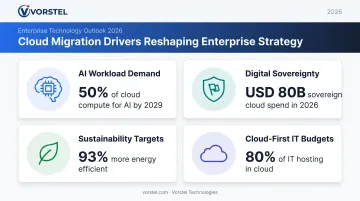
Migration in 2026 carries obligations that did not exist three years ago: AI infrastructure readiness, data residency compliance, FinOps governance, and carbon footprint accountability. Choosing the right provider means finding one that addresses all of these — not just the technical lift of moving workloads.
10 Best Cloud Migration Service Providers (2026)
Providers were assessed across six consistent criteria:
- Multi-cloud technical depth
- Migration methodology and tooling
- Industry experience and vertical specialization
- Security and compliance track record
- Post-migration support model
- Verified client outcomes or analyst recognition
1. Vorstel Technologies
Background: Vorstel Technologies is a global digital transformation consulting firm with operations across India, Germany, Singapore, Finland, and Hungary. It serves 30+ enterprise and startup clients with a 97% client satisfaction rate. Core offerings span cloud and infrastructure, DevOps, enterprise architecture, AI/ML, and SaaS consulting across SAP, Microsoft, and Salesforce.
Standout value: Vorstel can engage at any stage of a cloud journey — from greenfield strategy to mid-project rescue — delivering 92% faster deployment cycles and 45% reduction in system downtime compared to industry benchmarks. Its Zero-Fee Solution Evaluation covers cloud readiness assessment, IT strategy, and migration planning with no initial commitment.
| Dimension | Details |
|---|---|
| Key Cloud Platforms | AWS, Azure, GCP; SAP on Cloud, Microsoft Azure, Salesforce integrations |
| Best Suited For | Global enterprises and fast-moving startups needing cloud migration embedded in broader digital transformation; organizations requiring SAP/Microsoft/Salesforce consulting alongside infrastructure migration |
| Notable Strength | Agile engagement model — takes over migration projects at any stage; combines cloud infrastructure with ERP, AI/ML, and DevOps under one roof |
2. Accenture
Background: Accenture is a global consulting firm with cloud practices spanning 120+ countries and tens of thousands of certified cloud specialists. Its "Cloud First" initiative covers strategy, migration factory execution, and managed operations across AWS, Azure, and GCP.
Standout value: Accenture holds a Leader position in both the 2025 Gartner Magic Quadrant for Public Cloud IT Transformation Services and the Forrester Wave: Application Modernization and Multicloud Managed Services, Q1 2025, placing it among a small group of firms recognized as a Leader in both reports. Proprietary migration accelerators position it as the go-to option for Fortune 500 enterprises with complex, multi-regional environments.
| Dimension | Details |
|---|---|
| Key Cloud Platforms | AWS, Azure, GCP (multi-cloud and hybrid) |
| Best Suited For | Large global enterprises with complex, regulated, multi-system environments |
| Notable Strength | Scale and automation toolkits; dual Forrester and Gartner Wave leadership |
3. Deloitte
Background: Deloitte approaches cloud migration as both a technology initiative and a business transformation exercise. It has been named a Leader in the 2025 Gartner Magic Quadrant for Public Cloud IT Transformation Services for the fifth consecutive year, with the furthest placement on the Vision axis since 2021.
Standout value: Deloitte connects cloud migration to business process re-engineering, change management, and governance. When structural and technology transformation are happening at the same time, this integrated approach reduces friction across both the IT and organizational sides of the project.
| Dimension | Details |
|---|---|
| Key Cloud Platforms | AWS, Azure, GCP (all major platforms) |
| Best Suited For | Organizations undergoing simultaneous IT and organizational transformation; large enterprises in finance, healthcare, manufacturing |
| Notable Strength | Change management alongside cloud execution; furthest Completeness of Vision in 2025 Gartner MQ |
4. IBM
Background: IBM brings decades of enterprise IT experience to hybrid cloud migration, supported by its Cloud Migration Factory and AI-powered tooling through IBM Cloud Pak for AIOps. It is a consistent choice for enterprises carrying significant legacy infrastructure debt.
Standout value: IBM's ability to bridge on-premises mainframe environments with cloud-native services, supported by 24/7 global delivery teams, makes it the preferred option for highly regulated industries with mission-critical workloads. IBM was positioned as a Strong Performer in the Forrester Wave Q1 2025 for Application Modernization and Multicloud Managed Services.
| Dimension | Details |
|---|---|
| Key Cloud Platforms | IBM Cloud, AWS, Azure; Red Hat OpenShift (hybrid) |
| Best Suited For | Enterprises with mainframe and legacy workloads; financial services, insurance, public sector |
| Notable Strength | Mainframe modernization depth; AI-driven workload discovery via Cloud Pak for AIOps |
5. TCS (Tata Consultancy Services)
Background: TCS is one of the world's largest IT services firms with a process-driven, automation-first approach. Its Machine First™ Delivery Model and AI-based monitoring platforms enable complex, distributed migrations at scale across 50+ countries.
Standout value: TCS is named a Leader in the Forrester Wave: Application Modernization and Multicloud Managed Services, Q1 2025, with particular strength in migrating large ERP and legacy environments at scale. Cost-effective offshore delivery suits multinationals that need globally consistent execution without inflating per-project costs.
| Dimension | Details |
|---|---|
| Key Cloud Platforms | AWS, Azure, GCP; multi-cloud governance platforms |
| Best Suited For | Large multinationals in telecom, finance, healthcare, and retail with high-volume legacy workloads |
| Notable Strength | Machine First™ automation at scale; competitive offshore pricing |
6. Infosys
Background: Infosys operates one of the most extensive cloud migration practices globally through Infosys Cobalt, covering migration and modernization, cloud management, FinOps, and cloud security. It is named a Leader in the Forrester Wave Q1 2025.
Standout value: Infosys specializes in migrating large application portfolios rapidly using automated cutover and fallback systems. Its global delivery network provides near-continuous support coverage, which is particularly valuable for enterprises managing hundreds of applications in a single migration program.
| Dimension | Details |
|---|---|
| Key Cloud Platforms | AWS, Azure, GCP; containerization and serverless architectures |
| Best Suited For | Large enterprises with 100+ application portfolios; logistics, financial services, retail |
| Notable Strength | Infosys Cobalt automation-led migration factory; AI-powered monitoring for ongoing optimization |
7. Wipro
Background: Wipro's FullStride Cloud Studio and Cloud Migration Studio offer a systematic delivery approach emphasizing repeatability, automation, and multi-cloud governance. Wipro is a Leader in the 2025 Gartner Magic Quadrant for Public Cloud IT Transformation Services.
Standout value: Wipro's proprietary automation tools reduce manual migration steps significantly, enabling enterprises to move large workload volumes faster and more consistently. Its outcome-based pricing tied to migration speed targets is a differentiator for cost-conscious programmes.
| Dimension | Details |
|---|---|
| Key Cloud Platforms | AWS, Azure, GCP; hybrid and multi-cloud environments |
| Best Suited For | Enterprises pursuing large-scale, rapid migrations; retail, manufacturing, financial services |
| Notable Strength | Cloud Migration Studio automation; outcome-based pricing models |
8. Cognizant
Background: Cognizant is a US-headquartered global IT services provider known for an engineering-heavy approach to cloud migration. It is named a Leader in the Forrester Wave Q1 2025, with documented HIPAA-compliant cloud work and compliance assessments covering PCI-DSS, GDPR, and HIPAA.
Standout value: Pre-built migration accelerators shorten timelines while keeping costs competitive. Industry-specific compliance frameworks give Cognizant an edge with mid-to-large enterprises in regulated sectors where technical rigor and cost discipline both matter.
| Dimension | Details |
|---|---|
| Key Cloud Platforms | AWS, Azure, GCP; cloud-native development and DevOps |
| Best Suited For | Mid-to-large enterprises in healthcare, financial services, and retail seeking cost-quality balance |
| Notable Strength | Pre-built accelerators; compliance frameworks covering HIPAA, PCI-DSS, and GDPR |
9. Capgemini
Background: Capgemini is a France-headquartered IT consulting leader with deep expertise in European compliance requirements. It is named a Leader in the Forrester Wave: Application Modernization and Multicloud Managed Services, Q1 2025, with dedicated research on GDPR cross-border transfers and Schrems II implications for cloud migration.
Standout value: Capgemini's compliance-first migration approach, integrated with FinOps-driven post-migration governance, is the strongest option for European enterprises where GDPR and data residency requirements must be built into the migration architecture from day one.
| Dimension | Details |
|---|---|
| Key Cloud Platforms | AWS, Azure, GCP; industry cloud solutions for finance and public sector |
| Best Suited For | European enterprises, regulated industries (finance, healthcare, government), sustainability-focused organisations |
| Notable Strength | GDPR and data sovereignty expertise; FinOps-integrated cloud cost governance |
10. HCL Technologies
Background: HCL Technologies has built a reputation for structured, engineering-driven cloud migrations with a measurable ROI focus. It holds a Leader position in the 2024 Gartner Magic Quadrant for Public Cloud IT Transformation Services and is also named a Leader in the Forrester Wave Q1 2025. HCLTech FinOps provides AI-driven cloud cost optimization across multi-cloud environments.
Standout value: HCL's reusable migration toolkits and ROI-oriented methodology work well for hybrid cloud architectures, particularly in manufacturing and retail. Post-migration FinOps governance through HCLTech FinOps ensures cost optimization continues well past go-live.
| Dimension | Details |
|---|---|
| Key Cloud Platforms | AWS, Azure, GCP; containerization and microservices architectures |
| Best Suited For | Enterprises in manufacturing, retail, and financial services seeking measurable hybrid cloud ROI |
| Notable Strength | Structured, toolkit-driven delivery with documented cost savings; AI-driven FinOps post-migration |
How We Chose the Best Cloud Migration Service Providers
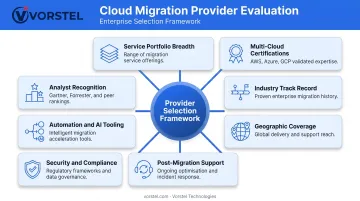
All providers were assessed across eight consistent dimensions:
- Service portfolio breadth — does migration include assessment, execution, and post-migration optimization?
- Multi-cloud certifications — verified depth across AWS, Azure, and GCP
- Industry-specific track record — regulated sector experience (finance, healthcare, government)
- Geographic coverage — ability to deliver across multiple regions and time zones
- Post-migration support — FinOps governance, managed services, security monitoring
- Security and compliance credentials — GDPR, HIPAA, PCI-DSS, and sovereign cloud capability
- Automation and AI tooling — migration factory methods and AI-assisted workload discovery
- Verified analyst recognition — Forrester Wave and Gartner Magic Quadrant positions based on publicly available reports
The Three Most Common Provider Selection Mistakes
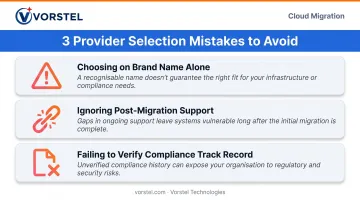
Three patterns consistently trip up the shortlisting process for organizations evaluating cloud migration providers:
- Choosing on brand name alone — a global SI may not be the right fit for a mid-market organization with a focused migration scope
- Ignoring post-migration support: migrations that succeed at launch but lack FinOps governance routinely produce cost overruns within 12 months
- Failing to verify compliance track record — ask specifically whether the provider has documented experience in your regulatory environment (GDPR, HIPAA, PCI-DSS), not just general security credentials
The right provider depends on the complexity of your environment, the cloud platforms involved, and your organization's readiness to change. For organizations that want expert guidance before committing, Vorstel Technologies offers a Zero-Fee Solution Evaluation covering cloud readiness assessment, IT strategy, and migration planning.
Conclusion
Choosing a cloud migration partner comes down to fit, not name recognition. Large global SIs bring scale, automation factories, and analyst credentials. Boutique specialists bring agility, domain depth, and the ability to engage at any stage of a program — including rescuing projects already underway.
The providers in this list cover the strongest options across different needs:
- Accenture, Deloitte, Wipro — large enterprise transformation programs
- Capgemini — European compliance-first migrations
- IBM — mainframe and legacy modernization
- TCS, Infosys, Cognizant — high-volume portfolio migrations at competitive cost
- HCL — hybrid cloud ROI
- Vorstel Technologies — cloud migration embedded within broader digital transformation, including SAP, Microsoft, and Salesforce workstreams
Regardless of where you are in the process — early strategy or deep into execution — evaluate providers on post-migration cost governance and scalability, not just execution speed. A migration that goes live on time but drifts into uncontrolled cloud spend within six months has not succeeded.
If you are at any stage of that journey and want a structured starting point, Vorstel Technologies offers a free consultation and cloud readiness assessment.
Frequently Asked Questions
Who are the top cloud infrastructure platforms?
The three dominant cloud infrastructure platforms by market share are AWS, Microsoft Azure, and Google Cloud Platform (GCP) — which Synergy Research Group confirmed together account for 63% of enterprise cloud infrastructure spending as of Q3 2025. Oracle Cloud and a group of specialized providers hold meaningful shares in specific segments. Most migration service providers hold certifications across at least the top three.
What are the main types of cloud migration (the 6 R's)?
The 6 R's framework covers: Rehost (lift-and-shift with no changes), Replatform (optimize and move), Refactor (re-architect for cloud-native), Repurchase (switch to SaaS), Retire (decommission unused workloads), and Retain (keep on-premises). Note that AWS Prescriptive Guidance now documents seven strategies, adding "Relocate" as a distinct option. Most enterprises blend strategies across their application portfolio rather than applying one approach uniformly.
How long does a cloud migration typically take?
Timelines vary considerably by scope — small lift-and-shift projects can wrap in weeks, while large enterprise programs spanning hundreds of applications commonly run 12–24 months. AWS Prescriptive Guidance benchmarks individual migration waves at roughly 3–4 weeks each, with portfolio assessment adding 1–2 weeks per wave. Readiness assessment and phased planning are the biggest determinants of timeline.
What is the difference between cloud migration and cloud modernization?
Migration moves workloads to the cloud — often as-is or with minor changes. Modernization re-architects applications for cloud-native capabilities such as containers, microservices, and serverless functions. The two are often sequential: organizations migrate first to reduce infrastructure costs, then modernize to unlock performance and agility benefits.
What should I look for when evaluating a cloud migration provider?
Focus on five criteria: multi-cloud certifications across your target platforms; industry-specific compliance experience in your regulatory environment; a structured methodology with defined assessment, execution, and post-migration phases; transparent pricing; and verifiable client references with measurable outcomes — not just case study summaries.