Introduction
Over 90% of Fortune 500 companies run SAP — yet the gap between having SAP installed and actually getting value from it is where most enterprises struggle. Deploying, migrating, or optimizing SAP requires deep module knowledge, project governance, and change management expertise that internal IT teams seldom have in-house. Without that expertise, projects stall, timelines bloat, and costly rework follows.
The stakes are high. According to SAPinsider's 2025 migration research, 55% of organizations cite project duration as a major challenge, and 31% of SAP transitions exceed their budget. Choosing the right external partner is often the deciding factor between a transformation that delivers and one that drains resources.
This guide covers what an SAP consultancy actually does, the full range of services they provide, how engagements unfold in practice, key specialization areas, and what to look for when choosing a partner.
Key Takeaways
- An SAP consultancy is a structured firm that manages the full lifecycle of SAP deployments — not a solo contractor
- Core services: implementation, S/4HANA migration, process optimization, integration, training, and post-go-live support
- Engagements follow a defined process: discovery → design → build → go-live → continuous improvement
- 43% of SAP projects flag change management and user adoption as the top risk — the human side matters as much as the technical
- Choosing the right partner means evaluating project track record, methodology transparency, and the ability to engage mid-journey
What Is an SAP Consultancy?
An SAP consultancy is an organization that provides advisory, implementation, and support services across the SAP product ecosystem — including S/4HANA, SAP BTP, SAP Fiori, SAP Ariba, and more.
The distinction from an individual SAP consultant matters: a consultancy fields structured teams across multiple modules and project phases, with defined project governance, quality controls, and accountability that a solo practitioner cannot replicate.
Two Main Categories
Large Global System Integrators (GSIs):
- Handle enterprise-scale, multi-country deployments
- Wide module coverage but often slower to mobilize and deploy
- Higher cost structures and longer sales cycles
Boutique and Mid-Size Consultancies:
- Deeper specialization within specific modules or industries
- Faster onboarding and more flexible engagement models
- More direct access to senior-level specialists without large-team overhead
Why Demand Is Growing
The global ERP software market is projected to reach $157 billion by 2033, growing at a 9.5% CAGR. SAP's own maintenance deadlines are accelerating demand further — mainstream support for SAP ECC ends in 2027, pushing organizations to engage consultancies for structured migration programs before that window closes.
Core Services SAP Consultancies Provide
SAP Implementation and System Rollout
New SAP implementation is the foundational service. Consultancies assess current business processes, map requirements to SAP modules, configure the system, migrate data from legacy platforms, and manage delivery through go-live.
This is not a plug-and-play exercise. Two concepts determine long-term system health:
- Customizing — configuring SAP's standard settings to match the client's specific processes, without modifying the underlying code
- Custom development — writing ABAP code or building BTP extensions for requirements that cannot be met through configuration alone
Getting the balance right at the outset avoids a fragile, over-customized system that becomes expensive to maintain and upgrade.
SAP System Migration and Upgrades
The migration from SAP ECC 6.0 to S/4HANA is the defining project for most enterprises this decade. There are three paths, and choosing the wrong one is costly:
| Migration Path | What It Involves | Best For |
|---|---|---|
| Greenfield | Fresh implementation; clean start | Organizations wanting full process redesign |
| Brownfield | System conversion; existing data and config retained | Those prioritizing speed and continuity |
| Selective Data Transition | Hybrid approach; selective migration of data and processes | Complex landscapes needing flexibility |
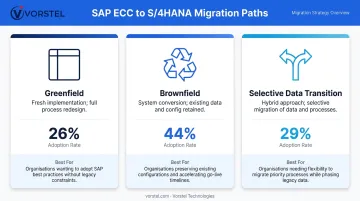
ASUG's 2025 research shows 44% of organizations choose brownfield, 29% selective data transition, and 26% greenfield. An experienced consultancy guides clients through this choice based on process complexity, custom code volume, and transformation goals — not just technical preference.
Process Optimization and Continuous Improvement
Not every SAP engagement starts from scratch. Many organizations live on SAP systems that underperform — underutilized modules, inefficient workflows, siloed data.
SAP consultancies provide ongoing advisory that includes:
- Auditing unused or misconfigured SAP functionality
- Redesigning workflows to eliminate manual steps
- Integrating analytics through SAP Analytics Cloud or embedded S/4HANA reporting
- Embedding AI to automate high-volume processes — SAP's own data shows AI-assisted finance functions can deliver 50% shorter cost-center reporting time and 75% less setup time for fixed-asset master data
Integration and Third-Party Connectivity
Modern enterprises don't run SAP in isolation. Salesforce, Microsoft 365, custom applications, and legacy databases all need to exchange data with the ERP core.
SAP consultancies design and implement integration architectures — typically using SAP Integration Suite, SAP BTP, or third-party middleware — to eliminate data silos and ensure consistent information flows across systems. Vorstel Technologies, for example, uses SAP BTP to connect SAP landscapes with third-party platforms, reducing manual data reconciliation across client environments.
Training, Change Management, and User Adoption
Getting the technology right is only half the engagement. The other half is ensuring people actually use it. ASUG's 2025 data is clear: 43% of organizations cite change management and user adoption as a primary project risk, and 57% recommend starting change management early.
A consultancy's responsibility here includes:
- End-user and key-user training across departments
- Role-based documentation and quick reference materials
- Organizational change management planning
- Adoption monitoring and remediation after go-live
A system that goes live but sits underused delivers no ROI — which is why adoption tracking and post-go-live remediation are built into the project scope from day one, not addressed after the fact.
How an SAP Consulting Engagement Works
Phase 1 — Discovery and Needs Assessment
Every well-structured SAP engagement starts with structured discovery: stakeholder interviews, process walkthroughs, current-state system analysis, and gap identification. The output is a clear scope definition, risk register, and implementation roadmap.
SAP's own methodology (SAP Activate) formalizes this through Fit-to-Standard workshops — validating scope, documenting gaps, and establishing which standard processes can be adopted before any configuration begins. Skipping this phase is a primary driver of scope creep and budget overruns.
Phase 2 — Solution Design and Architecture
Discovery findings get translated into a solution blueprint:
- Which SAP modules to activate
- Data model and master data governance approach
- Integration requirements and architecture
- Infrastructure decision: cloud (public or private), on-premise, or hybrid
- Project governance structure and escalation paths
This phase produces the definitive design document that guides all subsequent build work.
Phase 3 — Configuration, Development, and Testing
The build phase involves:
- System configuration (customizing) — aligning SAP standard settings to business requirements
- Custom development — ABAP development or BTP extensions for genuine gaps
- Unit testing — validating individual components
- Integration testing — confirming data flows work end-to-end
- User acceptance testing (UAT) — business users validate real-world scenarios
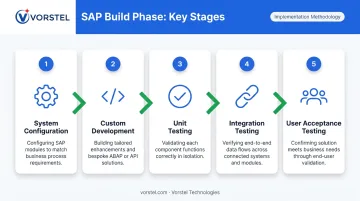
Experienced consultancies build robust testing protocols here. Issues caught in UAT cost a fraction of what they cost to fix post-launch.
Phase 4 — Go-Live and Hypercare
Go-live is the highest-risk moment in any SAP project. The hypercare period immediately following — typically two to four weeks of intensive support — is where consultancies monitor system stability, resolve emerging issues rapidly, and prevent business disruption.
That risk is measurable: 31% of ASUG respondents reported costs exceeding expectations, and project duration challenges jumped from 37% in 2024 to 55% in 2025. Teams that skip or understaff hypercare tend to absorb those overruns directly.
Phase 5 — Post-Go-Live Support and Optimization
Once hypercare wraps, ongoing managed services keep the system performing and evolving:
- Incident resolution and break-fix support
- Performance monitoring and tuning
- Scheduled enhancements and quarterly reviews
- Strategic advisory as business needs evolve
ASUG data shows newer S/4HANA adopters realize value in 4.4 months, compared to 7.2 months for organizations that have been live longer — suggesting that proactive optimization after go-live compresses the ROI timeline significantly.
Key Specialization Areas Within SAP Consulting
Module-Level Specializations
Most enterprises need multi-module coverage, not single-module experts. Core specialization areas include:
- Finance and Controlling (FI/CO) — general ledger, cost center accounting, profitability analysis
- Materials Management and Supply Chain (MM/SD/EWM) — procurement, sales, warehouse management
- Human Capital Management (HCM/SuccessFactors) — payroll, talent, workforce planning
- Production Planning (PP/MES) — manufacturing execution, capacity planning
Platform and Technology Specializations
Platform and technology work now accounts for a growing share of SAP engagements:
- SAP S/4HANA Cloud (public and private editions)
- SAP Business Technology Platform (BTP) — used by 44% of organizations surveyed in SAPinsider's 2024 BTP benchmark, rising to 58% among larger enterprises
- SAP Integration Suite — adopted by 63% of the same cohort
- SAP Analytics Cloud — in use at 47% of surveyed organizations
- AI-embedded processes — automating procurement, financial close, and predictive maintenance
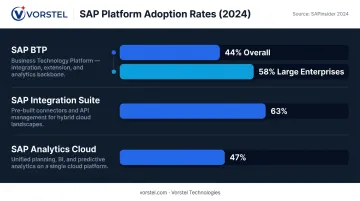
Consultancies that design and deploy AI-assisted workflows — using SAP's Joule capabilities or BTP AI services — are actively shortening financial close cycles and reducing manual procurement steps for clients today.
Industry Vertical Specializations
Out-of-the-box SAP configurations don't account for sector-specific compliance rules, reporting structures, or operational workflows. Consultancies with vertical depth configure and extend SAP to meet those demands:
- Manufacturing (quality management, MES integration)
- Retail and e-commerce (omnichannel order management)
- Logistics and distribution (EWM, transport management)
- Financial services (regulatory reporting, risk management)
How to Choose the Right SAP Consultancy
1. Verified delivery track record
Ask for case studies from comparable projects — similar industry, system scope, and company size. SAP Gold or Silver partner badges reflect sales performance metrics, not consulting quality. The project history matters more than the badge.
2. Methodology and transparency
A credible consultancy explains exactly how they approach discovery, design, testing, and hypercare — with defined milestones, escalation processes, and documented deliverables. Vague commitments ("we'll figure it out as we go") are a red flag.
3. Ability to engage at any project stage
Many organizations aren't starting from zero. They need a consultancy to rescue a stalled implementation, optimize a live system, or accelerate a specific module rollout. Partners who require a full restart before they can contribute add cost and delay.
Vorstel Technologies is structured for exactly this scenario. With 200+ SAP project engagements, the firm can step into an active implementation, a stalled rollout, or a post-go-live optimization without requiring a full restart. Their Zero-Fee Solution Evaluation lets organizations get expert input before any financial commitment — a low-risk way to test a partner's depth before signing on.
Frequently Asked Questions
What is the difference between an SAP consultancy and an independent SAP consultant?
An SAP consultancy is a structured firm with teams covering multiple modules, project governance, and defined delivery accountability. An independent consultant is a single practitioner. For complex implementations, consultancies provide broader coverage and risk management that solo consultants typically cannot match.
How long does an SAP implementation project typically take?
Timelines range from a few months for focused cloud deployments to 18–24+ months for full greenfield enterprise rollouts. ASUG's 2025 research puts the average S/4HANA transition at around 18 months — though a thorough discovery phase will produce a more precise estimate for your specific scope.
Do businesses still need an SAP consultancy if they have an internal IT team?
Internal IT teams manage day-to-day operations effectively, but SAP implementations require specialized module expertise, project governance, and change management capabilities that go well beyond standard IT skill sets. An external consultancy complements rather than replaces the internal team.
What industries benefit most from SAP consulting services?
Manufacturing, retail and e-commerce, logistics, financial services, and energy see the strongest ROI — generally any industry with complex procurement, production, finance, or supply chain processes that benefit from properly configured ERP environments.
How do I evaluate whether my SAP consultancy is delivering value?
Track milestone adherence, system performance against baseline KPIs (processing speed, error rates, downtime), and user adoption rates. A strong consultancy also proactively surfaces improvement opportunities rather than waiting to be asked.
What is SAP S/4HANA and why are so many businesses migrating now?
S/4HANA is SAP's next-generation ERP built on the in-memory HANA database, enabling real-time analytics and a simplified data model. SAP's mainstream maintenance for the older ECC platform ends in 2027 (extended support runs to 2030 at a premium), making migration a time-sensitive priority for organizations still running legacy SAP.