The tension many organizations face is real: internal teams often believe they can manage the complexity themselves, while bringing in outside consultants feels like an added line-item expense. But that framing misses the point entirely.
This article gives you a clear, practical framework for deciding whether hiring an ERP consulting firm is the right call for your situation — based on your project complexity, internal capabilities, and what failure actually costs.
Key Takeaways
- ERP consulting firms cover the full project lifecycle — selection, implementation, data migration, and change management
- You likely need one if your project is complex, your team lacks ERP experience, or a previous attempt has stalled
- Consulting fees are typically far less than the cost of a stalled rollout or costly rework
- A seasoned internal ERP team handling a straightforward deployment may not need outside help
What Does an ERP Consulting Firm Actually Do?
An ERP consulting firm guides your organization through the full implementation lifecycle. That's different from what an ERP vendor does (sell and deploy their own software) or what a systems integrator does (build technical connections between platforms).
A consulting firm works on your behalf — not the vendor's.
The Core Scope
According to Prosci's ERP implementation framework, a successful ERP deployment spans six phases: Preparation, Planning, Execution, Testing, Go-Live, and Post-Implementation Review. Consulting firms can be engaged across all six or brought in at specific stages.
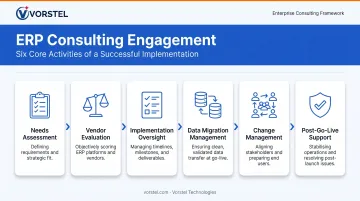
Their typical activities include:
- Needs assessment — stakeholder interviews, workflow mapping, gap analysis, and translating business goals into system requirements
- Vendor evaluation — objective platform comparison based on your functional needs, integration fit, scalability, and total cost of ownership
- Implementation oversight — project governance, milestone tracking, risk management, and keeping delivery on schedule
- Data migration management — structured methodology for moving legacy data into the new schema cleanly
- Change management — preparing your teams for the transition so adoption actually happens post-go-live
- Post-go-live support — stabilizing the system and addressing issues that surface after launch
Not every phase carries equal risk — but consultants earn their place in all of them.
Where Consulting Decisions Change Outcomes
Most teams underestimate the needs assessment phase. When consultants start by mapping existing workflows and identifying gaps before any configuration begins, they prevent the most expensive type of problem: discovering mid-project that the ERP doesn't fit how your business actually operates.
Firms like Vorstel Technologies are also built to engage at any project stage — including stepping into a stalled or troubled implementation to diagnose what went wrong and redirect the effort.
6 Signs You Should Hire an ERP Consulting Firm
Think of this as a checklist. If several of these apply, bringing in a consulting firm isn't optional — it's advisable.
Sign 1: Your Internal Team Has Limited ERP Experience
ERP implementations demand specialized knowledge across technical configuration, data architecture, and change management. Most internal IT teams, regardless of how capable they are, haven't managed a full ERP lifecycle before.
According to Panorama Consulting's 2026 ERP Report, schedule overruns were most commonly tied to organizational issues — including governance failures, resistance to change, and inadequate process redesign. Less than a quarter of organizations reported an intense focus on change management. These aren't software problems. They're expertise gaps — and gaps like these don't close themselves mid-project.
Sign 2: Your Project Involves Complex Data Migration or System Integrations
Data migration is where ERP projects most often fail. Moving legacy records into a new schema involves:
- Cleaning duplicates and resolving format incompatibilities
- Validating data integrity across departments
- Connecting third-party tools like CRM, SCM, and finance systems
Without a structured methodology, errors compound. An ERP loaded with bad data is unreliable from the moment it goes live. TechTarget identifies the primary data migration challenges as poor data quality, incompatible formats, resource constraints, and system compatibility issues — each requiring deliberate process, not just technical effort.
Sign 3: You're Running Multiple Business Units, Regions, or Compliance Environments
Multi-entity and multi-country deployments introduce complexity that multiplies risk at every layer:
- Regulatory compliance across jurisdictions
- Currency, language, and workflow configuration
- Cross-border data-transfer regulations and data governance
Gartner identifies data governance, data integrity, and cross-border data-transfer regulations as major ERP implementation roadblocks in global contexts. 56.5% of organizations surveyed in Panorama's 2026 report were multinational — which gives a sense of how common this complexity actually is, even among mid-market companies.
Sign 4: A Previous ERP Implementation Stalled, Failed, or Went Over Budget
When a prior attempt ran into significant delays, blew past budget, or never fully went live, the software is rarely the root cause. The failure usually traces back to gaps in project governance, requirements definition, or change management.
The cost of getting this wrong can be severe. TechTarget documents cases like National Grid's two-year cleanup costing $585M and Revlon's SAP implementation failure — following a merger — that caused $64M in lost sales and triggered investor litigation.
A consulting firm can perform a root-cause analysis and design a recovery plan before the situation compounds further.
Sign 5: Your Organization Is Undergoing Simultaneous Change
M&A activity, aggressive growth, or a parallel digital transformation makes an ERP implementation dramatically harder. The business becomes a moving target, and aligning ERP scope to a shifting organizational structure requires dedicated expertise.
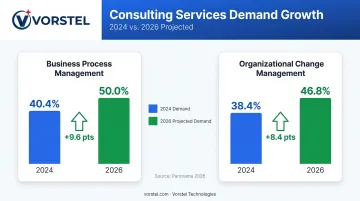
Panorama's 2026 data reflects this reality: demand for Business Process Management guidance jumped from 40.4% to 50.0%, and Organizational Change Management from 38.4% to 46.8%. Technical deployment alone doesn't hold when the organization underneath it keeps shifting.
Sign 6: You Lack a Vendor-Neutral Evaluation Process
ERP vendors present their own platforms favorably. The risk: you end up selecting a system that fits the vendor's capabilities rather than your business requirements.
An independent consulting firm evaluates options based on your needs — functionality, scalability, integration fit, and total cost of ownership — without a financial stake in the outcome. This matters most during vendor selection, where a wrong decision locks you into years of consequences.
When You Might NOT Need an ERP Consulting Firm
Consulting isn't always necessary. Smaller, well-scoped projects with the right internal capabilities can succeed without it.
You may be able to proceed internally if:
- Your deployment is single-location with no complex integrations
- You have an experienced in-house ERP lead who has managed a full lifecycle before
- Your existing system is straightforward to migrate from
- Your organization isn't undergoing simultaneous structural change
That said, lightweight advisory support — rather than full consulting — is still worth considering for vendor contract negotiation and requirements sign-off, even on simpler projects.
Watch out for vendor dependency: Some ERP platforms include strong implementation support from their own teams. That support is valuable — but it isn't vendor-neutral. If your team doesn't own requirements definition and change management, relying solely on vendor support still creates real risk.
The Real Cost: Consulting Fees vs. Getting It Wrong
The instinct to treat consulting fees as an avoidable expense misses how the math actually works.
What "Over Budget" Actually Looks Like
Panorama's 2024 ERP Report puts the median ERP project cost at $450,000 with a median duration of 15.5 months. More than a quarter of organizations in the 2026 report went over budget — with the most common driver being unexpected additional technology needs. Almost a quarter ran over schedule, primarily due to organizational issues.
For a median project, a 20% cost overrun translates to $90,000 or more in unplanned spend — even on a carefully budgeted project.
That figure also excludes the operational cost of running parallel systems, consuming internal resources beyond planned hours, and delaying the business value the ERP was supposed to deliver.
The Hidden Costs Consulting Firms Prevent
These are the costs that rarely appear in initial project budgets:
- Overpaying for licenses when vendor contracts aren't negotiated with experience behind them
- Accumulating scope creep as departments request modifications without clear upfront requirements
- Driving up post-go-live support costs through inadequate user training and low adoption
- Discovering defects after launch, where fixes cost significantly more than catching them during UAT
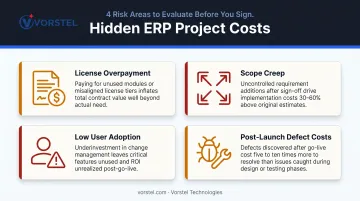
Catching these early is precisely where consulting fees pay for themselves — and it sets the stage for the ROI conversations that come after go-live.
What Good Looks Like
Demand for post-implementation and benefits realization support jumped from 28.3% to 42.1% between Panorama's 2024 and 2026 surveys. Organizations aren't just focused on finishing deployments — they're tracking whether ERP investments actually deliver. A well-run implementation with proper consulting support creates the conditions for that ROI to materialize.
What to Look for in an ERP Consulting Partner
Not all consulting firms are equal. Use these criteria when evaluating a potential partner:
Industry and platform expertise Look for documented experience in your specific industry (manufacturing, retail, e-commerce) and deep expertise with the ERP platforms you're evaluating. Vague generalist credentials are a warning sign. A firm with 200+ SAP projects and a 95% Salesforce implementation success rate brings platform depth that actually matters when things get complicated during go-live.
Independence and methodology Confirm the firm has no financial incentive tied to recommending a specific vendor. Ask for a documented project methodology that covers requirements gathering, milestone tracking, risk management, and change management. The right partner dedicates resources across planning, design, implementation, and post-go-live support — not just the final sprint. TechTarget's partner selection guidance outlines this as a baseline expectation.
Track record and references Ask for case studies from projects with comparable scope and industry. Measurable outcomes matter more than a simple completion certificate. Look for:
- On-time and on-budget delivery rates
- Post-go-live user adoption metrics
- Client references willing to speak to the recovery process, not just the launch
Any firm can claim they finished a project. Fewer can show what the client actually gained from it.
Ability to engage at any stage Some consulting firms only work on new, from-scratch implementations. If there's any chance you'll need mid-course correction, confirm upfront that the firm can join an ongoing project, diagnose issues, and drive recovery without restarting from zero.
Frequently Asked Questions
How much does an ERP consultant cost?
ERP consulting costs vary based on scope and engagement model (hourly advisory, fixed-fee, or full-lifecycle retainer). The more relevant question: what does a failed or over-budget implementation cost without one?
What does an ERP consulting firm actually do?
Consulting firms cover the full implementation lifecycle: needs assessment, vendor evaluation, implementation oversight, data migration management, change management, and post-go-live support. They work on behalf of the client, not the vendor.
When should you NOT hire an ERP consulting firm?
Smaller organizations with experienced internal ERP leads, simple single-system deployments, and limited integration requirements may manage without full consulting. Lightweight advisory support — particularly for vendor selection and requirements sign-off — is still worth considering.
What's the difference between an ERP vendor and an ERP consulting firm?
ERP vendors sell and implement their own software and have an inherent interest in its adoption. Independent consulting firms evaluate multiple platforms and advocate for your requirements, not the vendor's capabilities.
Can an ERP consulting firm help if our implementation is already underway?
Yes. Experienced firms can step into a project at any stage — including mid-implementation or after a stalled rollout — to diagnose root causes, restructure the approach, and drive the project to a successful outcome.
How long does an ERP consulting engagement typically last?
Selection-only engagements typically run a few months. Full lifecycle consulting spans 12–18 months or longer for enterprise deployments, with industry research pointing to median project durations of 9–15 months depending on organizational scale.