IT systems are growing faster than most organizations can manage them. Security threats multiply. Cloud environments sprawl. ERP migrations stall. And internal IT teams — already stretched thin keeping operations running — rarely have the bandwidth to step back and think strategically.
That's where IT management consulting comes in. This guide covers what it is, what consultants actually do, the tangible business outcomes it delivers, and how to decide whether your organization needs it.
Key Takeaways
- IT management consulting aligns technology systems with strategic business goals, going well beyond fixing immediate problems.
- Consultants assess current IT environments, identify gaps, and lead implementation of targeted solutions.
- Key benefits include reduced downtime, stronger cybersecurity, faster digital transformation, and better ROI on technology spend.
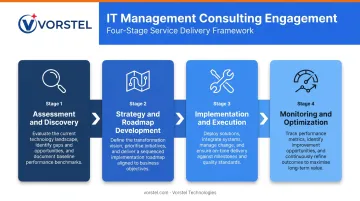
- Engagements typically follow four stages: assessment, strategy, implementation, and ongoing optimization.
- The right partner brings industry-specific expertise and a track record of measurable outcomes — not generic advice.
What Is IT Management Consulting?
IT management consulting is a professional service that helps organizations optimize their technology environments for performance, security, and strategic alignment. The emphasis is on strategic — consultants focus on building technology infrastructure that serves where the business is headed, not just where it stands today.
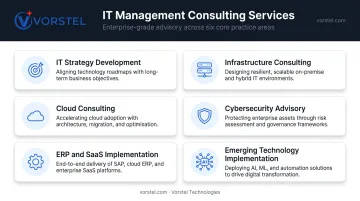
The scope is broad. Core service areas typically include:
- IT strategy development — defining how technology investments should support business priorities
- Infrastructure consulting — designing scalable, resilient network and systems architecture
- Cloud consulting — planning migrations, optimizing spend, and managing multi-cloud environments
- Cybersecurity advisory — identifying vulnerabilities, ensuring compliance, and building layered security frameworks
- ERP and SaaS platform implementation — selecting, deploying, and optimizing platforms like SAP, Salesforce, or Microsoft 365
- Emerging technology implementation — AI, machine learning, and automation solutions tied to measurable outcomes
Who It Serves
IT management consulting was once associated primarily with large enterprises. That's changed. Fast-growing startups, mid-market companies modernizing legacy systems, and global enterprises managing complex ERP environments all engage IT management consultants regularly.
The global IT consulting market was valued at $111.95 billion in 2025 and is projected to reach $209.99 billion by 2030 — a 13.4% CAGR — reflecting how broadly organizations across every sector are turning to external strategic expertise.
IT Management Consulting vs. IT Management
The distinction matters. IT management is operational: keeping systems running, resolving help desk tickets, managing licenses, maintaining uptime. IT management consulting is strategic: evaluating whether those systems are the right ones, whether they're configured optimally, and whether they're actually serving business goals.
A simple example: IT management ensures your ERP runs without errors today. IT management consulting decides which ERP to implement, designs the migration plan, and ensures the platform delivers ROI after go-live.
What Does an IT Management Consultant Do?
IT management consultants sit at the intersection of business strategy and technology execution. Experienced consultants take ownership of complex technology projects from diagnosis through delivery, not just advisory memos.
Assessing and Diagnosing Current IT Systems
Every engagement starts with a thorough audit. Consultants evaluate network infrastructure, software stack, security posture, data management practices, and how well current IT actually supports business objectives. The output is an honest, evidence-based picture of where things stand.
Building IT Strategy and Roadmaps
From the assessment findings, consultants build prioritized technology roadmaps. This typically covers:
- Identifying capability gaps across systems and teams
- Recommending platforms or migrations — ERP upgrades, cloud transitions, AI implementations
- Sequencing initiatives by business impact and organizational readiness
Leading Implementation and Managing Change
Recommending a solution is one thing. Delivering it is another. Experienced consultants oversee software rollouts, system integrations, cloud migrations, and DevOps transformations — while actively managing the human side of change to drive adoption and minimize disruption across internal teams.
Cybersecurity and Risk Management
Implementation work also surfaces security gaps that need addressing in parallel. Consultants identify vulnerabilities, recommend compliance frameworks (GDPR, HIPAA, and others depending on the industry), and build layered security postures that account for the expanded attack surfaces that come with hybrid and remote environments.
Long-Term Advisory and Optimization
The relationship often extends well beyond go-live. Ongoing advisory engagements involve performance monitoring, periodic reviews, and recommendations as the business scales — ensuring the technology stack keeps pace with business growth rather than lagging behind it.
Why IT Management Consulting Matters: Key Business Benefits
The cost of poor IT strategy is rarely visible until something breaks — a security breach, a failed ERP migration, or a competitor who moved faster because they made smarter technology decisions. Here's what the right consulting engagement actually delivers.
Faster Digital Transformation with Less Risk
Most digital transformations underperform. BCG found that only 1 in 4 transformations deliver value-creating, enduring change — but formal transformation programs with long-term strategic orientation achieve 12.5 percentage points higher total shareholder return over five years. The difference comes down to structured methodology, clear accountability, and phased delivery — the core of what IT management consultants bring to the table.
Reduced Downtime and Operational Disruption
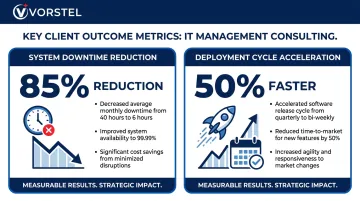
Operational continuity depends on identifying failure points before they become outages. Through strategic consulting engagements, Vorstel Technologies has helped enterprise clients achieve a 45% reduction in system downtime and 92% faster deployment cycles — results that follow when technology decisions are made with operational impact in mind, not just technical specs.
Better Decision-Making Through Data and Technology Alignment
Siloed systems produce siloed decisions. IT management consultants help organizations build integrated data environments where real-time insights reach the people who need them. When leadership can trust their data, two things happen: strategic decisions improve, and the gap between identifying an opportunity and acting on it narrows significantly.
Cost Optimization and Maximized ROI on Technology Investments
Technology overspend is a persistent problem. Flexera's 2026 State of the Cloud report found that estimated wasted cloud spend rose to 29%, reversing a five-year downward trend — with 84% of organizations struggling to manage cloud spend and exceeding budgets by an average of 17%.
Consultants address this directly by:
- Identifying redundant tools and underutilized licenses
- Consolidating and rationalizing the tech stack
- Aligning spend to actual business priorities
In most cases, the consulting investment recovers itself through operational savings alone.
How the IT Management Consulting Process Works
Most engagements follow a structured but flexible model. Some organizations need end-to-end consulting from strategy through implementation. Others engage consultants for a specific challenge — a cloud migration, a security overhaul, a stalled ERP project. The process adapts to fit.
Stage 1: Assessment and Discovery
Consultants gather information through stakeholder interviews, system audits, and workflow analysis. The output is a clear, evidence-based picture of where the organization stands technologically — what's working, what isn't, and where the most critical gaps lie.
Stage 2: Strategy and Roadmap Development
Consultants translate assessment findings into a prioritized strategy. This includes platform recommendations, migration plans, security frameworks, and a phased implementation schedule aligned with business goals and budget cycles. The roadmap is sequenced by impact and the organization's realistic capacity to execute — not aspirations detached from constraints.
Stage 3: Implementation and Execution
Strategy meets reality in this phase. Consultants oversee technology deployments, integrations, and change management, coordinating with internal teams and third-party vendors to keep execution on track. Deep platform experience — in environments like SAP, Salesforce, or cloud-native DevOps pipelines — is what separates execution that holds from one that stalls mid-project.
Stage 4: Monitoring, Optimization, and Ongoing Support
Post-implementation, the focus shifts to performance monitoring and continuous improvement. Periodic reviews ensure the technology environment evolves alongside the business — and that investments made in earlier phases keep delivering value rather than accumulating into technical debt.
How to Choose the Right IT Management Consulting Partner
Not all consulting relationships deliver equal value. The evaluation criteria that matter most:
- Domain expertise — Deep experience in your industry and your specific technology stack. Generic consulting produces generic results.
- Customized approach — Look for evidence that engagements are tailored to your situation, not templated from a previous client.
- Cybersecurity practices — Any consulting partner touching your IT environment should demonstrate strong security governance in their own operations and recommendations.
- Transparent communication — Deliverables, timelines, and progress should be clear throughout — not just in the proposal.
- Proven track record — Client case studies, satisfaction metrics, and verifiable outcomes matter more than credentials listed on a website.
Technical fit is only part of the equation — cultural fit and engagement flexibility matter just as much. The right firm should be able to enter at any stage of a project, not just from day one.
Vorstel Technologies is built precisely for this. The firm can take over assignments mid-stream, offers a Zero-Fee Solution Evaluation, and brings hands-on expertise across SAP, Microsoft, Salesforce, AI, cloud, and DevOps to clients across global markets.
Before committing to any partner, ask directly:
- Do you have experience in our specific industry?
- Can you scale with us as our needs evolve?
- What does post-implementation support look like?
- What is your client satisfaction track record, and can you share relevant case studies?
Frequently Asked Questions
What is an IT management consultant?
An IT management consultant is a specialist who helps businesses assess, strategize, and improve how they use technology. They combine technical expertise with business acumen to align IT systems with organizational goals and deliver measurable outcomes across the business.
What is the difference between IT management and IT management consulting?
IT management handles day-to-day operations and maintenance of existing systems. IT management consulting is strategic and project-based — focused on evaluating technology gaps, recommending improvements, and leading transformation initiatives that change how technology serves the business.
When should a business hire an IT management consultant?
Key triggers include digital transformation initiatives, cloud migration or ERP implementation, growing cybersecurity risks, misaligned technology spend, or when internal IT teams lack the capacity or expertise for strategic projects.
How long does an IT management consulting engagement typically last?
Timelines vary widely — a targeted technology audit may take a few weeks, while a full-scale digital transformation program can span multiple years. Most firms structure engagements in phases to manage cost and risk.
What industries benefit most from IT management consulting?
Manufacturing, retail, financial services, healthcare, and e-commerce tend to see the most immediate value — particularly organizations undergoing significant growth, regulatory change, or legacy system modernization.
How much does IT management consulting cost?
Costs vary based on scope, engagement model, and firm expertise — but the practical measure is ROI, not the fee. The right investment typically eliminates operational inefficiencies and technology overspend that far exceed what the engagement costs. Vorstel Technologies offers a zero-fee initial consultation to scope engagements before any commitment.