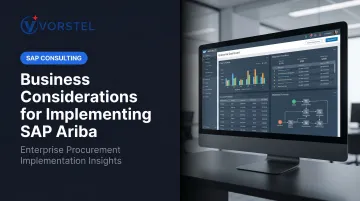
But "deploying SAP Ariba" and "successfully implementing SAP Ariba" are two different things. The platform's breadth is both its strength and its complexity. Organizations that treat it as a software rollout rather than a business transformation initiative routinely struggle with delayed go-lives, poor adoption, and ROI that never materializes.
This guide is written for business leaders, not IT teams. It covers the strategic decisions, planning fundamentals, and organizational factors that determine whether an SAP Ariba implementation delivers real value — or becomes an expensive lesson.
Key Takeaways
- SAP Ariba spans the full source-to-pay cycle, but successful implementation requires deliberate business planning before any configuration begins.
- Supplier network readiness, data quality, integration complexity, and scope definition are the factors most likely to derail timelines and ROI.
- Change management is consistently underestimated — Prosci research shows projects with excellent change management are up to 7x more likely to meet objectives.
- A phased rollout reduces risk and accelerates time-to-value over a full deployment at once.
- Partnering with an experienced SAP implementation firm compresses timelines and prevents costly mid-project course corrections.
What Is SAP Ariba and Why Are Businesses Implementing It?
SAP Ariba is a cloud-based spend management suite that covers the full source-to-pay (S2P) process: strategic sourcing, contract management, guided buying, supplier lifecycle management, invoicing, and analytics. It runs on the SAP Business Network, the world's largest B2B trading platform, supporting over $6 trillion in annual transactions.
What Organizations Are Trying to Achieve
The business case for SAP Ariba typically centers on four goals:
- Gain spend visibility through competitive sourcing and consolidated supplier data
- Replace manual, email-based procurement with automated, policy-driven workflows
- Enforce contract terms and purchasing policies at the point of purchase
- Improve supplier onboarding, communication, and performance tracking
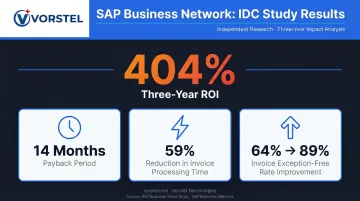
The business case has strong empirical backing. A 2025 IDC study sponsored by SAP reported that organizations using SAP Business Network achieved an average 404% three-year ROI with a 14-month payback period. Invoice processing time dropped 59%, and the share of invoices processed without exception rose from 64% to 89%.
Greenfield vs. Brownfield: Why It Matters from Day One
Organizations typically approach SAP Ariba from one of two starting points — and each demands a different planning strategy.
Greenfield implementations start from scratch — no existing Ariba system, no legacy data to untangle. Teams can design procurement processes around best practices rather than working around entrenched habits.
Brownfield implementations involve migrating from a legacy procurement system or ERP-based purchasing process. The added complexity is real: legacy data must be cleansed before migration, supplier relationships need to be transitioned to the new platform, and process habits built around the old system drive the bulk of change management effort. That last point — user adoption — is typically where brownfield projects stall.
Building the Business Case: Cost, ROI, and Strategic Value
Before any configuration begins, leadership needs a documented business case. That means a structured justification that ties investment to measurable outcomes — not just a slide deck.
What a Strong Business Case Covers
- Current-state pain points (manual processes, poor spend visibility, invoice exceptions)
- Projected efficiency gains with baseline metrics to compare against post-go-live
- Estimated cost savings across procurement categories
- Alignment to broader strategic goals (supplier risk reduction, ESG compliance, end-to-end process digitization)
Understanding Implementation Costs
SAP Ariba is a subscription-based platform. SAP's official onboarding resources indicate that deployment services for initial setup and configuration are included with the subscription — but that covers only baseline configuration, not the full cost of implementation. Total cost varies based on:
- Number and complexity of modules licensed
- Organization size and number of business units in scope
- Integration requirements (ERP, financial systems, supplier portals)
- Data migration and cleansing effort
- Training and change management investment
There is no publicly verified industry-standard cost range for full enterprise SAP Ariba deployment. Validate any estimate directly with SAP or through your implementation partner's formal scoping process.
ROI Expectations and Timelines
Short-term gains tend to come from process automation — reducing manual purchase order creation, streamlining approvals, and cutting invoice processing time. Longer-term strategic value comes from spend analytics, supplier risk management, and contract compliance enforcement. Plan for both, and don't measure success at the three-month mark.
Define your success metrics before go-live. Without pre-established benchmarks, ROI assessment after the fact becomes guesswork. Common metrics include:
- Procurement cycle time (days from requisition to PO)
- Spend under management (percentage of total spend processed through the platform)
- Supplier onboarding time
- Invoice processing accuracy and exception rate
- Cost savings as a percentage of addressable spend
Key Business Considerations Before Implementing SAP Ariba
These are the factors most likely to determine whether your implementation delivers on its promise. Treat each as a decision point, not just a checklist item.
Supplier Network Readiness
SAP Ariba's collaborative value depends on suppliers actually using the network. The good news: SAP reports that most buyers find 50–80% of their suppliers are already transacting on SAP Business Network. The challenge lies in the remaining 20–50%.
Suppliers not on the network create manual workarounds — email confirmations, phone-based order acknowledgments, and disconnected invoicing — that offset the efficiency gains you're building toward.
Before finalizing your business case:
- Segment suppliers by spend volume and transaction frequency
- Identify which top-tier suppliers are already on the Ariba Network
- Assess onboarding effort and timeline for suppliers who aren't
On supplier fees: Standard accounts are free. Enterprise accounts incur usage-based fees only after a supplier both transacts five documents and exceeds $50,000 USD in volume within a given buyer-supplier relationship. For most mid-sized suppliers, participation costs are minimal — but this should be communicated clearly during onboarding to prevent resistance.
Data Quality and Governance
Poor data going into SAP Ariba produces poor analytics, failed integrations, and procurement decisions based on inaccurate information. Supplier master data with duplicate records, inconsistent naming conventions, or outdated contact details will cause problems from day one.
Deloitte's ERP transformation guidance is unambiguous: data profiling, cleansing, and standardization are prerequisites for project success — not optional preparation steps. Incomplete or inconsistent records cause costly disruptions during and after migration.
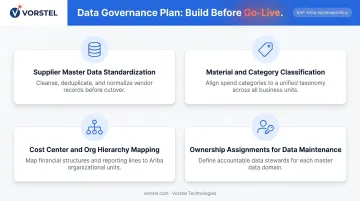
Establish a data governance plan before build begins — not after go-live problems surface. This should include:
- Supplier master data standardization
- Material and category classification
- Cost center and organizational hierarchy mapping
- Ownership assignments for ongoing data maintenance
SAP's own master data integration framework supports importing master data from SAP ERP or S/4HANA directly — but the quality of what you import determines the quality of what you get out.
System Integration Requirements
SAP Ariba doesn't operate in isolation. It needs to exchange data with your ERP, financial systems, and potentially supplier portals. SAP Integration Suite's managed gateway supports integration with both SAP S/4HANA and SAP ECC, covering purchase orders, invoices, goods receipts, and supplier data.
Integration decisions that must be resolved during planning — not mid-build:
- Real-time versus batch integration (each has latency and cost tradeoffs)
- Data format compatibility between Ariba and your ERP
- Error handling and exception routing protocols
- Non-SAP ERP systems require additional middleware consideration
Integration complexity directly affects cost, timeline, and risk. Underestimating it is one of the most common reasons enterprise implementations run over budget.
Platform Complexity and Feature Scope
SAP Ariba spans strategic sourcing, guided buying, contract management, supplier lifecycle management, and invoicing. Attempting to activate all of these in a single deployment creates configuration complexity, extended timelines, and user overload.
The platform's capabilities also differ meaningfully between direct procurement (raw materials, production inputs) and indirect procurement (services, office supplies, IT). These categories require separate planning across three dimensions:
- Data structures — direct procurement ties to BOMs and production schedules; indirect does not
- Approval workflows — indirect spend often involves more stakeholders and cost centers
- Supplier dynamics — direct suppliers tend to be fewer, higher-volume, and more integration-ready
Defining scope across both procurement types early prevents mid-project rework and keeps timelines realistic.
Defining Scope and Planning Your Implementation Roadmap
Scope definition is one of the most consequential decisions in an SAP Ariba implementation. Getting it wrong — usually by trying to do too much at once — is a primary driver of delayed go-lives and cost overruns.
Why Phased Rollouts Outperform Full-Scale Launches
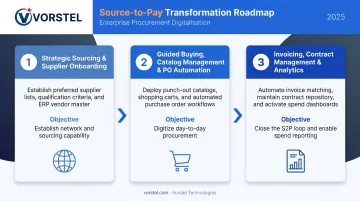
Deploying all modules across all business units at once concentrates risk and pushes business value further into the future. It also stacks change management demands that are hard to absorb simultaneously. A phased approach spreads both the effort and the risk — and delivers early wins that build momentum.
A Practical Phase Sequencing Example
| Phase | Scope | Primary Objective |
|---|---|---|
| Phase 1 | Strategic sourcing, supplier onboarding, supplier portal | Establish network and sourcing capability |
| Phase 2 | Guided buying, catalog management, PO automation | Digitize day-to-day procurement |
| Phase 3 | Invoicing, contract management, analytics | Close the S2P loop; enable spend reporting |
SAP's recommended framework — SAP Activate — structures deployments across Prepare, Explore, Realize, and Deploy phases. For midsize organizations or fixed-scope rollouts, SAP Ariba Snap can compress that timeline to 12 weeks or less.
Choosing the Right Implementation Partner
Organizations without deep SAP Ariba experience benefit from working with a partner who has. The right partner doesn't just configure the system — they anticipate integration issues before they surface, apply reusable deployment patterns, and accelerate user adoption through structured enablement.
Vorstel Technologies has completed 200+ SAP project implementations and delivers deployments 92% faster than industry averages. Their SAP Ariba practice spans sourcing, contract management, and supplier collaboration, with typical delivery timelines of 3–5 months. Organizations still assessing their readiness can start with Vorstel's Zero-Fee Solution Evaluation.
The partner you select shapes your internal execution model — which makes the governance structure you build around them equally important.
Governance: Who Owns the Implementation
Implementation failures are more often governance failures than technology failures. Establish your project structure before kickoff:
- Executive sponsor — visible leadership commitment; escalation authority
- Procurement lead — process ownership and business requirements sign-off
- IT architect — integration design and system landscape decisions
- Change management lead — communication, training, and adoption planning
Without these roles filled and empowered, decisions stall, priorities conflict, and the implementation drifts.
Change Management and Organizational Readiness
Implementing SAP Ariba is as much a people challenge as a technology one. Approval hierarchies shift. Supplier communication moves to the network. Buyers use guided buying instead of calling a supplier directly. Finance processes invoices differently. Each of these changes requires people to learn new behaviors, and many of them will resist.
Prosci research puts the impact clearly: projects with excellent change management are up to 7x more likely to meet their objectives than those with poor change management. McKinsey's research on digital transformations found that only 16% of organizations successfully improved performance and sustained those changes.
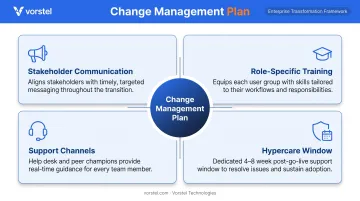
Core Components of an Effective Change Management Plan
- Stakeholder communication: Communicate the purpose, scope, and timeline repeatedly across multiple channels — email alone won't cut it
- Role-specific training: Buyers, finance teams, approvers, and suppliers each need different training content; one-size-fits-all sessions lose people fast
- Support channels: Help desk access, floor walkers during early go-live, and peer champions reduce escalations and build confidence
- Hypercare window: A structured post-go-live support period (typically 4–8 weeks) catches issues before they solidify into bad habits
Internal readiness is only half the equation. Strategic suppliers transacting through the Ariba Network need guided onboarding too — suppliers who don't know how to use the platform become a source of friction, not collaboration.
Vorstel Technologies offers a Zero-Fee Solution Evaluation for organizations that want a clear readiness picture before committing to a full implementation. The consultation covers IT strategy and digital transformation readiness, delivered virtually at no cost.
Frequently Asked Questions
What is SAP Ariba implementation?
SAP Ariba implementation is the process of deploying SAP's cloud-based procurement platform: configuring modules, integrating with existing ERP and financial systems, migrating master data, and enabling users to automate and manage source-to-pay processes across the organization.
How much does SAP Ariba implementation cost?
There is no single published cost range from SAP or major analysts. Total cost depends on licensed modules, deployment scope, integration complexity, data migration effort, and change management investment. Budget should also account for ongoing subscription fees and post-go-live support — not just the initial deployment.
How long does an SAP Ariba implementation typically take?
It depends on scope. Preconfigured solutions like SAP Ariba Snap can go live in 12 weeks or less for midsize organizations. Fixed-scope rapid deployments have been completed in 10 weeks. Full enterprise rollouts across multiple business units take considerably longer. Scoping tightly and phasing the rollout are the two most consistent drivers of faster delivery.
What are the most common reasons SAP Ariba implementations fail?
The four most consistent failure factors are: inadequate change management, poor data quality at migration, underestimated integration complexity, and attempting to deploy too many modules at once without a structured phasing plan.
Do suppliers need to pay to join the SAP Ariba Network?
Standard accounts are free. Enterprise account fees only apply after a supplier transacts five documents and exceeds $50,000 USD in volume within a specific buyer relationship. This means smaller suppliers can participate without cost, so set that expectation clearly when onboarding them.
Should we implement SAP Ariba in phases or all at once?
A phased approach is strongly recommended for most organizations. It reduces deployment risk, allows teams to learn and adjust between phases, and delivers measurable business value faster since early phases reach production while later ones are still in configuration.