Yet activity alone doesn't guarantee results. McKinsey found that organizations captured a median of only 31% of expected revenue benefits from recent transformations — with top performers capturing 50%. The difference isn't effort. It's execution.
This guide covers what business transformation actually means, its four core pillars, the stages it unfolds across, proven acceleration strategies, common failure traps, and how to measure whether it's working.
Key Takeaways
- Business transformation = fundamental reinvention of strategy, process, people, and technology — not incremental improvement
- Four interdependent pillars drive it — neglect any one and the others stall
- The journey moves through 5 distinct stages, from diagnosis through sustained evolution
- Speed depends on urgency, internal champions, and partners who can execute — not just advise
- Success is measurable — but only if you capture baselines before you begin
What Is Business Transformation (and Why It Matters Now)
Business transformation is the organization-wide reimagining of how a company operates, delivers value, and competes. True transformation changes the business model itself — how value is created, how customers are served, and how the organization executes at every level. A technology upgrade or process efficiency project doesn't qualify.
The urgency is real. According to McKinsey research, nine in ten C-level leaders reported their organizations had pursued at least one large-scale transformation in the previous two years. But prevalence doesn't equal success — most organizations leave significant value on the table.
Business Transformation vs. Digital Transformation
These terms get conflated constantly. Here's the actual distinction:
- Digital transformation focuses on adopting and integrating technology to create value at scale
- Business transformation is broader — encompassing strategic, cultural, operational, and financial change, with digital as one key enabler
Treating transformation as purely a technology initiative is one of the most reliable paths to a failed program. When technology is expected to carry the strategic, cultural, and operational dimensions on its own, those dimensions don't get carried — they get ignored.
The 4 Pillars of Business Transformation
Business transformation stands on four interdependent pillars: Strategy, Process, People & Culture, and Technology. Weakness in any single pillar undermines the rest. Organizations that try to transform through technology alone, without addressing strategy, process, and people simultaneously, consistently underdeliver.
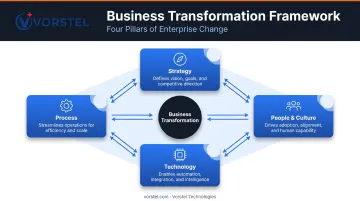
Strategy Pillar
The strategy pillar centers on defining a clear, aspirational future state: what the business is working to become, not just how to improve what already exists.
Effective transformation strategy requires an "outside-in" lens: shaped by market opportunities and evolving customer expectations, not just internal pain points. Leaders must balance short-term operational continuity with long-term ambition, and articulate a vision compelling enough to generate organizational urgency without a crisis forcing the issue.
Process Pillar
Process redesign during transformation should challenge whether a workflow needs to exist at all — not simply whether it can be digitized faster.
Transformation-grade process work involves:
- Mapping current-state workflows to identify genuine waste and duplication
- Questioning the purpose of each process against the future business model
- Redesigning and standardizing those that survive scrutiny
- Eliminating those that don't
The bar is higher than efficiency. The question is whether each process serves the company you're becoming, not the company you've been.
People & Culture Pillar
The people pillar is consistently the most underestimated and the most cited reason transformations fail. Prosci research found that initiatives with excellent change management met or exceeded objectives 88% of the time — compared to just 13% with poor change management.
Three factors matter most:
- Change champions at every level — not just executive sponsors, but mid-level advocates who translate vision into daily action
- Clear communication — employees need to understand how their specific role connects to the transformation goal
- Cultural permission to adapt — people must feel safe questioning old habits and experimenting with new approaches
Technology Pillar
Technology accelerates and enables the other three pillars through cloud infrastructure, AI-powered automation, ERP platforms (SAP, Microsoft, Salesforce), and real-time data integration. Technology choices must be driven by business outcomes, not trends.
This is where experienced implementation partners create real leverage. Vorstel Technologies, for example, works across SAP, Microsoft, and Salesforce implementations with a track record of 92% faster deployment cycles and 45% reduction in system downtime for enterprise clients. Their ability to step into a transformation at any stage means organizations avoid the ramp-up costs that typically come with switching vendors mid-program.
The Stages of Business Transformation
Transformation is a journey, not an event. Organizations at different stages need different strategies and different types of support. These five stages are progressive milestones, not rigid steps — the pace between them varies considerably based on organization size, industry, and competitive urgency.
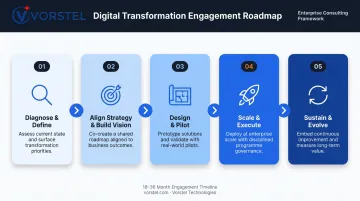
Stage 1: Diagnose and Define
Before any investment decision, leaders need an honest audit of the current state: capability gaps, inefficient processes, outdated systems, and cultural blockers.
Skipping this stage is expensive. Misaligned investments — technology purchases that don't address actual bottlenecks, for instance — are a symptom of inadequate diagnosis. Vorstel's Zero-Fee Solution Evaluation provides exactly this kind of structured starting point, covering automation, IT strategy, cloud, and software development with no upfront commitment.
Stage 2: Align Strategy and Build Vision
With a clear picture of the current state, leadership must define a shared transformation vision connected to measurable business outcomes.
This stage involves:
- Building cross-functional consensus (finance, operations, technology, customer-facing teams)
- Securing executive sponsorship with visible, active commitment
- Defining what "done" looks like — in specific, measurable terms — before execution begins
Stage 3: Design and Pilot
New processes get designed, technology solutions get selected, and controlled pilots run before full deployment. BCG found that initiatives with shorter periods between milestone deadlines and faster impact updates see a 5% to 15% increase in success rates — a direct argument for iterative, disciplined pilots over big-bang launches.
Test with real customers and real data before committing large-scale capital. Assumptions about customer behavior built inside conference rooms rarely survive contact with actual users.
Stage 4: Scale and Execute
Validated pilots move to systematic scaling across functions, geographies, and customer segments. This is the highest-risk stage, where change management, training, and continuous feedback loops are most critical.
BCG research shows transformations typically run 18 to 36 months in full, with the early "funding the journey" phase lasting 6 to 9 months. Most individual projects within that span complete in 2 to 4 months, meaning pace and sequencing decisions during scale-out directly affect how much value the transformation actually delivers.
Stage 5: Sustain and Evolve
Organizations that treat deployment as the endpoint watch their competitive advantage erode within 18 months. Sustained transformation requires ongoing investment — not just in technology, but in the organizational habits that keep change moving.
Sustaining transformation requires:
- Continuous KPI tracking and annual strategy refreshes
- Keeping technology current through updates, integrations, and new AI capabilities
- Building internal improvement capability so evolution becomes part of how the organization operates rather than a recurring special project
How to Accelerate Business Transformation
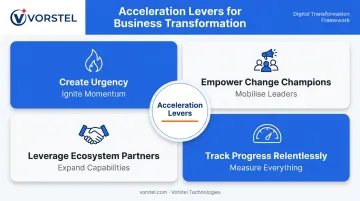
Create and Communicate Urgency
Urgency doesn't require a crisis. Leaders can build an "aspirational model" — a compelling, evidence-backed picture of the future that makes the cost of inaction visible. Market data on competitor moves, customer expectation shifts, and internal performance gaps all serve as urgency fuel.
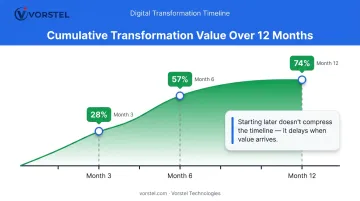
McKinsey data shows successful transformations deliver 28% of fully ramped-up value in 3 months, 57% in 6 months, and 74% in 12 months. Starting later doesn't compress that timeline. It simply delays when the value arrives.
Identify and Empower Change Champions
Transformation mandated only from the top fails in adoption. High-potential individuals across finance, operations, technology, and customer-facing functions need to be identified and empowered to translate vision into team-level action.
These champions don't need to be the most senior people in the room. They need credibility with their peers and genuine belief in the direction.
Leverage Ecosystem Partners
Building custom solutions from scratch is one of the most common budget killers in transformation programs. Partners who bring pre-built capabilities, domain expertise, and established deployment frameworks typically deliver faster results at lower cost than in-house builds — particularly when the organization lacks dedicated transformation capacity.
Vorstel Technologies operates this way in practice — joining client engagements at any stage, from initial assessment through full-scale rollout, without the ramp-up delays that come with switching vendors mid-journey. Their Zero-Fee Solution Evaluation gives organizations a structured way to get expert input before committing to a direction.
Track Progress Relentlessly
Measurement discipline separates transformations that sustain momentum from those that stall after the launch phase. Build tracking into the program structure from day one:
- Define KPIs before execution starts, not after the first review cycle
- Review progress on a fixed cadence (weekly for workstreams, monthly at the leadership level)
- Celebrate visible wins publicly — demonstrated progress is the most effective counter to internal skepticism
- Flag deviations early so course corrections stay manageable
Common Pitfalls to Avoid
Optimizing the current model instead of reimagining it. Many organizations invest heavily in making existing processes faster or cheaper without asking whether those processes belong in the future state at all. True transformation requires willingness to cannibalize what currently works.
Underestimating the people dimension. Technology implementations regularly go live on schedule, then fail in adoption because the workforce wasn't prepared or supported. Research links poor change management to only a 13% rate of meeting transformation objectives — making workforce readiness just as critical as the technology itself.
Scaling before validating with customers. Internally designed solutions that don't match actual customer behavior are expensive mistakes. Enforce test-before-scale discipline through pilots, NPS-style feedback, and direct customer input before committing major capital.
Avoiding these pitfalls won't guarantee transformation success — but falling into them almost always guarantees failure.
How to Measure Business Transformation Success
Measurement must begin before the transformation does. Without baselines, it's impossible to prove — or disprove — that the program is generating value.
Gartner found that only 48% of enterprise-wide digital initiatives meet or exceed their business-outcome targets. The organizations on the right side of that statistic share one characteristic: they define what success looks like before they start spending.
Key KPI Categories
| Category | What to Track |
|---|---|
| Operational | Process cycle times, error rates, system downtime |
| Financial | Revenue growth, cost reduction, technology ROI |
| Customer | NPS, retention rates, digital engagement |
| People | Employee adoption rates, change readiness scores |
Report on these dimensions on a fixed cadence (monthly or quarterly) using scorecard formats that make progress immediately visible to the executive team and board. Leaders who wait for annual reviews to assess transformation health routinely discover problems too late to act on them.
Frequently Asked Questions
What are the 4 pillars of business transformation?
The four pillars are Strategy, Process, People & Culture, and Technology. Successful transformation requires all four to be addressed simultaneously. Weakness in any single pillar undermines the others, regardless of how well the remaining three are executed.
What are the stages of business growth?
The most authoritative framework comes from Churchill and Lewis's HBR model: Existence, Survival, Success, Take-off, and Resource Maturity. Each stage demands different transformation priorities; what works for a scaling startup rarely applies to an established enterprise navigating market disruption.
How do you accelerate business growth?
Four core levers drive faster transformation: a clear vision backed by urgency, change champions at every level, proven technology partners, and real-time KPI tracking. Without that structure, moving fast simply compounds the wrong decisions.
What's the difference between business transformation and digital transformation?
Digital transformation focuses on adopting and integrating technology at scale. Business transformation is broader, encompassing strategic, cultural, and operational reinvention across the entire enterprise, with digital transformation as one important component within it.
How do you measure the success of a business transformation?
Measure across four dimensions: financial ROI, operational efficiency gains, customer satisfaction, and employee adoption rates. Critically, baselines must be captured before the transformation begins. Without them, any improvement claim is impossible to verify or communicate credibly.