This is precisely the problem IT strategy consulting exists to solve. Rather than fixing today's technical issues, it builds a structured, forward-looking plan that connects technology decisions to actual business goals — growth targets, operational efficiency, risk reduction, and competitive positioning.
This guide covers what IT strategy consulting is, what consultants actually do, the key benefits, how the process works, and how to choose the right partner.
Key Takeaways
- IT strategy consulting aligns technology decisions with long-term business objectives, not just day-to-day operations
- Engagements span current-state assessments, future-state roadmaps, governance, and security strategy
- It differs from IT support and managed services in scope, time horizon, and intent
- The right time to engage: during growth, transformation, compliance pressure, or when IT investment decisions feel unclear
- Choosing the right firm requires evaluating expertise, methodology, cultural fit, and proven outcomes
What Is IT Strategy Consulting?
IT strategy consulting is a professional service that helps organizations determine how technology should support their business goals. Unlike day-to-day IT support, it addresses the decisions that shape the next three to five years: which investments to prioritize, which systems are holding the business back, and what a realistic path forward looks like.
As Deloitte describes it, technology strategy work involves designing strategies and operating models that align technology investments with business objectives — covering everything from system modernization to composable cloud solutions.
What IT Strategy Consulting Actually Covers
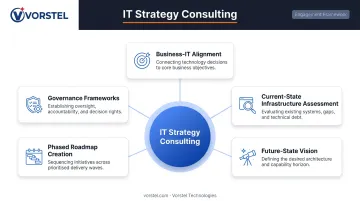
A typical engagement spans several interconnected areas:
- Business-IT alignment — mapping technology decisions to growth targets, efficiency goals, and risk tolerances
- Current-state infrastructure assessment — understanding what exists, what's working, and what's costing more than it should
- Future-state vision — defining where IT needs to be in two to five years, not just next quarter
- Phased roadmap creation — sequencing initiatives by business impact, urgency, and available resources
- Governance frameworks — establishing who decides what, and how IT decisions get made consistently going forward
How It Differs from General IT Consulting
General IT consulting addresses the how — specific implementations, system configurations, or technical troubleshooting. IT strategy consulting focuses on the what and why: which direction to move in, and why that direction serves the business.
The distinction has real consequences. A company that launches a cloud migration or ERP rollout without a strategic foundation can end up with capable technology solving the wrong problems — at significant cost.
Who Engages IT Strategy Consultants?
- Global enterprises navigating digital transformation at scale
- Mid-size businesses experiencing rapid growth or technology sprawl
- Organizations under compliance pressure with unclear IT accountability
- Companies whose planned initiatives — ERP modernization, cloud migration, AI adoption — lack a strategic foundation
The output isn't a static report filed away after delivery. It's a working roadmap — one that gets revisited as priorities shift, new technologies emerge, and business conditions change.
What Does an IT Strategy Consultant Do?
An IT strategy consultant serves as a bridge between business leadership and IT teams. The job is to translate high-level goals (revenue growth, operational efficiency, risk reduction) into concrete, actionable technology initiatives that someone can actually execute.
Conducting a Current-State Assessment
Every engagement starts with a structured evaluation of the existing IT environment. This typically covers:
- Infrastructure and application landscape
- Security posture and compliance gaps
- Technical debt — McKinsey data shows that 10% to 20% of new-product technology budgets get diverted to tech debt issues, with tech debt equaling 20% to 40% of the technology estate's value before depreciation
- Process inefficiencies and internal skill gaps
This baseline is what makes the roadmap credible — and it's what separates a strategy built on real constraints from one built on assumptions.
Developing the IT Strategy and Roadmap
Assessment findings, combined with stakeholder input, feed into a phased, budget-aware IT roadmap. The best roadmaps prioritize initiatives by business impact, risk, and urgency rather than technology trends or vendor pressure.
Frameworks like TOGAF's Architecture Development Method formalize this process, building Target Architecture across business, data, application, and technology domains before developing the migration plan.
Managing Digital Transformation Initiatives
Consultants guide organizations through transformative efforts: cloud migrations, ERP or CRM implementations, AI adoption. The goal is ensuring these projects are integrated and intentional, not executed in isolation.
That implementation depth matters when choosing a consulting partner. Vorstel Technologies, for example, brings 200+ SAP project experiences and a 95% success rate in Salesforce CRM implementation — meaning the roadmaps they build reflect what these programs actually require to succeed.
Establishing Governance and Decision Frameworks
Strong governance is what makes an IT strategy sustainable after the engagement ends. Consultants help define:
- Standards and ownership models for ongoing IT decisions
- KPIs that measure technology outcomes, not just activity
- Controls that reduce shadow IT and reliance on individual judgment
COBIT 2019's framework covers 40 governance and management objectives aligned to enterprise goals. That structure gives organizations a consistent basis for IT decision-making — so governance doesn't collapse when the consulting engagement ends.
Key Benefits of IT Strategy Consulting
Done well, IT strategy consulting shifts technology from a cost center into a direct driver of business performance. Here's what that shift produces in practice.
Alignment Between IT and Business Goals
The most common complaint from executives isn't that IT is incompetent — it's that IT operates in a different language. Strategy consulting closes that gap by translating growth targets, customer experience priorities, and risk tolerances into specific technology initiatives.
When IT understands why it's building something, not just what to build, the results change significantly.
Smarter Technology Investment Decisions
Competing priorities and limited budgets are universal. IT strategy consulting introduces structured prioritization — a clear framework for deciding which initiatives to fund, sequence, or retire.
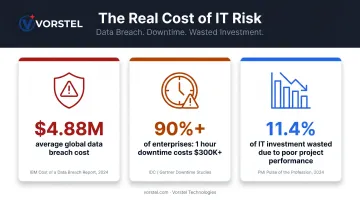
The cost of skipping this step is real. PMI's research found 11.4% of investment is wasted due to poor project performance. In the cloud specifically, Flexera reports 29% of cloud spend is estimated to go to waste. A defined strategy and governance structure directly addresses both problems.
Reduced Operational Risk and Improved Resilience
A strong IT strategy surfaces cybersecurity gaps, compliance exposures, and infrastructure vulnerabilities before they become incidents.
The stakes are significant. IBM's 2024 Cost of a Data Breach report puts the global average breach cost at $4.88M, while ITIC reports that more than 90% of mid-size and large enterprises say one hour of downtime costs over $300,000. Strategic security planning — deciding where to invest and why — is different from day-to-day security operations. Both matter, but the strategic lens determines whether you're ahead of risk or behind it.
Support for Scalable Growth and Digital Transformation
IT strategy consulting provides the foundation organizations need before launching major initiatives like cloud adoption, SAP implementations, or AI-driven automation.
The numbers on what happens without that foundation are sobering. BCG found 70% of digital transformations fall short — but organizations that apply structured success factors (integrated strategy, leadership commitment, agile governance, and progress monitoring) improve their odds from 30% to 80%.
The AI picture is equally telling. McKinsey found 88% of organizations use AI in at least one function, yet only 39% report enterprise-level EBIT impact. Adoption without a governing strategy reliably produces tools, not outcomes.
Long-Term Cost Predictability and ROI
Reactive IT environments generate unpredictable costs: emergency fixes, redundant systems, unplanned downtime. A defined IT strategy enables proactive planning, smarter vendor negotiations, and optimized resource allocation.
For Vorstel Technologies clients, that shift is measurable:
- 45% reduction in system downtime for enterprise clients
- 92% faster deployment cycles compared to industry averages
How the IT Strategy Consulting Process Works
Most engagements follow a recognizable structure, though the pace and depth vary by organization size and complexity.
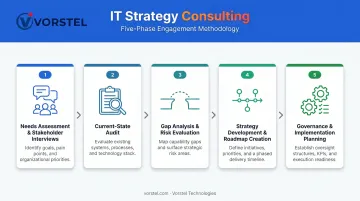
The Five-Phase Process
- Needs assessment and stakeholder interviews: Understand business goals, pain points, and what leadership actually needs from technology — not just what IT reports upward
- Current-state audit: Evaluate infrastructure, applications, security, technical debt, and processes against an established baseline
- Gap analysis and risk evaluation: Identify what's blocking the desired future state and quantify the cost of inaction
- Strategy development and roadmap creation: Build phased priorities with KPIs, budget parameters, and sequencing logic
- Governance and implementation planning: Establish the decision rights, standards, and accountability structures that keep execution aligned with intent
The Process Is Iterative, Not Linear
IT strategies need to evolve. Businesses change, technologies emerge, and market conditions shift. A roadmap treated as a one-time deliverable becomes outdated quickly — quarterly reviews during periods of rapid change, and at minimum an annual refresh, keep the strategy relevant.
Common Mistakes to Avoid
- Starting with technology instead of business goals — leads to a roadmap that solves the wrong problems
- Skipping change management — without organizational buy-in, even a well-built strategy stalls
- Treating cybersecurity as a parallel workstream — security must be embedded throughout the process, not bolted on at the end
- Ignoring governance — without clear ownership and decision rights, the strategy never moves off the shelf
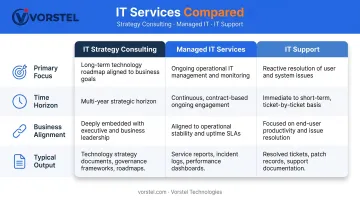
IT Strategy Consulting vs. Managed IT Services vs. IT Support
These three models are often confused. They're actually complementary — each serves a different purpose.
| Dimension | IT Strategy Consulting | Managed IT Services | IT Support |
|---|---|---|---|
| Primary focus | Long-term planning and direction | Ongoing operational execution | Reactive break-fix resolution |
| Time horizon | 2–5 years | Ongoing | Immediate |
| Business alignment | Directly tied to business outcomes | Maintains operational stability | Issue-specific |
| Typical output | Roadmaps, governance frameworks, investment priorities | System uptime, security operations | Resolved tickets |
Strategy consulting defines what needs to be built or changed. Managed services and IT support handle execution and day-to-day reliability. Most organizations use all three — layered to cover strategy, stability, and day-to-day fixes.
One practical consideration: when a consulting firm also offers implementation and managed services, the transition from strategy to execution happens without the gap that derails most roadmaps. The same partner carrying a strategy into execution is far less likely to let it sit unused.
When to Hire an IT Strategy Consultant — and How to Choose the Right One
Clear Signals You Need IT Strategy Consulting
- IT costs are rising without clear ROI or a coherent explanation
- The organization is undergoing growth, a merger, or a major digital transformation
- Executives lack a multi-year technology roadmap
- Cybersecurity or compliance has become a board-level concern
- Planned initiatives — ERP, cloud migration, AI adoption — lack a strategic foundation
Key Criteria for Evaluating a Consulting Firm
- Confirm proven experience in your industry and the relevant technology areas — ERP, cloud, AI, security
- Look for a clear process from assessment through roadmap to governance, not vague promises
- Assess whether they ask the right business questions and can explain complex concepts to non-technical stakeholders
- Require verifiable outcomes — client testimonials, case studies, and measurable results, not just credentials
Choosing a Partner Who Can Meet You Where You Are
Not every organization needs a strategy engagement from scratch. Many are already mid-transformation and need a partner who can rapidly assess where things stand, identify what's off-track, and course-correct without starting over.
Vorstel Technologies is built for exactly this scenario — joining mid-transformation engagements, assessing what's working, and driving outcomes across SAP, Microsoft, Salesforce, cloud, AI, and enterprise architecture. With 30+ global clients and 97% client satisfaction, they bring a structured entry point through a Zero-Fee Solution Evaluation, letting organizations define scope and explore fit before committing to a full engagement.
Approach the selection process as a strategic partnership evaluation, not a vendor transaction. The right firm should understand your business model, challenge your assumptions where needed, and stay accountable to measurable outcomes — not just polished deliverables.
Frequently Asked Questions
What does an IT strategy consultant do?
An IT strategy consultant helps organizations align technology decisions with business goals by assessing the current IT environment, identifying gaps, and building actionable roadmaps. They work directly with executive leadership and IT teams to translate growth targets and risk tolerances into specific technology initiatives.
How is IT strategy consulting different from IT consulting?
IT consulting broadly covers technical advice, implementations, and specific solutions. IT strategy consulting focuses specifically on the long-term direction of technology — the what and why of IT investment, rather than the how of technical execution.
How long does an IT strategy consulting engagement typically last?
Initial engagements covering assessment and roadmap development typically run 4–12 weeks, depending on organization size and complexity. Ongoing advisory relationships can extend for months or years to ensure the strategy evolves alongside the business.
What types of businesses benefit most from IT strategy consulting?
Any organization where technology decisions carry significant business risk — enterprises undergoing digital transformation, fast-growing startups, manufacturers modernizing operations, and organizations in regulated industries facing compliance pressure.
Can IT strategy consulting help with AI and digital transformation initiatives?
Yes, and it's typically where these initiatives should begin. IT strategy consulting ensures AI adoption, cloud migration, and transformation programs are sequenced correctly, aligned to real business outcomes, and supported by the infrastructure and governance required to sustain them.
How much does IT strategy consulting typically cost?
Pricing varies widely based on scope, engagement duration, and firm size. Look for firms that offer an initial no-cost evaluation — such as a Zero-Fee Solution Evaluation — to establish fit and define scope before committing to a full engagement.