Introduction
Most organizations have launched an AI initiative. Far fewer have made it work at scale. McKinsey's research on digital transformations found that 90% of companies have launched digital transformations but realized only one-third of expected revenue benefits — a gap that points less to technology failure and more to how organizations are approaching AI strategy itself.
The consulting industry sits at the center of this tension. AI now automates much of what junior analysts spent years doing: market research, data synthesis, hypothesis generation, first-draft slide decks. That same automation is raising the bar on what strategy consulting must deliver — clearer judgment, stronger stakeholder alignment, and transformation leadership that no tool can replicate.
That's exactly what this guide addresses. It covers what AI strategy consulting actually means today, how it's restructuring consulting firms and client relationships, what a credible engagement looks like from readiness through optimization, and how to choose the right partner.
Key Takeaways
- AI strategy consulting is about connecting AI capabilities to measurable business outcomes — not selecting tools.
- BCG's 10-20-70 rule splits AI value: 10% algorithms, 20% technology and data, 70% people and processes.
- AI is collapsing the traditional consulting pyramid, pushing firms toward senior-heavy, specialist-led team structures.
- A credible engagement covers readiness, use case prioritization, implementation, change management, and ongoing optimization.
- The right partner can enter at any stage of your transformation — not just at greenfield conditions.
What AI Strategy Consulting Actually Means Today
AI strategy consulting is the structured process of helping an organization identify where AI creates value, build a roadmap to capture it, and embed AI into operations that align with business objectives. Most organizations mistake it for IT consulting or a one-off tool deployment — and that confusion is where implementations stall.
The real difference: IT consulting delivers technical systems, and tool deployment installs software. AI strategy consulting tackles a harder question — how does AI change how this organization competes and makes decisions? That's a business problem first, a technology problem second.
Why the Discipline Has Evolved
Generative AI and agentic workflows have compressed the economics of analysis work. Tasks that previously required weeks of junior analyst effort — competitive benchmarking, financial modeling, synthesis across large document sets — now take hours with AI assistance. This hasn't eliminated the need for consulting. It has shifted what consulting must deliver.
As Deloitte's AI strategy research notes, the strongest AI strategies tend to begin without mentioning AI at all. They start with the organization's business objectives — its "north star" — and work backward to determine where AI accelerates progress toward those goals. Consultants who lead with AI tools rather than business problems tend to underdeliver.
The Four Pillars Every AI Strategy Must Address
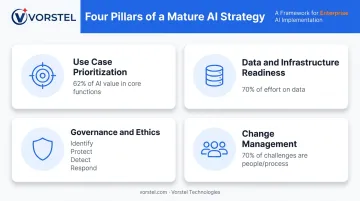
A mature AI strategy needs to cover all four of these areas. Engagements that skip one consistently struggle:
- Use case identification and prioritization — BCG data shows 62% of AI value concentrates in core business functions: operations (23%), sales and marketing (20%), and R&D (13%)
- Data and infrastructure readiness — McKinsey estimates 70% of AI solution development effort goes toward wrangling and harmonizing data before any model runs
- Governance and ethics — the NIST AI Risk Management Framework defines four functions: Govern, Map, Measure, and Manage — all of which must be addressed before deployment
- Change management — BCG's 2024 research found 70% of AI implementation challenges are people and process issues, not technical ones
How AI Is Reshaping Consulting Firms
The traditional consulting pyramid (large bases of junior analysts feeding insight upward to small senior teams) made sense when research was manual and expensive. AI has broken that model.
According to HBR's 2025 analysis, AI is actively changing consulting firm structures. Tasks historically handled by junior consultants — research, data synthesis, initial drafting — are now automated, eroding the business case for analyst-heavy teams. Firms are restructuring toward more senior and technically specialized talent, with smaller teams carrying higher-impact mandates.
The Productivity Paradox at the Frontier
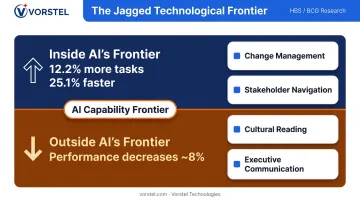
The HBS/BCG GPT-4 field study with 758 BCG consultants produced a nuanced finding: for tasks inside AI's capabilities, consultants completed 12.2% more tasks and finished 25.1% faster. But for tasks outside that frontier, AI use actually reduced performance. This "jagged technological frontier" is now one of the most important concepts in AI consulting — because it clarifies exactly where human judgment remains irreplaceable.
The distinctly human work in consulting includes:
- Organizational change management and workforce enablement
- Stakeholder consensus-building and political navigation
- Reading cultural dynamics within client organizations
- Translating AI outputs into executive narratives that drive action
A separate HBS study of 640 entrepreneurs found that AI could not reliably distinguish strong ideas from mediocre ones — and low performers who followed generic AI recommendations saw performance decrease by roughly 8%. Judgment, in other words, is not yet automatable.
Competitive Boundaries Are Blurring
Forrester's AI Consultancies Wave evaluated 13 providers across 26 criteria, grouping strategy firms, Big Four accounting firms, IT services firms, and AI-native specialists in a single competitive category. The implication: boutique firms with deep AI fluency can now compete with established giants on speed, cost, and vertical specialization in ways that weren't possible five years ago.
That shift in who can compete is reshaping how firms get paid. As AI compresses delivery timelines from weeks to days, hourly billing becomes harder to justify. Emerging pricing models reflect this new reality:
- Outcome-based fees tied directly to measurable business results
- Subscription advisory retainers replacing project-by-project hourly billing
- Value-linked contracts where clients negotiate fees against defined performance targets
Key Components of an AI-Driven Consulting Engagement
Readiness Assessment
Every credible AI engagement begins here. The assessment evaluates:
- Data quality, availability, and governance structures
- Technology infrastructure and integration readiness
- Talent and skill gaps against AI ambitions
- Existing processes that AI will touch or transform
- The distance between current state and strategic objectives
Organizations that skip this phase tend to commit to ROI timelines their data infrastructure cannot support. Realistic baselines set here drive every subsequent decision.
Strategy Development and Use Case Prioritization
Consultants work with business stakeholders to identify, score, and sequence AI use cases based on three dimensions: strategic impact, technical feasibility, and resource requirements. BCG's research shows that AI leaders focus on fewer high-priority opportunities — roughly half as many as other companies — and pursue them with greater intensity.
Early, visible wins matter because they build the organizational confidence and executive support needed for the harder, longer-term transformation work ahead.
Implementation Planning and Deployment
The transition from strategy to execution covers:
- Technology stack selection aligned to existing ERP, CRM, and cloud environments
- Integration architecture for platforms like SAP, Microsoft, and Salesforce
- Proof-of-concept design with defined success criteria
- Governance guardrails for responsible deployment
McKinsey estimates that 90% of ML development failures stem from poor productization and integration — not poor model quality. Firms like Vorstel Technologies, which bring cross-platform expertise across SAP, Microsoft, and Salesforce ecosystems, reduce this risk by working within existing enterprise infrastructure rather than building alongside it.
Change Management and Workforce Enablement
Most AI initiatives don't fail in the data lab — they fail here. McKinsey's research is direct: for every $1 spent developing digital and AI solutions, organizations should plan at least another $1 for user adoption and enterprise scaling.
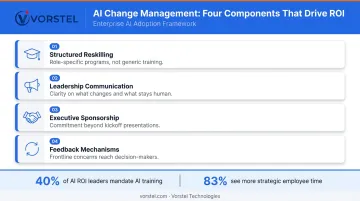
What effective change management looks like in practice:
- Structured reskilling programs tied to specific role evolution (not vague "AI literacy" training)
- Clear leadership communication about how work will change — and what stays human
- Executive sponsorship that goes beyond kickoff presentations
- Feedback mechanisms so frontline concerns reach decision-makers
Deloitte's research found that 40% of AI ROI leaders mandate AI training as a core competency, and 83% believe agentic AI will enable employees to spend more time on strategic and creative work. The dominant workforce strategy among organizations successfully scaling AI is reskilling, not replacement.
Ongoing Optimization and Performance Measurement
AI engagements don't end at launch. Models drift as underlying data changes and degrade as business conditions shift. That means continuous monitoring against business KPIs — not just technical performance metrics — and scheduled retraining cycles built into the operating model from day one.
A continuous support model should include:
- Define KPIs during the readiness phase — not after deployment
- Drift monitoring and retraining schedules
- Regular strategy reviews as generative AI capabilities evolve
- Clear accountability for model performance at the business level
The 10-20-70 Rule and What It Means for Your Strategy
BCG frames the 10-20-70 rule as the most useful heuristic for understanding where AI transformation value actually originates:
| Component | Share of Value | What It Covers |
|---|---|---|
| Algorithms and AI technology | 10% | Model selection, training, technical performance |
| Technology infrastructure and data processes | 20% | Data architecture, MLOps, integration |
| People and processes | 70% | Culture, leadership, change adoption, capability building |
Organizations that direct most of their AI budget toward technology are investing heavily in the smallest value driver. Technology matters — but governance, culture, and capability building are where transformations actually succeed or fail.
Designing Strategy Backward from Organizational Reality
The "70% people" dimension demands that AI strategies be designed from the transformation backward, not the technology forward. Deloitte's finding (that the strongest AI strategies begin without mentioning AI) reflects this directly. Starting with technology selection and working toward business goals routinely produces solutions that are technically functional but never actually adopted.
Governance Must Be Built In, Not Bolted On
Ethical considerations, data privacy compliance (GDPR, the EU AI Act's risk-based framework), explainability requirements, and accountability structures need to be embedded from day one. Organizations that retrofit governance after deployment face two compounding problems: regulatory exposure during the gap, and the far harder work of unwinding architectural decisions already made without those constraints in place.
Build for Evolution, Not Point-in-Time Solutions
Generative AI capabilities are advancing faster than most enterprise deployment cycles. AI strategies need to be architecturally flexible — designed to incorporate new model capabilities without requiring full rebuilds. Engagements that lock organizations into rigid, point-in-time architectures accumulate technical debt that makes adapting to the next wave of AI capabilities significantly more expensive than starting flexible.
How to Choose the Right AI Consulting Partner
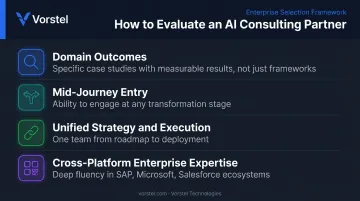
The real differentiator between AI consulting partners isn't credentials — it's whether they can deliver in your specific context. Four criteria that actually matter:
- Domain-specific outcomes, not just credentials — ask for case studies with specific challenges, technologies, and measurable results. A partner who can only speak in frameworks hasn't done the work.
- Ability to enter at any stage — many organizations are mid-journey: they've started implementations, hit obstacles, or inherited decisions from previous teams. A partner who requires greenfield conditions to engage is a significant limitation.
- Strategy and execution in one team: partners who hand off from strategy to implementation create a predictable failure point. The team that designs the roadmap needs to understand what execution actually requires.
- Cross-platform enterprise expertise — organizations running SAP, Microsoft, or Salesforce need partners who understand how to embed AI within those ecosystems, not alongside them. SAP alone reports that natural-language access across its ecosystem is expected to save up to 600 million working hours per year for its global community.
Transparency is a practical filter. A trustworthy partner presents real case studies with specific outcomes and starts with a structured evaluation before locking in a solution path.
Vorstel Technologies applies this directly: its zero-fee solution evaluation offers expert assessment of automation, IT strategy, and cloud solutions before any financial commitment is made.
The Forrester AI Consultancies Wave evaluated 13 providers across 26 criteria spanning strategy, technical implementation, governance, and ecosystem fluency. Evaluating partners across those same dimensions, rather than by brand category alone, leads to more defensible selection decisions.
Frequently Asked Questions
What is the 10-20-70 rule for AI?
The 10-20-70 rule, framed by BCG, holds that approximately 10% of AI transformation value comes from the algorithms themselves, 20% from technology infrastructure and data processes, and 70% from people factors: culture, change management, and leadership adoption. It's a useful corrective against overinvesting in technology at the expense of organizational readiness.
Can AI replace strategy consultants entirely?
No. AI automates research, analysis, and hypothesis generation effectively, but cannot replicate stakeholder judgment, political navigation, or the ability to translate complex outputs into decisions executives will act on. The HBS/BCG study confirms AI augments inside its frontier and reduces performance outside it.
What is the difference between AI consulting and traditional management consulting?
Traditional consulting relies on human-led research and analysis cycles. AI consulting integrates automated intelligence into every engagement stage, compressing insight delivery while shifting the human role toward interpretation, facilitation, and transformation leadership. Output is faster, but the human judgment required is, if anything, more sophisticated.
How do you measure the ROI of an AI strategy consulting engagement?
Key indicators include decision cycle time reduction, automation cost savings, revenue impact from AI use cases, and employee and customer experience improvements — all measured against baseline KPIs set during the readiness phase. Most organizations reach satisfactory ROI within two to four years, longer than the seven to twelve months typical for conventional technology investments.
How long does it take to implement an AI strategy?
Timelines range from three to six months for targeted deployments to twelve to twenty-four months for enterprise-wide transformation. Phased approaches that start with one or two high-visibility wins before scaling consistently sustain executive support better than attempting broad transformation at once.
What should companies look for in an AI consulting partner?
Look for proven cross-industry experience with transparent outcomes, the ability to engage mid-journey without requiring clean-slate conditions, and genuine expertise across enterprise platforms like SAP, Microsoft, and Salesforce. Partners who evaluate fit before proposing solutions reduce the risk of stalled engagements.