Introduction
Most organizations can articulate an AI vision. Executing one is a different problem entirely. The result is a familiar pattern: disconnected pilots that never scale, cautious waiting while competitors move faster, and mounting pressure to show ROI on investments that haven't fully launched yet.
According to McKinsey's 2025 State of AI survey, 78% of organizations now use AI in at least one business function — up from 55% just a year earlier. The gap between early movers and late adopters is widening fast.
This guide cuts through the uncertainty. Here's what you'll find:
- A clear definition of AI digital transformation (and how it differs from traditional approaches)
- A practical framework for building strategy before selecting tools
- A five-stage implementation roadmap
- The most common challenges and how to overcome them
- KPIs that prove whether your transformation is actually working
Key Takeaways
- AI digital transformation changes the fundamental way organizations create value, not just the speed of existing processes
- Strategy must start with business objectives, not technology selection
- Narrow, measurable pilots outperform broad rollouts every time
- Data readiness is the #1 predictor of AI project success or failure
- ROI spans multiple dimensions: track operational efficiency, customer experience, and business agility together
What Is AI Digital Transformation?
AI digital transformation is the deliberate integration of AI technologies into core business operations to reshape how an organization creates value. The distinction from conventional digital transformation is critical: this is about reimagining workflows, not just digitizing them.
Traditional digital transformation meant replacing manual processes with digital tools: moving paper records to spreadsheets, phone orders to web portals, on-premise systems to cloud. Useful — but ultimately a faster version of what already existed.
AI transformation goes further. It embeds intelligence — systems that learn, adapt, and improve — into the heart of how a business operates.
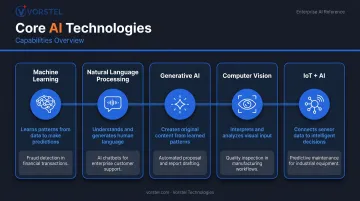
The Technologies That Power It
| Technology | Core Capability | Example Use Case |
|---|---|---|
| Machine Learning | Pattern recognition, prediction | Demand forecasting, fraud detection |
| NLP | Language understanding and generation | Customer service automation, document parsing |
| Generative AI | Content, code, and product creation | Marketing copy, software development |
| Computer Vision | Visual data processing | Defect detection, quality control |
| IoT + AI | Real-time operational data capture | Predictive maintenance, supply chain visibility |
What It Looks Like in Practice
- Retail personalization: A retailer uses ML models trained on purchase history, browsing behavior, and seasonal data to deliver individualized product recommendations — reducing overstock while increasing basket size.
- Manufacturing quality control: A manufacturer deploys computer vision models trained on thousands of product images to flag defects in real time, replacing inconsistent manual inspection at the production line.
- Financial document processing: JPMorgan's COIN system uses AI to interpret commercial loan agreements — work that previously consumed 360,000 lawyer and loan-officer hours annually now happens in seconds.
Building Your AI-Driven Digital Transformation Strategy
Start With Business Problems, Not Tools
The most common strategic mistake is choosing AI technology first and then searching for a problem to solve. Before evaluating any platform, leaders should define specific business problems: Are you trying to reduce customer churn? Compress product development cycles? Cut manual processing costs?
This matters because only about one-third of expected revenue benefits from digital transformations are typically realized, according to McKinsey's analysis of more than 200 large companies. The gap between ambition and outcome almost always traces back to technology-led rather than business-led strategy.
Reframe How You Measure ROI
Traditional ROI models often undervalue AI because they apply fixed, pre-defined outcome measurements to something that evolves over time. A better approach:
- Identify 1-2 high-impact use cases with clear, measurable baselines
- Run pilots with defined success metrics — time saved, error reduction, resolution speed
- Use early wins to build internal momentum and justify broader investment
- Treat ROI as dynamic — capabilities and returns compound as models improve
Build Data Governance First
No AI model performs well on poor data. Gartner predicts that through 2026, organizations will abandon 60% of AI projects not supported by AI-ready data. Another 63% of organizations either lack or are unsure they have the right data management practices.
A strong data foundation requires:
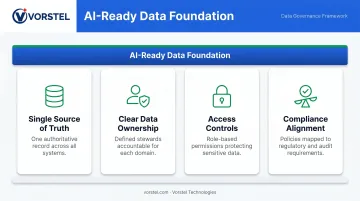
- A single source of truth — eliminating conflicting data across departments
- Clear data ownership — defined accountability for each dataset
- Access controls — role-based permissions and audit trails
- Compliance alignment — especially in regulated industries like finance and healthcare
One early quick win: AI can help clean and structure imperfect legacy data, making data preparation itself a useful first use case.
Audit Infrastructure and Integration Readiness
Before scaling AI, organizations need an honest view of their existing IT landscape: legacy bottlenecks, data silos, and integration gaps. This is where strategy meets execution, and where hidden API limitations and data migration issues tend to emerge.
Connecting AI to existing SaaS and ERP ecosystems — SAP, Microsoft 365, Salesforce — requires technical depth that most internal teams don't carry in-house. Vorstel Technologies works across these platforms, helping organizations move from infrastructure assessment through to deployment without losing momentum mid-implementation.
Get Cross-Functional Buy-In Early
AI transformation fails when it's treated as an IT initiative. Sustainable transformation requires:
- Business unit leaders who connect AI initiatives directly to their team's measurable goals
- Finance and HR engaged on ROI measurement and workforce planning
- C-suite sponsorship providing authority to push past departmental resistance
- Internal AI evangelists drawn from frontline teams, who champion adoption where resistance is highest
Map each AI initiative explicitly to a department's goals, not just technical capabilities.
A Stage-by-Stage AI Transformation Implementation Roadmap
Stage 1 — Readiness Assessment
Before building anything, audit what exists. A thorough readiness assessment covers:
- Infrastructure quality: Legacy system dependencies, integration gaps, compute capacity
- Data quality: Availability, cleanliness, and structure of key datasets
- Talent inventory: Current AI/ML skills vs. what's needed
- Cultural readiness: Leadership appetite, change tolerance, existing experimentation culture
Skipping this step is expensive. Mid-project pivots caused by undiscovered infrastructure constraints or data gaps are among the most common reasons AI initiatives stall.
Stage 2 — Data Collection, Organization, and Governance
This phase builds the foundation every subsequent AI initiative depends on. Key activities:
- Collect and centralize data from across departments
- Digitize legacy records and unstructured sources
- Cleanse, validate, and structure datasets
- Establish governance rules: ownership, access controls, retention policies
This phase often requires DataOps tooling and may involve upskilling existing staff or bringing in specialized data engineers.
Stage 3 — Pilot With Narrow, High-Impact Use Cases
Broad rollouts rarely succeed on first attempt. Start with 1-2 use cases that have:
- Clear baselines (current time, cost, error rate you're improving against)
- Short feedback loops (results visible within weeks, not months)
- A single KPI owner accountable for the outcome
Strong starting candidates: automating IT ticket routing, deploying an AI-powered customer service chatbot, or using predictive analytics for inventory management. Klarna's AI assistant is a useful benchmark — it handled 2.3 million customer service conversations in its first month, cutting repeat inquiries by 25% and reducing average resolution time to under two minutes.
Only 48% of AI projects reach production on average, according to Gartner. Narrow, well-defined pilots improve those odds significantly.
Stage 4 — Scale Across Business Functions
Once pilots prove ROI, expand systematically — not simultaneously. Prioritize functions where:
- Data infrastructure is already solid
- Business owners are engaged and accountable
- The use case mirrors a validated pilot pattern
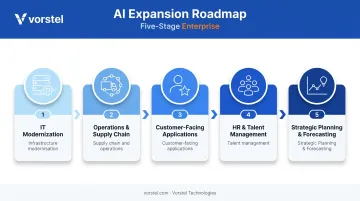
A proven expansion sequence runs:
- IT modernization
- Operations and supply chain
- Customer-facing applications
- HR and talent management
- Strategic planning and forecasting
Scaling requires dedicated change management. Roles shift. Workflows change. Engineering, IT, and business teams must collaborate more closely than most organizations are used to.
Stage 5 — Embed Continuous AI Evolution
AI transformation doesn't have an end date. Organizations that treat it as a one-time project tend to lose ground quickly — capabilities degrade, models drift, and competitors who kept investing pull ahead.
Build for continuity:
- Regular review cycles — quarterly assessments of model performance and business impact
- Continuous upskilling — investing in AI literacy across all levels, not just technical teams
- Experimentation culture — creating safe channels for testing new AI applications
- Forward planning — agentic AI and autonomous workflow automation are already in production at leading organizations; evaluating readiness now puts you ahead of the curve, not behind it
Overcoming Common AI Transformation Challenges
Scaling Beyond Pilots
Getting a pilot to work is one problem. Getting it to work at enterprise scale is another. Common blockers include:
- Insufficient compute infrastructure for larger data volumes
- Lack of executive sponsorship to mandate adoption past early departments
- No defined operating model for managing AI across business units
Hybrid cloud architecture typically provides the flexibility needed for scaling AI workloads without massive upfront infrastructure investment.
Data Quality, Security, and Compliance
Poor data quality is the leading cause of AI underperformance. Practical risks include:
- Biased training data producing skewed outputs
- Unsecured sensitive data creating regulatory exposure
- Inconsistent data formats across legacy systems breaking model inputs
Governance controls that address these risks: encryption at rest and in transit, role-based access management, regular data auditing, and documented data lineage. Organizations in regulated sectors — healthcare, financial services, manufacturing — face additional complexity and should prioritize compliance architecture before model development.
Change Management and Cultural Resistance
AI disrupts established roles, and that uncertainty drives resistance. Managing it effectively requires:
- Transparent communication about what's changing and why
- Phased rollouts that don't overwhelm entire teams at once
- Employee training that focuses on how AI assists rather than replaces
- Leadership modeling — executives and managers visibly using AI tools signals cultural permission
Internal AI evangelists — people who bridge technical teams and frontline employees — are often the difference between adoption that sticks and adoption that stalls.
Talent Shortages and the Case for Expert Partners
The World Economic Forum's 2025 Future of Jobs Report found 63% of employers identify skill gaps as a major barrier to transformation over 2025–2030. AI talent — data engineers, ML engineers, AI architects — is scarce and expensive to hire.
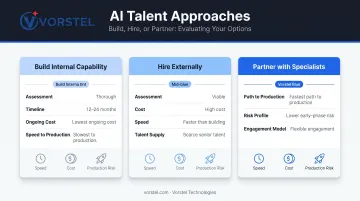
Most organizations weigh three approaches:
- Building internal capability is thorough but slow — expect 12–24 months to upskill at scale
- Hiring externally is viable but costly, especially for senior ML and AI architecture roles
- Partnering with specialists gets you to production faster, with lower risk during critical early phases
Vorstel Technologies offers a Zero-Fee Solution Evaluation — a no-commitment starting point for organizations wanting to assess their AI transformation needs with experienced consultants before committing to a full engagement.
Measuring Success: KPIs for AI-Driven Digital Transformation
Operational Efficiency Metrics
Set baselines before implementation so gains are clearly attributable. Key indicators:
- Task automation rate — percentage of previously manual tasks handled by AI
- Processing time reduction — time saved per transaction, ticket, or document
- Error rate — before vs. after AI assistance
- System downtime frequency — particularly relevant for AI-assisted IT operations
Customer and Employee Experience Metrics
Transformation should improve both sides of the equation:
Customer-facing:
- Net Promoter Score (NPS) trends
- Resolution time and first-contact resolution rate
- Personalization engagement rates (click-through, conversion)
Employee-facing:
- Time saved on repetitive tasks per employee per week
- AI tool adoption/utilization rates (a direct proxy for cultural acceptance)
- Productivity per employee in AI-assisted workflows
Business Agility and Innovation Indicators
Beyond efficiency, the most durable measure of AI transformation is whether the organization is becoming more responsive:
- Speed of data-driven decision-making vs. previous cycles
- Time-to-market for new products or services
- Frequency of process improvements initiated from AI insights
- Ability to pivot in response to market signals
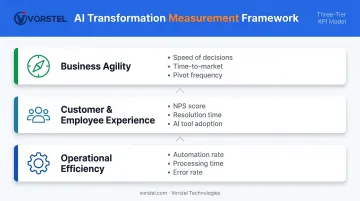
McKinsey's five-layer AI measurement framework covers five dimensions: financial impact, strategic outcomes, operational KPIs, user adoption, and technical performance. It provides a practical structure for tracking all three categories above while keeping the focus on metrics that tie directly to business value.
Worth noting: approximately 60% of organizations have not yet seen enterprise-wide EBIT impact from AI programs, per McKinsey. The gap between pilots and measurable outcomes is real — which makes it critical to connect every initiative to a clear value hypothesis from the start, rather than measuring activity and calling it progress.
Frequently Asked Questions
What is AI digital transformation?
AI digital transformation is the strategic integration of AI technologies — machine learning, NLP, generative AI, and computer vision — into core business operations to fundamentally change how an organization creates value. Unlike basic digitization, the result is intelligent, adaptive systems that learn and improve over time rather than simply executing static rules.
How is AI digital transformation different from traditional digital transformation?
Traditional digital transformation replaced manual processes with digital tools — essentially doing the same things faster. AI digital transformation embeds intelligence into those systems, enabling them to learn, predict, and make autonomous decisions. The result is a fundamentally different way of operating, not just a faster version of old processes.
How do I start an AI digital transformation strategy?
Begin with a readiness assessment covering data quality, infrastructure gaps, and specific business objectives — before selecting any technology. Then identify 1-2 high-impact, measurable use cases for a focused pilot rather than attempting an enterprise-wide rollout from day one.
What are the biggest challenges in AI-driven digital transformation?
The top challenges are data quality and governance issues, difficulty scaling AI beyond initial pilots, organizational change resistance, and scarcity of specialized AI talent. Working with experienced implementation partners can close the talent gap and get pilots into production faster.
How long does AI digital transformation typically take?
Early pilots can deliver measurable results within weeks. Enterprise-wide transformation is typically a multi-year journey, with timelines varying by organizational size, complexity, and data maturity. The single biggest variable is how quickly your organization can act on pilot learnings and scale what works.
How do you measure the ROI of AI in digital transformation?
Measure ROI across three dimensions: operational efficiency (processing time, error reduction), customer and employee experience (NPS, resolution times, productivity), and business agility (speed of decisions, time-to-market). Treat ROI as dynamic — it grows as AI capabilities deepen and organizational adoption matures.