ERP is the launchpad, not the destination. Without a deliberate strategy layered on top of the platform, even a well-chosen system can sit half-implemented for years, generating costs without generating value.
This guide covers what ERP digital transformation actually means, why ERP is the operational backbone of any broader transformation initiative, how to build a phased roadmap that manages risk, and the best practices that separate successful deployments from the ones that become cautionary tales.
Key Takeaways
- ERP digital transformation uses ERP as the central platform to unify data, automate processes, and enable AI, cloud, and analytics across the enterprise
- Success requires clean data first, then integrated platforms, then redesigned processes, then analytics — in that order
- Phased implementation, executive buy-in, and change management are non-negotiable
- 46% of companies plan to replace their ERP within 36 months, making the decision about when and how to transform more urgent than ever
- AI and composable ERP architectures — modular, best-of-breed systems — are shifting how enterprises build and extend their transformation stack
What Is ERP Digital Transformation?
ERP digital transformation is the deliberate process of using an ERP system as the operational and data foundation for adopting advanced digital capabilities. That means cloud infrastructure, AI, process automation, and real-time analytics — all working together to improve efficiency, enhance customer value, and unlock growth.
An ERP upgrade and a digital transformation are not the same thing. Swapping one system for another without redesigning the processes around it is an expensive migration — nothing more. Transformation changes how people, data, and decisions interact across the organization.
ERP vs. Digital Transformation: What's the Difference?
Digital transformation is the strategic goal. ERP is the platform through which that goal is delivered.
The distinction matters in practice:
- ERP upgrade: New software, same processes — faster at doing what you already did
- Digital transformation: New software and redesigned processes — fundamentally different outcomes
A manufacturer moving from paper-based inventory management to a cloud ERP that feeds real-time stock data into procurement and order workflows is undergoing transformation. The ERP didn't cause it — the deliberate redesign of operations around it did.
Why This Matters Right Now
Legacy ERP systems — many installed well before cloud, mobile, and real-time data became standard expectations — were built for a fundamentally different operating environment. According to IDC's 2024 ERP modernization research, 46% of companies planned to replace their current ERP within 36 months, with 44% planning to invest in SaaS ERP in the same window.
That scale of planned replacement reflects a widening gap between what legacy systems can do and what markets now demand. Organizations that treat ERP modernization as a pure IT exercise — rather than a business transformation initiative — will close that gap on paper while falling further behind in practice.
Why ERP Is the Backbone of Digital Transformation
No analytics engine, AI model, or automation tool can produce reliable outputs without trustworthy inputs. That's the core argument for treating ERP as the foundation of any transformation initiative.
Data Centralization: The Starting Point
A modern ERP creates a single source of truth by consolidating data from finance, supply chain, HR, sales, and operations. Without this unified data layer, downstream technologies — predictive analytics, AI, business intelligence platforms — are working with fragmented, inconsistent information.
The cost of skipping this step is significant. Gartner research shows that poor data quality costs organizations an average of $12.9 million per year, and 59% of organizations don't even measure their data quality. Building AI capabilities on top of that foundation produces unreliable results at scale.
Integrated Business Processes
ERP connects functional silos — finance, procurement, inventory, CRM, customer service — so data flows automatically rather than through manual handoffs, emails, or spreadsheet exports. The practical effect:
- Real-time inventory data reaches sales teams before they commit delivery dates
- Finance sees procurement activity without waiting for end-of-month reports
- Customer service resolves issues with full order history visible in one screen
- Cross-functional decisions reflect current data, not last week's exports
Composable Architecture and Future-Readiness
Modern ERP platforms — SAP S/4HANA, Microsoft Dynamics 365, Oracle NetSuite — are built on modular, open-API ecosystems. This composable architecture lets organizations add capabilities incrementally: an AI forecasting module here, an IoT sensor integration there, a new CRM connector next year.
Gartner notes that by 2027, more than 70% of recently implemented ERP initiatives will fail to fully meet their original business-case goals. Composable ERP architecture is the primary risk-reduction strategy here — it allows course correction without dismantling the core system.
Automation as an Enabler at Every Phase
That modularity is what makes automation practical at every stage. ERP automation delivers value from day one, with early wins that compound as the platform matures:
- Automated invoice processing — eliminating manual data entry and cutting AP processing time by up to 80%
- Compliance reporting automation — reducing manual reconciliation work in finance
- Data entry elimination — freeing operational staff for higher-value work
As the platform matures, automation extends to demand forecasting, supply chain optimization, and AI-assisted decision support. Vorstel's engagement with a manufacturing client, for example, replaced a fully manual invoice workflow with an AI Builder-powered process that reads, validates, and archives invoices automatically — cutting processing time from days to minutes.
Customer-Centric Transformation
Panorama Consulting's 2024 ERP Report identified customer experience improvements as the most commonly achieved ERP benefit, with a realization rate of 70.1% in the prior year's cohort. ERP integration with CRM and e-commerce platforms directly enables:
- Personalized experiences driven by unified customer and order data
- Real-time inventory visibility that prevents over-promising on delivery dates
- Faster order fulfillment through automated handoffs between sales, warehouse, and logistics
- Higher retention rates as service teams resolve issues with complete context on one screen
Building Your ERP Digital Transformation Strategy: A 4-Phase Framework
Most ERP transformations fail not because of the technology chosen, but because of the sequence in which things happen. This framework addresses that.
Phase 1 — Data Readiness
Before any platform migration or technology investment, audit and clean existing data. Fragmented item masters, duplicate customer records, inconsistent currency handling, and unmapped legacy fields are among the most common culprits that derail implementations post-go-live.
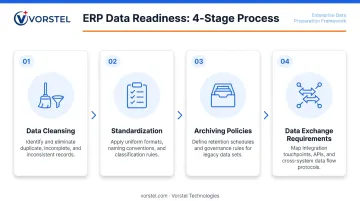
A solid data governance program at this stage includes:
- Data cleansing — identifying and resolving duplicates, inconsistencies, and gaps
- Standardization — establishing naming conventions, field formats, and validation rules
- Archiving policies — determining what historical data migrates and what gets archived
- Data exchange requirements — mapping how data will flow between ERP and adjacent systems
Skipping this phase doesn't save time. It shifts the problem downstream, where it costs far more to fix.
Phase 2 — Platform Standardization and Integration
Define the technology platform strategy: either consolidate onto a single ERP (SAP S/4HANA, Microsoft Dynamics 365) or build a best-of-breed stack using Salesforce for CRM, a cloud ERP for finance, and a WMS for logistics, connected through modern APIs.
The platform choice matters less than ensuring all key systems share data seamlessly in real time. What fails organizations is not the platform decision itself, but the integration strategy (or absence of one) that follows.
Vorstel's cross-platform depth across SAP, Microsoft, and Salesforce, backed by 200+ SAP projects and a 95% Salesforce implementation success rate, lets the team guide clients through this decision based on operational fit, not vendor preference.
Phase 3 — Process Re-Engineering
Layering new technology on top of broken processes produces broken digital processes. Redesign must come before deployment, not after.
Three stakeholder groups require distinct attention:
- Customers — self-service portals, omnichannel order management, real-time visibility into orders and inventory
- Employees — automation of repetitive tasks, improved access to decision-relevant data, simplified interfaces (SAP Fiori, for example)
- Suppliers — EDI integration, vendor portals, real-time inventory sharing that reduces over-ordering and stockouts
The sequence is deliberate: start with the customer experience layer, where early wins are most visible, then redesign internal and supplier-facing processes from there.
Phase 4 — Analytics, Insights, and Continuous Improvement
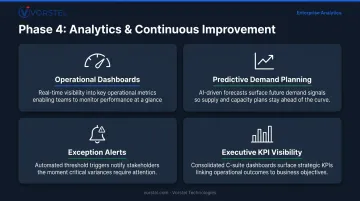
The final phase converts the integrated data platform into a decision engine. At this stage, organizations gain access to:
- Operational dashboards — real-time visibility into inventory, order status, and financial performance
- Predictive demand planning — ML models trained on historical sales, seasonality, and promotional patterns
- Exception alerts — automated flags for supply chain delays, compliance gaps, or budget variances
- Executive KPI visibility — consolidated performance dashboards across business units
This phase is not a finish line. It's the start of a continuous improvement cycle where new data, shifting market conditions, and emerging technologies get absorbed without disrupting core operations.
Managing Risk Through Phased Deployment
Most ERP transformations run 10–18 months, with Panorama's 2024 report citing a median of 15.5 months across a sample of mid-market organizations. Attempting a full simultaneous rollout across all modules and locations is the fastest route to disruption.
Two phased approaches dominate successful deployments:
- Module-by-module — updating one functional area at a time (finance first, then supply chain, then HR)
- Site-by-site — piloting at one location before expanding to others
Organizations that engage an experienced implementation partner, including one capable of joining mid-implementation, significantly reduce the risk of costly derailments. Vorstel is designed specifically for this: the team can step in at any stage of a client's transformation, assess where things stand, and move the project forward without starting from scratch.
ERP Digital Transformation Best Practices
Align ERP Strategy with Business Objectives From Day One
ERP must be embedded in organizational culture and tied directly to measurable business goals — not treated as an IT project. Transformations that remain confined to the IT department consistently underperform.
Business leaders need to co-own the initiative. That means participating in defining success criteria, sitting in on key design decisions, and visibly championing the change across their teams.
Prioritize Change Management as Rigorously as Technical Deployment
Panorama's 2024 data shows less than half of organizations had an intense focus on change management. That gap explains a significant portion of underperforming implementations.
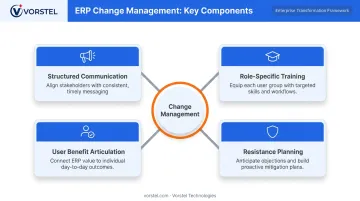
Effective change management requires:
- Structured communication programs explaining why the change is happening, not just what is changing
- Role-specific training timed to when people actually need it
- Clear articulation of how new processes benefit the individual user, not just the business
- A plan for resistance — because resistance is predictable, and planning for it is not optional
Invest in Data Governance Before, During, and After Implementation
Data quality is not a one-time pre-migration task. It's an ongoing discipline. Governance frameworks should define:
- Assign clear ownership for each data domain so accountability doesn't fall through the cracks
- Establish validation rules that define what clean, accepted data actually looks like
- Map how data flows between ERP and connected systems before migration begins
Services like SAP MDG (Master Data Governance) provide the structural framework for maintaining consistency across the enterprise post-implementation.
Design for Cloud-Readiness and Scalability
Cloud-based ERP delivers lower infrastructure overhead, automatic updates, and a modern foundation for deploying emerging technologies — including AI tools that require elastic compute environments. For organizations not yet ready for a full cloud migration, cloud-ready on-premises configurations offer a transitional path.
The right strategy depends on the specific operational profile. Vorstel's Zero-Fee Solution Evaluation is designed exactly for this: providing expert analysis of cloud readiness without a cost commitment, so organizations can make the platform decision with full information rather than vendor pressure.
Measure Transformation with KPIs, Not Just Go-Live Milestones
Dashboards should be in place before go-live, not configured afterward. Relevant transformation KPIs include:
- Reduction in system downtime (Vorstel clients have seen 45% reductions on average)
- Order cycle time improvements
- Forecast accuracy rates (MAPE, bias)
- Customer satisfaction scores
- Operational cost reduction per transaction
Organizations that define these metrics before implementation have a concrete baseline — making it possible to evaluate whether transformation is delivering real results, not just a successful go-live date.
How AI and Emerging Technologies Are Reshaping ERP Transformation
AI Inside the ERP
Generative AI and machine learning are now embedded directly inside ERP platforms, not bolted on as afterthoughts. Gartner forecasts that by 2026, more than 80% of enterprises will have used GenAI APIs or deployed GenAI-enabled applications, up from under 5% in 2023. Within ERP specifically, Panorama reported AI adoption increased 10.2% year-over-year among its 2024 survey respondents.
Practical examples already in production:
- SAP Joule: a natural language AI assistant embedded across SAP's cloud portfolio, letting non-technical users query ERP data conversationally
- Oracle Demand Management: AI-driven forecasting that combines machine learning with statistical methods for more accurate supply planning
- AP automation in manufacturing: Vorstel built an end-to-end invoice processing solution using AI Builder, replacing a fully manual workflow with automated validation, ERP updates, and file archiving
IoT and Real-Time Data
For manufacturing, distribution, and field service organizations, IoT sensors feeding real-time operational data into ERP create capabilities that weren't possible with traditional configurations:
- Predictive maintenance — detecting equipment stress patterns before failure occurs
- Live inventory tracking — automated reorder triggers based on actual bin-level data
- Connected field service — IoT-powered diagnostics enabling proactive service dispatch
The Sequence Warning
Organizations that deploy AI or advanced analytics on top of fragmented, poorly governed ERP data will produce unreliable outputs. Gartner identifies poor data quality as a primary reason data and analytics initiatives fail, at an average cost of $12.9 million per year.
ERP modernization must come first. Chasing AI-powered operations before the data foundation is sound sets the entire initiative up to fail.
Frequently Asked Questions
What is ERP digital transformation?
ERP digital transformation uses an ERP system as the central platform to integrate cloud, AI, automation, and analytics — redesigning how people, processes, and data interact across the entire organization. It goes beyond a software upgrade; it's a structural shift in how the business operates and makes decisions.
Is ERP the same as SAP?
No. ERP (Enterprise Resource Planning) is a category of business software. SAP is one of the leading vendors that builds ERP systems. Other major ERP platforms include Microsoft Dynamics 365, Oracle NetSuite, and Salesforce — each suited to different business sizes, industries, and operational needs.
Is ERP difficult to learn?
Modern ERP systems are far more user-friendly than legacy platforms, but adoption still requires structured training and change management. The learning curve varies by platform, customization depth, and how well your implementation partner handles onboarding.
What are the biggest challenges in ERP digital transformation?
The most common failure points: poor data quality entering migration, lack of executive sponsorship, underestimating change management needs, and attempting to implement everything at once rather than in deliberate phases. All of these are predictable and preventable with the right planning upfront.
How long does an ERP digital transformation typically take?
Typical ERP implementations run 10–18 months, with Panorama's 2024 research citing a median of 15.5 months for mid-market organizations. Phased rollouts and a strong implementation partner can shorten that timeline considerably.