Introduction
If a digital-native competitor entered your market tomorrow — no legacy infrastructure, no institutional inertia, built entirely around modern platforms and data — would your current business model survive the pressure?
That question isn't hypothetical. It's the operating reality for most industries right now.
Many businesses confuse digitizing their operations with transforming them. Installing new software or moving files to the cloud is digitization. Real digital transformation is something different: it reshapes how you create value, deliver it to customers, and capture revenue — from the ground up.
IDC forecasts worldwide digital transformation spending to reach nearly $4 trillion by 2027, which signals that this is no longer a niche investment — it's a mainstream business imperative. This article unpacks what digital transformation actually means for business models, where it drives measurable impact, and what a credible execution path looks like for organizations ready to act.
Key Takeaways
- Digital transformation reinvents how businesses create, deliver, and capture value — reshaping strategy, not just operations
- It spans five core areas: business models, operations, products/services, customer experience, and employee experience
- McKinsey's 2024 research found digital and AI leaders outperform laggards by 2x to 6x on total shareholder returns
- Top barriers are cultural resistance, legacy systems, and unclear strategy — all solvable with the right approach
- Start with two or three high-impact areas — full-scale simultaneous overhauls rarely succeed
What Digital Transformation Really Means for Business Models
Three related terms get used interchangeably, and that confusion is expensive:
| Term | What It Means |
|---|---|
| Digitization | Converting analog information to digital format (scanning documents, digitizing records) |
| Digitalization | Using digital data to optimize existing processes (automating approvals, reducing manual steps) |
| Digital transformation | Reinventing how the business creates, delivers, and captures value — using digital technology as a foundation |
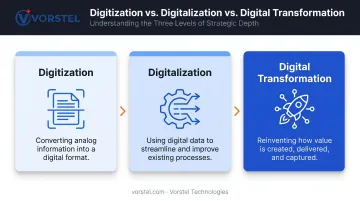
Most companies invest heavily in the first two and call it transformation. The result is faster versions of the same old model, not a fundamentally better one.
What "Business Model" Actually Covers
A business model answers four questions: What do you offer? Who do you serve? How do you reach them? How do you get paid? Digital transformation disrupts all four simultaneously.
Consider two examples that illustrate this clearly:
- Netflix shifted from DVD-by-mail to streaming — changing the revenue model (subscription vs. per-rental), the product (on-demand vs. scheduled access), and the customer relationship (data-driven personalization vs. physical browsing).
- Uber eliminated the need to own vehicles entirely, facilitating over 6 billion rides by 2019 according to HBR — an asset-light approach that redefined what a transportation company looks like.
Neither is a technology story. Both are business model stories that technology made possible.
The Cultural Dimension
Technology is rarely the hard part. Leadership alignment, workforce readiness, and a clear vision for where the business is headed are harder to get right — and more consequential when they're missing. Initiatives that start with technology purchases before answering "why are we doing this?" produce expensive digitalization, not transformation.
The 5 Core Areas of Digital Transformation
Organizations rarely transform all five areas simultaneously. The realistic starting point depends on where competitive pressure is highest or where customer expectations are furthest from current capabilities. Each of the five domains below represents a distinct transformation lever — with different risk profiles, timelines, and organizational dependencies.
Business Models and Revenue Streams
This is the highest-impact domain, and the highest-risk. Changing the business model means shifting how value is created and captured:
- One-time product sales → recurring subscriptions
- Direct distribution → platform ecosystems
- Product ownership → outcome-based pricing
The upside is significant. BCG found that only 30% of digital transformations met or exceeded target value and created sustainable change. Companies that get six key success factors right, however, can flip those odds to 80%.
Business Processes and Operations
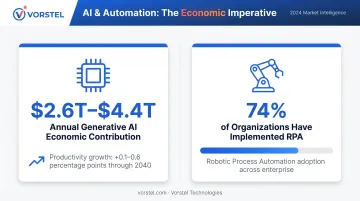
Process transformation means automating manual workflows, eliminating redundant steps, and building intelligent workflows using AI and robotic process automation (RPA). The goal isn't automation for its own sake — the point is freeing human capital for higher-value work.
McKinsey estimates generative AI alone could add $2.6T to $4.4T annually to the global economy across analyzed use cases and raise labor productivity growth by 0.1 to 0.6 percentage points annually through 2040. Deloitte's 2022 survey found 74% of organizations had already implemented some form of RPA — making it table stakes, not a differentiator.
Products and Service Innovation
Embedding digital technology into products creates new value and new data. IoT-enabled manufacturing equipment, connected vehicles, and app-based service delivery all generate continuous feedback loops that accelerate product improvement.
Agile and DevOps practices compress the distance between customer feedback and product response. Chevron's automated CI/CD pipeline, for example, delivers code changes in 7 minutes and new infrastructure in as few as 30 minutes — a pace traditional development simply can't match.
Employee Experience and Workforce Enablement
Transformation fails without workforce buy-in. KPMG's 2023 US Technology Survey found 57% of businesses said employee resistance directly influences technology investment decisions , making people the most consistently underestimated variable in transformation planning.
Key enablement priorities based on the same KPMG research:
- Digital literacy — cited as in-demand by 52% of respondents
- Data fluency — cited by 49%
- Ability to teach others — cited by 53% (peer learning accelerates adoption faster than top-down training)
Upskilling isn't optional spending. Organizations that treat it as overhead consistently see lower ROI from their technology investments.
Customer Experience and Engagement
Every transformation initiative ultimately connects to this domain. Customers expect personalized, omnichannel experiences with 24/7 accessibility , and they switch providers when those expectations go unmet.
AI, CRM platforms, and data analytics enable the shift from reactive to proactive engagement: anticipating needs before customers articulate them, personalizing interactions at scale, and building loyalty through relevance rather than damage control.
The Business Impact: How Digital Transformation Reshapes Performance
Operational Efficiency and Cost Reduction
Cloud adoption is one of the clearest levers. McKinsey's research found effective cloud use can improve application development and maintenance productivity by 38% and infrastructure cost efficiency by 29% for migrated applications. That said, lift-and-shift migrations without application optimization tend to increase costs rather than reduce them.
Cloud migration is a strategy, not a transaction. The value comes from redesigning how work gets done on the new infrastructure — not from simply relocating existing workloads.
Competitive Advantage and Market Positioning
Digital maturity creates a self-reinforcing advantage. McKinsey's 2024 analysis found digital and AI leaders outperform laggards by 2x to 6x on total shareholder returns. The gap doesn't narrow over time — it widens as digital leaders reinvest efficiency gains into faster innovation cycles.
BCG's numbers put that gap in sharper relief: only 35% of companies achieved their digital transformation objectives in a 2021 study of more than 850 businesses. The majority of competitors are either failing at transformation or not attempting it seriously.
New Revenue Streams and Business Opportunities
Digital transformation opens monetization paths that didn't previously exist. Vorstel Technologies helps organizations identify which paths fit their specific situation — mapping current capabilities to market opportunities as part of its implementation work across SAP, Microsoft, and Salesforce.
- Data-as-a-service — selling insights derived from operational or customer data
- Platform ecosystems — acting as an intermediary connecting supply and demand
- Digital product offerings — software or app-based extensions of physical products
- Marketplace models — enabling third-party transactions on proprietary infrastructure
Agility and Resilience
The COVID-19 pandemic provided the clearest real-world evidence. McKinsey's 2020 survey of 899 executives found digitization of customer interactions, supply-chain management, and internal operations accelerated by 3 to 4 years. Remote work and collaboration changes were implemented 43x faster than previously expected, averaging 10.5 days versus an anticipated 454 days.
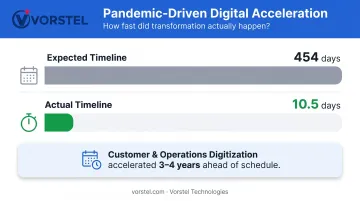
Businesses with cloud scalability, modular architectures, and integrated data visibility adapted. Those without them scrambled. Digital transformation shapes not just normal-state performance, but how organizations survive disruption when it arrives.
Common Challenges in Digital Transformation (And How to Address Them)
Resistance to Change and Cultural Inertia
KPMG's 2023 survey identified the top transformation barriers among US technology executives:
- Collaboration breakdown: 47%
- Lack of internal skills: 41%
- Risk-averse culture: 40%
- Legacy technology constraints: 39%
Culture and people dynamics drive most of these failures — not the technology itself. Addressing them requires a deliberate organizational approach:
- Executive sponsorship with visible commitment, not just budget allocation
- Internal digital champions who translate change into practical, day-to-day terms
- Transparent communication about why transformation is happening and what it means for teams
- Continuous learning programs rather than one-time training events
Legacy Systems and Integration Complexity
Outdated infrastructure creates data silos, compatibility barriers, and security vulnerabilities that slow every transformation initiative downstream. Forrester research found technical debt actively pulling energy away from innovation. Gartner estimates that by 2028, organizations using structured technical debt management will report 50% fewer obsolete systems than peers who don't.
Full replacement is rarely the right answer. Prioritize modernizing systems that directly affect customer-facing operations or data flow first — these deliver the most immediate transformation value and build the clearest business case for continued investment.
Unclear Strategy and Misaligned Priorities
Many organizations invest in technology without connecting it to specific business outcomes. The result is a collection of disconnected tools rather than a coherent transformation.
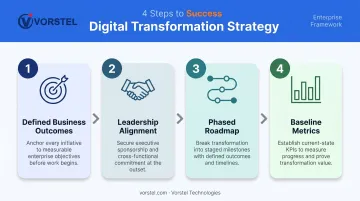
Successful transformation requires:
- Defined business outcomes — not "implement AI" but "reduce order processing time by 40%"
- Leadership alignment across business and technology functions
- A phased roadmap with clear milestones, not a simultaneous overhaul
- Baseline metrics established before transformation begins, so ROI can be measured objectively
How to Build Your Digital Transformation Roadmap
Start with Assessment and Prioritization
Before committing resources, map where you are:
- Audit your current technology, processes, and digital maturity across all key domains
- Identify where customer expectations are outpacing your current capabilities
- Select 2-3 domains with the highest impact-to-effort ratio as starting points
MIT CISR's Future Ready framework maps transformation across two axes: operational efficiency and customer experience. Most organizations find their clearest starting point on one axis — and building capability there creates the foundation for the other.
Build Momentum with Quick Wins
Large transformation programs that take years to show results lose organizational confidence and budget. A more effective pattern:
- Choose targeted, time-bound projects with measurable outcomes in 60-90 days
- Demonstrate value visibly to build credibility for larger initiatives
- Use early wins to identify what works before scaling
Each phase informs the next, and early-stage adjustments cost far less than mid-program pivots.
Know When to Bring in a Partner
Transformation expertise isn't always built in-house — and the cost of learning on the job is high. Vorstel Technologies works with organizations at any stage of this journey — from initial strategy and ERP implementation (SAP, Microsoft, Salesforce) through cloud infrastructure, AI integration, and DevOps. A particular strength is mid-project entry: assessing what's already in place and delivering outcomes without disrupting existing operations. That makes them worth a conversation when internal momentum has stalled or a project needs a faster path forward. They also offer a zero-fee solution evaluation for organizations exploring their options.
Frequently Asked Questions
What are the impacts of digital transformation?
The primary impacts span operational efficiency gains, improved customer experience, stronger competitive positioning, new revenue streams, and better decision-making through integrated data. The specific impact mix varies by industry and how far along the transformation journey an organization is.
What are the 5 main areas of digital transformation?
Business models, business processes, products and services, employee experience, and customer experience. Most organizations start with one or two areas and expand as capability and confidence build.
What is the difference between digitization, digitalization, and digital transformation?
Digitization converts analog information to digital format. Digitalization uses digital data to improve existing processes. Digital transformation goes further: it reinvents the entire business model, redefining how value is created, delivered, and captured through digital technology.
How does digital transformation change a business model specifically?
It changes what companies offer — new digital products or services — along with how they deliver value through new channels and platforms. Revenue models shift too, from one-time transactions to subscriptions, marketplace fees, or data monetization, often reaching customer segments that weren't accessible before.
What are the biggest challenges in digital transformation?
Cultural resistance and skills gaps, legacy system complexity, and the absence of a clear business-outcome-driven strategy. Addressing leadership alignment and change management before or alongside technology deployment improves success rates.
How do you measure the success of a digital transformation initiative?
Track both quantitative KPIs — revenue growth, cost savings, cycle time reduction, customer retention — and qualitative indicators like employee satisfaction and adaptability to market shifts. Establishing baseline metrics before the transformation begins makes measurement meaningful.