Digital transformation consulting exists to close that gap. It's the strategic bridge between ambition and actual outcomes — turning intention into a roadmap with clear phases, measurable milestones, and organizational buy-in.
This article covers what digital transformation consulting actually involves, how to build a results-driven roadmap across five phases, why most initiatives stall, what to demand from a consulting partner, and how to track whether your investment is working.
Key Takeaways
- Digital transformation consulting ties technology investments directly to measurable business outcomes, not just the tools you deploy.
- A structured roadmap moves through five phases: assess, align, select, implement, and optimize.
- 70% of transformation efforts fail — most due to unclear goals, resistance to change, and poor technology fit.
- The right consulting partner brings cross-domain expertise and can step in at any stage — whether you're just starting out or mid-implementation.
- ROI spans both financial and operational metrics; define it before execution starts, not after.
What Is Digital Transformation Consulting, and Why Does It Matter?
Digital transformation consulting is the practice of aligning an organization's digital initiatives with its core business strategy through expert external guidance. It covers technology adoption, process redesign, organizational change management, and outcome measurement — not just system implementation.
This is where it differs from pure IT consulting. An IT firm fixes what's broken and deploys what's requested. A transformation consultant asks harder questions: Why are we doing this? What does success look like? What has to change in how the business operates?
The Three Types of Organizations
Most enterprises fall into one of three categories:
- Unaware or reactive — technology decisions are made ad hoc, driven by urgency rather than strategy
- Aware but stuck — leadership understands the need to transform but can't scale efforts past isolated pilots
- Continuously transforming — digital capability is embedded into operations, and change is treated as a competitive advantage
Consulting adds the most immediate value for the second group, and the most compounding value for the third.
The market reflects this demand. Fortune Business Insights projects the global digital transformation consulting services market will grow from $185.18 billion in 2025 to $467.92 billion by 2034 — an 11% annual growth rate driven by enterprises recognizing they need more than internal IT teams to navigate this complexity.
That gap is precisely where external consultants earn their value. They bring an outside-in perspective, cross-industry pattern recognition, and specialized depth across domains that internal teams rarely cover in combination. Firms like Vorstel Technologies, for example, span AI/ML, ERP, Salesforce, Microsoft, cloud, and DevOps within a single engagement model — which means organizations get integrated assessment and execution without coordinating multiple vendors.
The 5 Critical Phases of a Digital Transformation Roadmap
A digital transformation roadmap is a living strategic plan. It connects where your organization is today to where it needs to be digitally, defining priorities, ownership, timelines, and success criteria along the way. The key word is adaptive: the roadmap evolves as execution reveals new data.
Here's how high-performing transformation programs structure the journey.
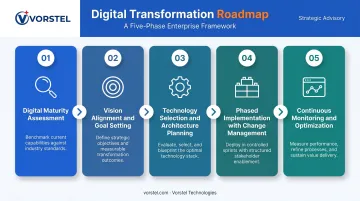
Phase 1: Digital Maturity Assessment
Every roadmap starts with an honest answer to: Where are we actually today?
This phase involves auditing existing infrastructure, identifying process bottlenecks, assessing talent gaps, and benchmarking current digital capabilities against industry standards. Skipping this step is one of the most expensive mistakes organizations make — it leads to technology investments that don't fit the actual environment.
Vorstel Technologies approaches this through a Zero-Fee Solution Evaluation, giving organizations a structured starting point without upfront financial commitment.
Phase 2: Vision Alignment and Goal Setting
Without clear business outcomes, technology goals drift. This phase translates business strategy into specific, measurable digital objectives:
- Reduce operational downtime by X%
- Cut deployment cycle time from weeks to days
- Improve customer satisfaction scores by a defined margin
- Achieve real-time data visibility across supply chain operations
Goals anchored to business outcomes — revenue, efficiency, customer experience — hold up under scrutiny. Goals anchored only to technology milestones ("we implemented Salesforce") don't.
Phase 3: Technology Selection and Architecture Planning
Technology selection should follow strategy, not drive it. Once goals are established, consultants evaluate which platforms and architecture patterns best fit the organization's specific context, existing systems, and growth trajectory.
Key platform decisions typically span:
| Domain | Platform Examples | What It Addresses |
|---|---|---|
| ERP | SAP S/4HANA | Core operations, financials, supply chain |
| CRM | Salesforce | Customer engagement, sales pipeline |
| Cloud | AWS, Azure, GCP | Scalability, infrastructure modernization |
| Collaboration | Microsoft 365 | Productivity, workflow integration |
| DevOps | CI/CD frameworks | Deployment speed, release reliability |
Vorstel's 200+ SAP project portfolio and 95% Salesforce CRM implementation success rate reflect the depth required to make these decisions without guesswork.
Architecture planning also means getting ahead of infrastructure trends. IDC forecasts global public cloud spending to surpass $1 trillion in 2026, growing over 21% year-over-year. Organizations that defer cloud architecture decisions today will be playing catch-up tomorrow.
Phase 4: Phased Implementation with Change Management
Phased implementation serves two purposes: it manages risk and sustains organizational momentum through visible progress.
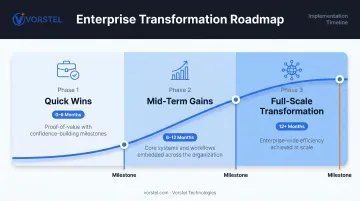
- 0–6 months: Quick wins that prove value early and build team confidence
- 6–12 months: Mid-term gains across core systems and workflows
- 12+ months: Full-scale transformation with measurable, enterprise-wide efficiency gains
Change management determines whether tools get adopted or abandoned. Prosci's research across 2,600+ change practitioners found that projects with excellent change management are 7x more likely to meet objectives — 88% meet or exceed goals versus just 13% with poor change management.
Communication, training, and leadership alignment are structural requirements, not optional extras.
Phase 5: Continuous Monitoring and Optimization
Transformation doesn't end at go-live. The final phase is an ongoing discipline:
- KPI dashboards tracking performance against defined baselines
- Quarterly strategy reviews with consulting partners
- Data-driven decisions on whether to scale, pause, or pivot specific initiatives
- Roadmap updates that incorporate new technologies and market shifts
Organizations that treat their roadmap as a static document lose the ability to course-correct. Those that build monitoring into the model treat transformation as a continuous capability — and sustain their gains over time.
Why Most Digital Transformation Initiatives Fail (And How to Avoid It)
The 70% failure rate isn't a fluke. BCG's research identifies specific, repeatable patterns that derail transformation programs — most of them preventable with the right approach from the start.
The Most Common Failure Points
Unclear goals not tied to business outcomes. Organizations adopt technology reactively — for modernization's sake, competitive pressure, or vendor influence — without defining what success looks like. Without measurable goals established upfront, there's no way to know whether the transformation is working.
Resistance to change at every level. BCG found that only 1 in 3 executives reported committed middle-management engagement in their transformations. Middle management is where strategy dies or lives.
Effective consulting embeds change management into delivery: not as a standalone workstream, but as an ongoing thread running through every phase.
The legacy system trap. More than half of companies BCG studied struggled with inflexible technology platforms. Organizations routinely underestimate how deeply siloed infrastructure impedes new tools. Experienced consultants design phased integration paths that modernize systems incrementally, avoiding the need for a costly full overhaul on day one.
Treating transformation as a one-time project. BCG's data shows that 90% of digital transformations in the "woe zone" lacked effective agile leadership, and only 2 in 5 organizations tracked progress effectively. Transformation programs that run without adaptive governance (quarterly reviews, real-time tracking, willingness to pivot) stall the moment initial energy wanes.
What the Data Actually Tells You
BCG breaks transformation outcomes into three zones:
- Win zone (30%): Meets or exceeds objectives with sustainable change
- Worry zone (44%): Creates some value but misses targets and lacks long-term change
- Woe zone (26%): Creates minimal value, less than 50% of target, with no sustainable impact
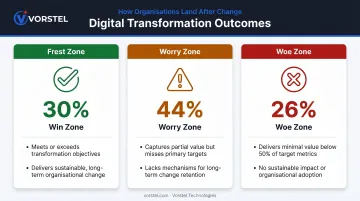
The companies in the bottom 70% spent comparable resources to those in the win zone — for dramatically worse returns. The differentiator isn't budget or technology choice. It's whether the organization has the execution discipline and strategic alignment to sustain change past the launch phase.
What to Look for in a Digital Transformation Consulting Partner
Not all consulting relationships deliver equal value. The right partner moves your roadmap forward — the wrong one creates dependency and delays the outcomes you're paying for.
Essential Partner Qualities
Cross-domain technical depth matters because transformation rarely lives in one technology silo. You need a partner with real expertise across AI, cloud, ERP, CRM, DevOps, and security — not specialists who hand off to other firms at every boundary.
Ability to join at any stage. Whether you're starting from scratch, scaling a pilot, or rescuing a stalled initiative, onboarding time directly affects outcomes. A partner who can enter mid-journey without a lengthy ramp-up period is a practical advantage, not just a nice-to-have.
Vorstel Technologies structures its delivery model around exactly this: taking over assignments at any stage in the fastest possible time, with a Zero-Fee Solution Evaluation to remove friction from the first step.
Global reach with local accountability. Organizations operating across geographies need a partner who understands regional business environments, regulatory requirements, and operational contexts. A multi-location delivery model with consistent standards across markets — not a single template applied everywhere — is a meaningful differentiator.
What to Avoid
- Partners who lead with platform recommendations before understanding your strategy
- Firms that deliver reports and frameworks without hands-on implementation capability
- Engagements without clearly defined KPIs or knowledge transfer plans
- Models that create permanent external dependency rather than building internal competency over time
The best consulting engagements end with your team more capable than when they started, not more reliant on outside help. That distinction is worth asking about before you sign anything.
How to Measure ROI and Success of Your Digital Transformation
ROI in digital transformation is multidimensional. It spans financial returns and operational performance — and both need to be tracked from the beginning.
The ROI Evidence
Accenture's Total Enterprise Reinvention research found that organizations that commit fully to transformation — "Reinventors" — achieve 10% higher incremental revenue growth, 13% higher cost-reduction improvements, and 17% higher balance-sheet improvements compared to peers.
Measurement discipline amplifies returns. Deloitte's 2023 survey of 1,600 business and technology leaders found that organizations with a holistic measurement mindset are 20% more likely to attribute medium-to-high enterprise value to their digital transformations. Yet 73% of leaders cite the inability to define exact metrics as their top barrier to measuring value.
Define KPIs before execution begins — measuring backwards rarely changes outcomes.
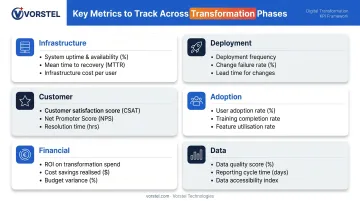
KPIs to Track Across Transformation Phases
| Category | Example KPIs |
|---|---|
| Infrastructure | System uptime, incident frequency, mean time to recovery |
| Deployment | Deployment cycle time, release frequency, rollback rate |
| Customer | Customer satisfaction score, NPS, resolution time |
| Adoption | Employee adoption rate of new tools, training completion |
| Financial | Cost savings vs. baseline, revenue impact, ROI vs. investment |
| Data | Time-to-insight, reporting accuracy, data availability |
Vorstel's enterprise clients have reported 45% reductions in system downtime and 92% faster deployment cycles — both of which are measurable from day one of a structured engagement.
Ongoing Transformation Health Checks
Set a quarterly review cadence with your consulting partner. Each review should answer:
- Are active initiatives tracking against defined KPIs?
- What new data has emerged that should influence the roadmap?
- Should any initiatives be scaled, paused, or redirected?
- How are adoption rates trending, and where do they need support?
Programs that build this review discipline into the engagement from day one consistently outperform those that treat measurement as a post-launch activity.
Frequently Asked Questions
What is digital transformation consulting?
Digital transformation consulting is the practice of aligning an organization's technology investments and digital initiatives with its core business goals through expert external guidance. It covers strategy, technology selection, implementation, change management, and outcome measurement — going well beyond pure IT consulting or one-time software implementation.
How do I know if my business needs a digital transformation consultant?
Key signals include technology decisions being made reactively rather than strategically, IT spending that doesn't map to business outcomes, transformation initiatives stalling mid-execution, or your team lacking specialized expertise in critical domains like AI, ERP, or cloud architecture.
What are the most common reasons digital transformation initiatives fail?
The top causes are unclear goals not tied to business outcomes, resistance to change without structured change management, and underestimated legacy system complexity. Many initiatives also fail because organizations treat transformation as a one-time project rather than a continuous capability requiring active governance.
How long does a digital transformation roadmap typically take to execute?
Transformation is phased. Quick wins are achievable in 3–6 months, mid-term goals in 6–12 months, and full-scale transformation over 12–24+ months depending on organizational complexity, scope, and the maturity of the consulting engagement.
What should I look for when choosing a digital transformation consulting partner?
Prioritize cross-domain expertise across AI, ERP, cloud, and DevOps — along with the flexibility to engage at any stage of your journey. The right partner has a track record of measurable client outcomes, global delivery capability, and a model designed to build your internal capability rather than lock in long-term reliance.
How is ROI measured in digital transformation consulting engagements?
ROI spans financial KPIs (cost reduction, revenue impact) and operational KPIs (uptime, deployment speed, adoption rates). Both parties should agree on these metrics before the engagement begins and track them through quarterly reviews against baselines set during the initial assessment.