For enterprises, manufacturers, retailers, and startups alike, the question is no longer whether to transform but how fast — and how well. Organizations that move too slowly are watching digitally native competitors erode their market share in real time. Those that move without a clear strategy are burning through budgets with little to show for it.
This article covers the forces driving urgency in 2025-2026, the trends actively reshaping operations today, what successful transformations are built on, why so many fail, and practical steps to move forward — whether you're just starting out or stuck mid-journey.
Key Takeaways
- Digital transformation spending approaches $4 trillion globally, making it a strategic necessity for most organizations
- Generative AI has shifted from experiment to core business function at 71% of organizations
- 70% of transformations fall short of objectives — misaligned goals and poor change management are the leading causes
- Successful transformation requires strategy, data, culture, and technology — in that order
- Starting with a focused pilot beats waiting for a perfect plan every time
Why Digital Transformation Is Accelerating Right Now
Three forces are colliding in 2025 to create genuine urgency.
Customer behavior has permanently shifted. The pandemic normalized digital-first interactions — remote work, online purchasing, self-service digital journeys — and customers haven't reverted. Forrester projects global online retail sales will grow from $4.4 trillion in 2023 to $6.8 trillion by 2028. Businesses built for physical-first interactions are now structurally mismatched with market demand.
AI has moved from IT roadmap to boardroom mandate. PwC's 2025 Annual Global CEO Survey of 4,701 CEOs across 109 countries found that almost half now cite integrating AI into their technology platforms and business workflows as a top-three priority for the next three years. That shift in executive priority is driving accelerated investment cycles that weren't on the table 24 months ago.
Legacy infrastructure has become a hard cost, not just a technical inconvenience. U.S. federal agencies historically spend around 80% of their IT budgets on operations and maintenance of existing systems — a pattern common across large enterprises. When most of your technology budget keeps aging systems running, it directly limits the capacity to build new capability, automate processes, or respond to competitive pressure.
Together, these three forces — shifting customer expectations, AI urgency, and the cost of legacy debt — are compressing the timeline for transformation from "multi-year roadmap" to immediate operational priority.
Top Digital Transformation Trends Reshaping Business in 2025-2026
These aren't emerging possibilities. They're active forces reshaping how organizations operate right now.
Artificial Intelligence and Generative AI at the Core
McKinsey's 2025 State of AI survey found that 71% of organizations now regularly use generative AI in at least one business function — a sharp increase from prior years. IBM's Global AI Adoption Index reports that 42% of enterprise-scale companies have actively deployed AI in production environments.
The applications go well beyond basic automation. Teams are using generative AI for:
- Intelligent document processing and workflow automation
- AI-assisted decision-making in finance and operations
- Predictive demand forecasting in retail and supply chain
- Real-time quality control in manufacturing
- Natural language interfaces for customer support
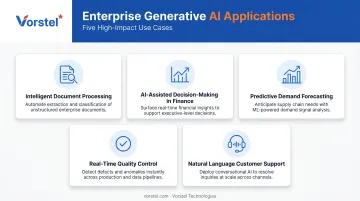
Vorstel's AI engagements illustrate the range. For a manufacturing client, they replaced a manual invoice management process with an AI Builder-powered workflow that reads, validates, and archives invoices automatically. For a global e-commerce client, they deployed an NLP solution on Microsoft Azure Cognitive Services to classify thousands of daily support queries by intent and urgency. That eliminated the manual triage bottleneck entirely.
Cloud Migration and Hybrid Infrastructure
Cloud has become the infrastructure layer that enables AI, analytics, and customer-facing applications to function at scale. According to IDC, 88% of cloud buyers were deploying hybrid cloud or actively operating one as of Q3 2024, and Flexera's research shows 89% of organizations use multicloud architectures.
The strategic question has shifted from "should we move to cloud?" to "how do we govern multiple cloud environments intelligently?" Enterprises are building hybrid architectures that keep sensitive workloads on-premise while routing AI, analytics, and customer-facing applications through cloud infrastructure.
Key priorities driving hybrid cloud adoption include:
- Workload portability across AWS, Azure, and Google Cloud environments
- Governance frameworks that enforce security and compliance across providers
- Cost optimization through intelligent workload placement
- Integration with on-premise ERP and legacy systems
Intelligent Automation and Process Optimization
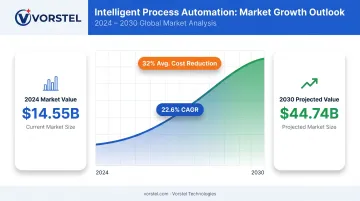
The intelligent process automation market was valued at $14.55 billion in 2024 and is projected to reach $44.74 billion by 2030, a 22.6% annual growth rate. Organizations that have moved past piloting to deploying automation at scale report average cost reductions of 32%, according to Deloitte's global intelligent automation survey.
Practical applications span every business function:
- Finance: automated invoice processing and reconciliation
- HR: onboarding workflows and compliance documentation
- Supply chain: real-time inventory adjustments triggered by demand signals
- Customer service: query routing and resolution without human triage
Cybersecurity as a Transformation Imperative
Every new digital capability expands the attack surface. IBM's Cost of a Data Breach 2024 report puts the average global breach cost at $4.88 million — a record high and the largest single-year jump since the pandemic. For financial services firms, that figure climbs to $6.08 million.
One response gaining traction is the "shift-left" approach: integrating security from the earliest stages of any transformation initiative rather than adding it after deployment. GitLab's 2024 Global DevSecOps Survey of more than 5,000 professionals found over half now consider application security part of their core role, not a separate team's responsibility.
Security practices organizations are embedding into transformation programs include:
- Identity and access management integrated with cloud provisioning
- Automated vulnerability scanning in CI/CD pipelines
- Zero-trust network architecture for hybrid environments
- Data encryption and residency controls for cross-border compliance
ERP and SaaS Platform Modernization
ERP modernization appears on nearly every enterprise transformation roadmap. The global ERP market is projected to reach $157 billion by 2033, reflecting sustained investment in platforms like SAP S/4HANA, Salesforce, and Microsoft Dynamics.
SAPinsider's 2025 benchmark research found that 32% of surveyed organizations had already completed their transition to SAP S/4HANA — a 10-percentage-point jump from 2024. When properly configured, these platforms don't just run operations. They feed AI models, trigger automation workflows, and power real-time executive dashboards — making the ERP the operational center of a broader transformation stack.
Vorstel's SAP practice, built on 200+ project engagements, covers the full spectrum: S/4HANA implementations, SAP BTP for extending and integrating intelligent applications, SAP Ariba for procurement digitization, and SAP MDG for enterprise data governance.
Key Elements of a Successful Digital Transformation
Organizations that realize lasting ROI from digital transformation don't succeed by chance. They share five structural elements — and the absence of any one of them is a reliable predictor of failure.
Leadership Alignment and Cultural Change
McKinsey found that transformations are 1.6 times more likely to succeed when a chief digital officer actively champions the effort. That statistic reflects a simple reality: when leadership can't articulate the "why" to employees — in business outcomes, not technology features — momentum evaporates.
Transformation efforts treated as IT projects instead of business-wide initiatives stall. Executive visibility isn't a nice-to-have; it's a structural requirement.
Clean Data Infrastructure and Integration
AI models are only as reliable as the data they train on. Automation workflows break when data exists in disconnected silos. Before investing in advanced capabilities, organizations need to address the foundational question: can the right data reach the right systems at the right time?
Breaking down silos across ERP, CRM, and cloud environments is often the highest-impact early investment — and it's where firms like Vorstel Technologies typically begin when joining a client's transformation at any stage.
Technology Stack Modernization
Legacy systems don't just cost money to maintain — they limit what's architecturally possible. A modern, interoperable stack enables:
- Real-time data flows across business units
- Scalable integration with AI and automation tools
- Faster deployment cycles without rearchitecting from scratch
The specific platforms matter less than the principle: build for connectivity and extensibility, not just current functionality.
Anchoring Every Initiative in Customer Outcomes
Every transformation initiative should trace back to a tangible improvement in how customers interact with the business. Faster resolution times, personalized journeys, self-service capabilities, proactive communication — these are the competitive differentiators that justify transformation investment in real business terms.
Defining Success Metrics and KPIs
Organizations that track outputs ("we deployed the system") instead of outcomes ("our order processing time dropped 40%") routinely underestimate what transformation has delivered — or miss that it hasn't. Establish baseline metrics before any initiative begins.
Deployment speed, system uptime, customer satisfaction scores, and cost per transaction can all be tracked from day one. Without that baseline, there's no honest way to measure whether the transformation actually worked.
Why Digital Transformation Initiatives Fail
BCG's research is direct: 70% of digital transformations fall short of their objectives. Only 30% fully succeed. The remaining 70% split between partial value creation and initiatives that produce limited lasting change.
Three failure patterns appear repeatedly across organizations of every size:
- Misaligned goals and absent executive sponsorship — When technology decisions can't be tied to specific business problems, organizational support evaporates. Without visible C-suite commitment, budget, talent, and attention migrate to other priorities.
- Employee resistance and inadequate change management — IBM's 2024 CEO study of 3,000 executives found that 64% of CEOs believe generative AI success depends more on people's adoption than on the technology itself. Fear of job displacement, unclear communication, and insufficient training are the most common adoption killers — yet change management consistently receives the smallest share of transformation budgets.
- Integration failures with legacy systems — New platforms deployed in isolation from existing infrastructure create parallel systems that don't communicate, duplicate data, and force employees to toggle between tools. A phased integration approach with strong technical oversight prevents this, but it requires upfront planning that often gets skipped in the rush to go live.
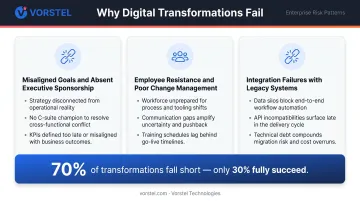
These failures are avoidable. BCG's research shows that organizations addressing six key transformation success factors can raise their odds of success from 30% to 80%.
How to Start or Accelerate Your Digital Transformation Journey
Whether you're defining your first transformation initiative or struggling to unlock value from one already underway, the approach should be the same: start with outcomes, not technology.
Practical first steps:
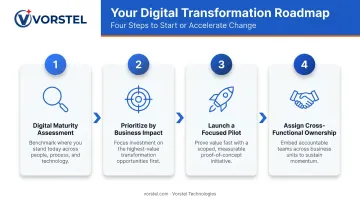
- Conduct a digital maturity assessment — BCG's Digital Acceleration Index benchmarks organizations across 41 dimensions — their data shows digitally mature companies were twice as likely to grow revenue by more than 10% between 2017 and 2020
- Prioritize by business impact — identify which transformation domains (customer experience, operations, data infrastructure) will deliver the clearest near-term ROI
- Launch a focused pilot — a contained, measurable initiative that validates technology choices and builds internal confidence before enterprise-wide commitment
- Assign cross-functional ownership — transformation initiatives with a single technology owner fail; successful ones have business, operations, and technology stakeholders co-accountable for outcomes
The difference between organizations that realize transformation ROI and those that don't often comes down to access to the right expertise at the right moment. Deep knowledge across AI, cloud, ERP, DevOps, and cybersecurity shortens the path to value and prevents the costly missteps that derail mid-journey programs.
That's where a partner like Vorstel Technologies makes a measurable difference. With expertise across AI implementation, SAP (including S/4HANA, BTP, and Ariba), Salesforce, Microsoft, and cloud infrastructure, they work with global enterprises and startups across Germany, India, Singapore, Finland, and Hungary. They join transformation engagements at any stage — assessment, mid-rollout, or optimization — and have earned a 97% client satisfaction rate across 30+ global clients.
Digital transformation is not a project with an end date. It's a continuous capability. Organizations that build an internal discipline of constant adaptation don't just keep pace — they pull ahead of competitors still waiting for a single initiative to deliver results.
Frequently Asked Questions
What are the stages of digital transformation?
Transformation moves through four phases: assessment and vision-setting, piloting focused initiatives, scaling across the organization, and continuous optimization. The journey is iterative — organizations often cycle back through earlier stages as market conditions and technology evolve.
What are the key elements of digital transformation?
Five elements consistently distinguish successful transformations: leadership alignment and cultural readiness, clean and integrated data infrastructure, technology stack modernization, a customer experience focus, and clear KPIs established before work begins.
Why is digital transformation happening now?
Several forces hit at once. Customer expectations permanently shifted toward digital-first experiences, digitally native competitors are raising the bar, and advances in AI and cloud have put capabilities that were once too expensive within reach of organizations of every size.
What technologies are driving digital transformation in 2025-2026?
The core technology drivers include:
- Generative AI and machine learning
- Cloud and hybrid infrastructure
- Intelligent process automation (RPA)
- Modern ERP and SaaS platforms (SAP, Salesforce, Microsoft)
- Integrated cybersecurity tooling
Edge computing and IoT are increasingly relevant in manufacturing and logistics contexts.
How long does digital transformation take?
There's no single answer. A focused AI pilot or process automation project can deliver measurable results within weeks. Enterprise-wide transformation is a multi-year ongoing discipline. The practical advice: don't wait for a perfect plan — start with a well-scoped initiative, prove value, then scale.