Introduction
Most organizations are sitting on enormous amounts of data — yet extracting real value from it remains frustratingly out of reach. Legacy databases, disconnected systems, and outdated on-premises infrastructure weren't built for the pace or complexity of modern business.
The scale of the problem is significant. IDC forecasts global data creation and replication will grow at a 23% CAGR through 2025, with enterprise data expanding even faster than consumer data. Organizations that can't process, govern, and act on that data will increasingly fall behind those that can.
Closing that gap starts with a clear modernization strategy. This guide breaks down what data modernization actually involves, the business case for it, how to plan effectively, and what to watch out for along the way.
Key Takeaways
- Data modernization = transforming legacy data infrastructure into scalable, cloud-native systems
- Core components include data integration, data quality, cloud migration, governance, and analytics enablement
- Key benefits: faster decisions, operational efficiency, stronger security, and AI readiness
- The 5 R's framework (Rehost through Rebuild/Replace) maps each workload to the right modernization path
- Partner selection matters as much as technology — the right partner addresses business outcomes, not just technical ones
What Is Data Modernization and Why Does It Matter Now
More Than Just Migration
Data modernization is the strategic process of updating an organization's data infrastructure, practices, and tools — moving from legacy on-premises systems to modern, cloud-based architectures that support analytics and AI.
The distinction from data migration matters, because conflating the two leads to scoped-down programs that deliver far less than expected:
| Data Migration | Data Modernization | |
|---|---|---|
| Scope | Moving data from point A to point B | Full infrastructure, governance, and tooling transformation |
| Duration | One-time technical task | Ongoing strategic initiative |
| Outcome | Data in a new location | Data that drives better decisions |
| Involves | Technical transfer | Architecture redesign, governance, culture change |
Migration is one step inside a modernization program — not a substitute for it.
The Urgency Is Real
The cloud-based data management services market is already valued at $43.83 billion in 2024 and projected to reach $173.63 billion by 2030 — a signal of how rapidly organizations are moving to modernize.
That growth isn't arbitrary. Three converging forces are pushing organizations to act:
- AI adoption: McKinsey reports AI adoption reached 72% in 2024 — but AI only works when underlying data is clean, accessible, and well-governed.
- Competitive exposure: According to Gartner, 63% of organizations lack the right data management practices for AI, and 60% of AI projects unsupported by AI-ready data will be abandoned by 2026.
- Regulatory exposure: GDPR, HIPAA, and SOC 2 compliance requirements demand audit trails, access controls, and data lineage that legacy systems don't provide.
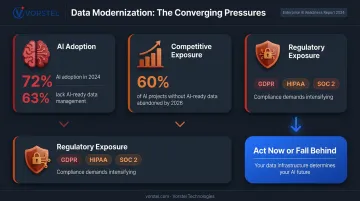
Each quarter without modernization means more technical debt, more compliance exposure, and fewer options when AI initiatives hit a data wall.
Core Components of a Data Modernization Strategy
Effective modernization is built on five interdependent components. Skipping any one of them creates gaps that undermine the others.
Data Integration
Modern enterprises pull data from dozens of sources — Salesforce CRM, SAP ERP, IoT sensors, third-party APIs, external databases. Without integration, analytics remains fragmented and unreliable.
Data integration creates a unified, single source of truth. Teams across the organization make decisions from the same data — not from conflicting spreadsheets or reports that were current last quarter.
Data Quality and Cleansing
Integration without quality control delivers unified bad data — which is often worse than fragmented data, because confidence in it is higher.
Quality work includes:
- Removing duplicate records
- Fixing formatting inconsistencies and errors
- Standardizing fields across source systems
- Validating accuracy against defined rules
This matters especially for AI and ML: models trained on poor-quality data produce unreliable outputs. Data quality isn't a one-time cleanup — it's an ongoing discipline.
Cloud Migration and Infrastructure
The shift from on-premises warehouses to cloud-native platforms (AWS, Azure, Google Cloud) unlocks capabilities that legacy infrastructure can't match:
- Elastic scalability — compute scales with demand, not hardware cycles
- Reduced infrastructure overhead — no physical servers to maintain or replace
- Real-time processing — streaming data pipelines instead of nightly batch jobs
Hybrid architectures are common during transition phases, where some workloads remain on-premises while others migrate incrementally.
Data Governance and Security
Governance defines who owns data, who can access it, and how changes are tracked. Without it, even a well-integrated, high-quality data environment becomes a liability.
Modern governance frameworks cover:
- Role-based access controls
- Data lineage tracking
- Automated compliance monitoring
- Full audit trails for regulatory requirements
Design governance into the architecture from day one — retrofitting it later is harder and more expensive, often requiring a full structural overhaul.
Advanced Analytics, BI, and AI Enablement
Clean, integrated, well-governed data sets the stage for real business value: real-time dashboards, predictive models, machine learning pipelines, and generative AI applications that actually work.
Organizations that skip the foundational work and jump straight to AI tools consistently underperform — not because the tools are wrong, but because the data feeding them isn't ready.
Key Business Benefits of Data Modernization
Faster, More Informed Decision-Making
Legacy systems typically produce batch reports, often delivering snapshots from hours or even days ago. Modern architectures deliver real-time access, so leaders act on current information rather than historical guesses.
Data democratization extends this advantage further. When trusted, governed data is accessible to business teams (not just IT), decision cycles compress across every function.
Improved Operational Efficiency
Consolidating siloed systems, automating data pipelines, and eliminating manual reconciliation reduces overhead and improves consistency. A Forrester Consulting study commissioned by Google found a composite organization using BigQuery and Looker achieved 205% three-year ROI, saving 5,200 annual hours of data analyst and engineering time, alongside $6M in user productivity gains and approximately $1M in legacy tool savings.
Enhanced Security and Compliance
Legacy systems carry patchwork security controls, bolted on incrementally over years and inconsistent across platforms. Modern cloud environments provide:
- Built-in encryption at rest and in transit
- Granular, role-based access controls
- Automated compliance monitoring
- Complete audit trails
The result: audit readiness on demand, faster regulatory certifications, and fewer costly remediation cycles.
Scalability Without Hardware Constraints
Cloud-native architectures scale horizontally as data volumes grow. Whether a manufacturer launching a new product line or a startup hitting rapid user growth, data infrastructure can scale in days rather than quarters.
Legacy systems degrade under load or require costly hardware upgrades that take months to procure and deploy.
AI and Innovation Readiness
This is where the business case becomes most compelling. Accenture found that companies with fully AI-led processes achieved 2.5x higher revenue growth and 2.4x greater productivity than peers. Yet the same research found 61% of organizations say their data assets aren't ready for generative AI.
Data modernization closes that gap. Organizations with clean, accessible, governed data deploy machine learning models quickly. Those still running on legacy infrastructure simply can't.
The R's Framework: A Practical Planning Guide
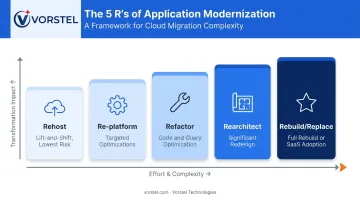
No two systems inside an enterprise require the same modernization treatment. The R's framework is a practical decision model drawn from cloud migration strategies across AWS, Azure, and Google Cloud. It helps organizations match the right approach to each workload based on complexity, cost, and business priority.
Rehost and Re-platform
Rehost (lift-and-shift) moves systems to the cloud with minimal changes. It's the fastest, lowest-risk starting point: useful for time-sensitive migrations or when the priority is simply getting off legacy infrastructure quickly.
Re-platform makes targeted optimizations during the move, such as switching from a self-managed database to a cloud-managed equivalent. It captures quick performance wins without requiring full redesign.
Best for: systems that function adequately but need a more stable, scalable home.
Refactor and Rearchitect
Refactor optimizes existing code or data structures to take better advantage of cloud capabilities, without changing the core architecture. Examples include query optimization, storage tier adjustments, and restructuring data pipelines.
Rearchitect involves significant redesign — breaking a monolithic data warehouse into domain-specific services, adopting a lakehouse architecture, or rebuilding data flows around event streaming. Higher effort, but the long-term performance and cost profile is substantially better.
Best for: systems where the current design is creating real performance or cost problems that rehosting won't solve.
Rebuild and Replace
Rebuild means rewriting a system from scratch using modern, cloud-native design patterns. Replace goes further: retire the legacy system entirely and adopt a purpose-built SaaS solution, such as moving from an on-premises CRM to Salesforce.
These are the highest-effort options. They also deliver the most transformational outcomes and are typically chosen when a system is too outdated to modernize incrementally, or when a better commercial solution already exists.
Best for: systems that are beyond repair or where a commercial alternative clearly outperforms anything you could build internally.
Common Challenges in Data Modernization
Legacy System Complexity
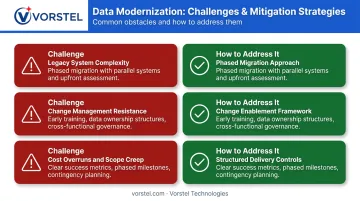
Legacy systems are often deeply embedded in operations — undocumented, tightly coupled with adjacent systems, and maintained by staff who've long since moved on. Migration carries real technical risk as a result.
How to address it: Start with a thorough data landscape assessment before committing to a scope or budget. Run old and new systems in parallel during transition phases. Migrate in waves, not all at once.
That upfront rigor pays off. McKinsey found cloud migration inefficiencies cost organizations an average of 14% more than planned each year — a number that drops significantly when discovery and assessment happen before a single line of code moves.
Change Management and Organizational Resistance
Even technically sound modernization projects fail when the people side is underestimated. New tools require new workflows, new data ownership responsibilities, and new skills — and resistance from staff comfortable with existing processes derails otherwise sound projects more often than most teams expect.
What works:
- Invest in training and change management from day one, not as an afterthought
- Establish clear data ownership and accountability structures before deployment begins
- Use cross-functional governance to keep modernization programs on track
Cost Overruns and Scope Creep
Hidden data quality issues, undocumented integrations, and unexpected compliance requirements have a way of surfacing mid-project — expanding scope and budgets in ways that weren't anticipated.
How to address it:
- Define clear success metrics before work begins
- Implement in phases with measurable milestones at each stage
- Conduct a comprehensive data landscape assessment before finalizing a budget
- Build contingency into the plan for what you don't yet know
How to Choose the Right Data Modernization Partner
What to Look For
The difference between a vendor and a consulting partner is practical, not semantic. Vendors deliver tools. Consulting partners understand your business context and design solutions around it.
Look for:
- Full-stack experience across cloud platforms, ERP systems, data governance, and AI/ML
- Industry context — a partner who understands your regulatory environment, not just generic cloud architecture
- Flexibility to engage at any stage — not just greenfield projects, but also mid-migration rescues and assessments
- Demonstrated outcomes — client satisfaction metrics and delivery success rates, not just capability lists
Key questions to ask any prospective partner:
- Do they have specific experience with the platforms your organization runs (SAP, Salesforce, Microsoft)?
- Can they show evidence of successful outcomes in comparable projects?
- Do they offer any low-risk evaluation phase before full engagement?
How Vorstel Technologies Approaches This
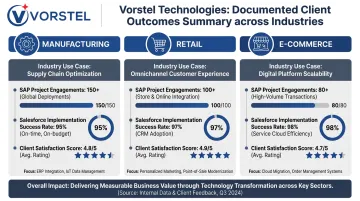
Vorstel Technologies is a global digital transformation consulting firm operating across SAP, Microsoft, and Salesforce ecosystems — the three platforms that underpin most enterprise data environments. Their delivery track record is specific:
- 200+ SAP project engagements across industries
- 95% Salesforce implementation success rate
- 97% client satisfaction across 30+ global clients
Those numbers reflect a broader capability: Vorstel can engage at any stage of a transformation. Whether an organization is conducting its initial assessment, is mid-migration and needs expert intervention, or is ready to move into AI enablement — they can step in without requiring a restart from scratch.
Documented client outcomes include:
- Manufacturing: Real-time defect detection using ML models
- Retail: Demand forecasting with predictive analytics
- E-commerce: NLP-based customer support automation via Azure Cognitive Services
For organizations that want expert input before making a financial commitment, Vorstel offers a Zero-Fee Solution Evaluation — a complimentary consultation delivered via Teams, Zoom, or Google Meet — covering automation, IT strategy, cloud migration, and data infrastructure. It's a low-risk way to get a clear picture of where your modernization effort should start.
Frequently Asked Questions
What is data modernization?
Data modernization is the strategic transformation of an organization's legacy data infrastructure — covering cloud migration, governance redesign, data integration, and analytics enablement — to improve accessibility, security, and decision-making. It goes well beyond a simple system-to-system move.
What are the 5 R's of data modernization?
The R's (commonly: Rehost, Re-platform, Refactor, Rearchitect, Rebuild/Replace) are a decision framework for choosing the right modernization approach for each legacy system or workload, based on complexity, cost, and business priority. Cloud providers like AWS and Azure use similar but slightly expanded versions of this framework.
What are the 4 pillars of data mesh?
The four pillars, as defined by Zhamak Dehghani, are: domain-oriented decentralized data ownership, data as a product, self-serve data infrastructure as a platform, and federated computational governance. Data mesh distributes data ownership across business domains rather than centralizing it in a single platform.
What is the difference between data modernization and data migration?
Data migration is a one-time technical task: moving data from one system to another. Data modernization is broader — it includes migration but also covers architecture redesign, governance frameworks, tooling upgrades, and the organizational changes needed to sustain long-term data value.
How long does a data modernization project typically take?
Timelines depend on organizational size, system complexity, and scope. Targeted modernization of a single system may take a few months; enterprise-wide transformation typically spans one to several years. Phased approaches help manage risk and surface business value early.
What industries benefit most from data modernization?
Manufacturing, retail, financial services, healthcare, and e-commerce see the strongest returns — real-time data and predictive analytics translate directly into competitive advantage in each. That said, Accenture's 2024 research across 15 industries found data readiness gaps nearly everywhere, suggesting the opportunity is widespread rather than sector-specific.