Introduction
Customer expectations have shifted dramatically. Today's customers don't just want good products — they expect seamless, personalized, and immediate experiences across every channel they use. According to Salesforce's State of the Connected Customer report, 88% of customers say the experience a company provides is as important as its products or services.
Most businesses are investing in new technologies — but customers aren't feeling the difference. The reason is structural: digital tools get layered onto outdated processes instead of being designed around the customer journey. The technology changes; the experience doesn't.
This article breaks down how digital transformation reshapes CX: the technologies driving real change, the organizational barriers that stall progress, and a practical framework for building a strategy that moves customers — not just metrics.
Key Takeaways
- Digital transformation shifts businesses from product-centric to customer-centric operations, enabling personalization at scale
- AI, automation, omnichannel platforms, CDPs, and cloud infrastructure are the core technologies driving modern digital CX
- Key benefits include hyper-personalization, consistent cross-channel experiences, faster support, and faster decisions backed by unified customer data
- Legacy systems, organizational silos, and skills gaps are the most common barriers — each requiring a coordinated response
- Effective strategy starts with desired customer outcomes, then works backward to technology selection
How Digital Transformation Reshapes Customer Experience
Real digital transformation changes something more fundamental than the tools a business uses. It shifts the entire operating model away from internal efficiency as the goal and toward reducing friction and delivering value for the customer at every step.
Customer Behavior Has Changed Fundamentally
Customers now move fluidly across channels. Salesforce data shows the average customer uses nine channels to communicate with companies, and McKinsey reports that 75% of customers use multiple channels during a single journey. Two-thirds of millennials expect real-time service responses.
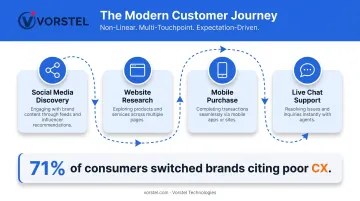
The journey itself has also become non-linear. A customer might:
- Discover a product through social media
- Research it on a website
- Purchase via mobile
- Seek support through live chat
Each step happens on a different channel, but customers expect continuity and personalization throughout. When that continuity breaks, they leave — 71% of consumers switched brands at least once in 2021, with 48% citing better customer service elsewhere as their reason.
The Human-Digital Balance
The most effective CX strategies use technology to eliminate friction and scale convenience, while preserving human judgment for complex or high-stakes interactions. Companies that automate without designing for human touchpoints often create distance rather than loyalty.
Start with the desired customer outcome, then identify which technologies close the gap — not the other way around. When technology drives strategy instead of CX goals, the result is typically:
- Fragmented platforms that don't share data
- Disconnected customer journeys across channels
- Digital investments that customers never actually feel
Organizations that reverse this sequence — letting tools dictate direction — end up solving internal problems while leaving the customer experience unchanged.
Key Technologies Driving the Digital Customer Experience
Artificial Intelligence and Machine Learning
AI shifts CX from reactive service to proactive engagement. It powers personalized product recommendations, predictive support, conversational interfaces, and sentiment analysis at a scale no human team could match.
The business impact is concrete. HubSpot's 2024 State of Service report found 92% of CRM leaders said AI improved customer service response times, and 86% said AI positively affected CSAT scores. Gartner predicts that by 2028, 70% of customers will use a conversational AI interface to initiate their service journey.
Vorstel Technologies implements AI solutions for CX, including:
- NLP-based query classification using Microsoft Azure Cognitive Services
- Predictive analytics models
- Sentiment analysis tools
In one documented engagement, a global e-commerce client replaced manual query sorting with an automated NLP system that classified and routed thousands of daily support messages by intent and urgency, materially improving response efficiency.
Automation and Self-Service
Intelligent automation handles high-volume, repetitive interactions around the clock, freeing human agents for complex, high-value work. Key outputs include:
- Automated email response workflows
- AI-powered chatbots and virtual agents
- Smart callback systems
- Self-service portals and knowledge bases
- Customer account management tools
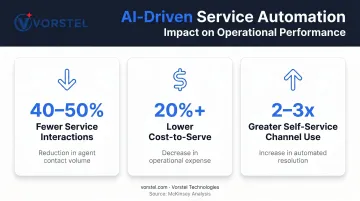
McKinsey's analysis of an Asian bank's AI-driven service transformation found 40–50% fewer service interactions, more than 20% lower cost-to-serve, and 2–3x greater self-service channel use — proof that better CX and lower operational cost can go hand in hand.
Omnichannel Platforms and Customer Data Platforms (CDPs)
CDPs and omnichannel platforms are the integration layer that makes AI and analytics work. Without unified customer data, every tool delivers a fragmented experience.
Currently, only 26% of organizations believe they provide a completely connected experience across all channels. The consequences are visible in daily operations: support professionals use an average of four separate tools, and 74% of leaders say switching between those tools slows ticket resolution.
Vorstel's Salesforce CRM implementation practice — with a 95% success rate — addresses this integration layer directly, connecting customer data, service workflows, and touchpoints across the business.
Advanced Analytics and Real-Time Feedback
Advanced analytics converts behavioral data, journey metrics, and NPS signals into continuous improvement intelligence. This replaces periodic surveys with real-time visibility into what's working and what isn't — giving CX teams a faster feedback loop for iteration.
Cloud Infrastructure
Cloud infrastructure provides the scalability and flexibility required to deploy and evolve CX tools rapidly. For enterprises serving geographically distributed customers, this is non-negotiable.
Vorstel's cloud migration and optimization services focus on cost efficiency, scalability, and performance: the three factors that determine whether a cloud investment actually enables better CX or simply moves existing limitations to a new environment.
Key Benefits of Digital Transformation for Customer Experience
Enhanced Personalization
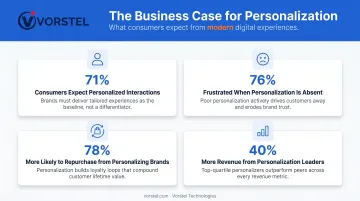
Digital transformation enables businesses to understand customers as individuals — using behavioral data, purchase history, and real-time signals to deliver tailored content, recommendations, and service. The numbers behind personalization are hard to ignore:
- 71% of consumers expect personalized interactions
- 76% report frustration when companies don't deliver them
- 78% are more likely to make repeat purchases from brands that personalize
- Companies excelling at personalization generate 40% more revenue than average performers
Seamless Omnichannel Experiences
With the right integration layer in place, customers can start an interaction on one channel and continue it on another without losing context. That continuity directly reduces frustration and improves satisfaction scores. 75% of customers expect consistent experiences across different service channels — and organizations that deliver it build measurable loyalty advantages.
Three factors make omnichannel delivery a competitive differentiator:
- Customers don't repeat themselves across channels
- Service history travels with the conversation
- Resolution times drop when agents have full context
Improved Customer Support Outcomes
AI and automation together enable:
- 24/7 availability without staffing costs
- Faster, more accurate issue routing
- Consistent resolution quality at scale
- Lower cost per interaction
82% of customers expect immediate problem resolution when they contact a company. Meeting that expectation at scale requires digital infrastructure — not just more agents.
Data-Driven Decision-Making
Digital transformation gives organizations a continuous stream of customer insight. Teams across the business can act on it in real time:
- Marketing targets with greater precision using behavioral signals
- Product teams iterate based on actual usage data
- CX leaders identify and fix friction points before they drive churn
This connects customer feedback directly to organizational action — so problems get resolved weeks before a quarterly survey would have surfaced them.
Common Barriers to a Successful Digital CX Transformation
Legacy Systems and Organizational Silos
These two barriers reinforce each other. Legacy platforms limit integration, slow iteration, and prevent the unified data views that personalization requires. Siloed teams create inconsistent customer journeys and competing investment priorities.
The scale of the problem is significant. Salesforce/MuleSoft's 2024 Connectivity Benchmark Report found:
The scale of the problem is significant. Salesforce/MuleSoft's 2024 Connectivity Benchmark Report found:
- 81% of IT leaders say data silos hinder digital transformation
- Only 28% of applications are connected on average across enterprises
- 95% of IT leaders say integration issues impede AI adoption
Without solving the integration layer, AI and analytics investments often deliver a fraction of projected ROI.
Skills Gaps and Cultural Inertia
Digital transformation requires competencies — in AI, data, experience design, and platform management — that most organizations don't have in sufficient depth internally. Hiring takes time; building institutional fluency takes longer.
Cultural resistance compounds this. Employees who fear displacement and leaders who underestimate the organizational change required can stall initiatives even when the technology investment is sound. Addressing skills and culture is as important as selecting the right tools — which is why Vorstel Technologies builds change management into every transformation engagement, not as an afterthought but as a core workstream alongside process optimization and system integration.
Misaligned Metrics
Performance systems that reward departmental efficiency rather than end-to-end customer value create a specific failure mode: digital initiatives succeed internally while failing to improve CX outcomes. Organizations that invest without a connected measurement framework struggle to demonstrate ROI, which creates pressure to cut programs before they can deliver impact.
How to Build a Successful Digital CX Strategy
Start With Customer Outcomes, Then Work Backward
Define what a successful customer journey looks like. Identify the friction points and gaps in that journey. Only then should you evaluate which technologies best address those specific gaps. This prevents the common trap of acquiring technology that solves the wrong problems or adds new complexity without adding customer value.
Build a Phased Roadmap
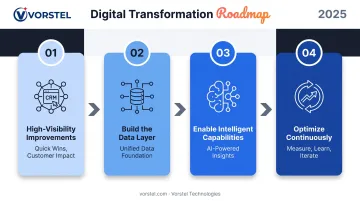
Attempting enterprise-wide transformation simultaneously consistently fails. A more effective approach:
- Start with high-visibility improvements — omnichannel support, self-service tools, CRM integration
- Build the data layer: CDP implementation, application integration, and analytics infrastructure form the backbone for everything that follows
- Enable intelligent capabilities — AI-powered personalization, predictive engagement, proactive support
- Optimize continuously by establishing a measurement cadence, running A/B tests, and redesigning journeys based on what the data actually shows
Most organizations don't start at step one — and they don't need to. Vorstel Technologies specializes in entering at any stage of this journey, with hands-on expertise across AI, SAP, Salesforce CRM, and cloud infrastructure. Their Zero-Fee Solution Evaluation is a useful starting point for teams unsure where they currently stand.
Foster Cross-Functional Alignment and Continuous Measurement
CX transformation requires shared ownership across IT, marketing, sales, and service — with KPIs tied to customer outcomes, not departmental performance. Build a measurement cadence where data directly informs decisions, and those decisions get tracked against real customer outcomes — reduced churn, faster resolution times, higher satisfaction scores. That's what separates organizations that sustain transformation from those that stall after the initial rollout.
Measuring the Impact of Digital Transformation on CX
The Right Metrics Framework
Forrester's CX measurement research defines three essential metric types that must work together:
| Metric Type | Examples | What It Reveals |
|---|---|---|
| Interaction metrics | Resolution time, first-contact resolution, journey completion rate | How efficiently the experience is delivered |
| Perception metrics | CSAT, Customer Effort Score (CES) | How customers feel about the experience |
| Outcome metrics | NPS, retention rate, revenue per customer | Whether the experience is driving business results |
Only 49% of CX professionals currently measure all three types together, and 71% fail to quantify how CX improvements drive business results. This measurement gap is one reason many transformation programs lose executive support before they deliver impact.
Digital Data as a Governance Tool
The most effective organizations don't just report on CX metrics — they use them to drive decisions. Behavioral analytics, sentiment signals, and A/B test results should feed directly into investment decisions, product iteration, and journey redesign, turning raw data into continuous course corrections rather than periodic reports.
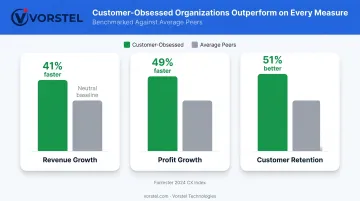
That discipline pays off. Forrester's 2024 US CX Index found that customer-obsessed organizations outperformed peers across every financial measure:
- 41% faster revenue growth
- 49% faster profit growth
- 51% better customer retention
Yet only 3% of companies currently meet the threshold for customer-obsessed. For most enterprises, closing the measurement gap is the most direct path to joining that group.
Frequently Asked Questions
How does digital transformation impact customer experience?
Digital transformation enables businesses to deliver faster, more personalized, and more consistent experiences by integrating technology across every customer touchpoint. It shifts organizations from reactive service models to proactive, data-driven engagement, anticipating customer needs rather than simply reacting to them.
What are the key stages and pillars of digital transformation?
The core pillars are technology, data, culture, and process design. Most organizations progress from digitizing basic interactions, to integrating channels, to enabling intelligent real-time personalization. Companies can accelerate from any stage with the right strategy and implementation partner.
What are the biggest challenges companies face when transforming their customer experience digitally?
Legacy systems, organizational silos, skills gaps, and misaligned metrics are the most common barriers. Addressing them requires coordinated action across technology, talent, and operating models. Adopting new tools without restructuring the underlying systems rarely closes the gap.
How do AI and automation improve customer experience?
AI enables personalized, proactive engagement at scale while automation handles high-volume routine interactions continuously. Together, they reduce friction, improve resolution times, and free human agents for complex, high-value interactions that require judgment and empathy.
How can businesses measure the impact of digital transformation on CX?
Connect digital behavioral metrics (resolution time, journey completion rate) to satisfaction metrics (NPS, CSAT, CES) and business outcomes (retention, revenue). Measuring all three together reveals whether transformation is driving real customer value, not just technology adoption.
What role does personalization play in digital customer experience?
Personalization is a core outcome of digital transformation, made possible by unified customer data and AI. Customers expect individualized interactions, and companies that deliver them see measurably higher satisfaction, loyalty, and revenue.