The pattern behind these numbers is consistent: transformations built around technology deployment — rather than customer outcomes — consistently underdeliver. Customer-centric digital transformation flips that sequence.
This article covers exactly what that means in practice: a precise definition, the business case for prioritizing it, the seven foundational pillars, a five-step strategy, the enabling technologies, and the metrics that tell you whether it's working.
Key Takeaways
- Customer-centric digital transformation puts customer outcomes — not technology — at the center of every initiative
- It breaks down channel silos by organizing teams and processes around the full customer journey
- Seven interdependent pillars form the practical framework for building customer-first capabilities
- Results come from aligning strategy, culture, data, and technology together — deploying tools without that alignment rarely moves the needle
- Mature measurement tracks customer value, experience quality, and business value together — not just NPS scores
What Is Customer-Centric Digital Transformation?
Customer-centric digital transformation is the deliberate redesign of business processes, technology architecture, and organizational culture so that every digital initiative is evaluated by the value it delivers to the customer — not just by operational efficiency or cost reduction.
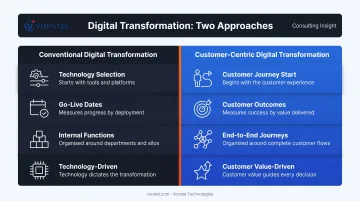
Conventional transformation programs typically start with a technology selection ("we need a CRM," "we need cloud infrastructure") and work backward toward business justification. Customer-centric transformation reverses that sequence entirely: it starts with the customer journey and works forward to the right technology stack.
The Customer Success Foundation
Deloitte's foundational definition captures this well: customer success is "the proactive orchestration of a customer's journey" to maximize value across the full lifecycle. The emphasis on proactive is deliberate. It means:
- Anticipating friction before customers feel it
- Designing for outcomes rather than one-off transactions
- Treating every touchpoint as part of a continuous relationship
Without this mindset, even well-executed technology deployments tend to optimize internal processes while leaving the actual customer experience fragmented — a pattern that's surprisingly common in enterprise transformations.
The core contrast:
| Conventional Digital Transformation | Customer-Centric Digital Transformation |
|---|---|
| Starts with technology selection | Starts with the customer journey |
| Measures success by go-live dates | Measures success by customer outcomes |
| Organized around internal functions | Organized around end-to-end journeys |
| Technology drives process redesign | Customer value drives technology choices |
Why It Matters: The Business Case for Customer-Centricity
Customer expectations have shifted structurally. The rise of XaaS and subscription models — where 75% of enterprise organizations now consume more than half of IT as-a-service — means customers no longer evaluate vendors on product features alone. They evaluate them on continuous value delivery. That shift forces every B2B provider to compete on outcomes, not just capabilities.
Revenue and Retention Impact
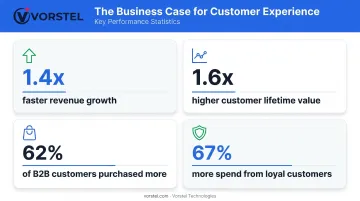
The financial case is well-documented. According to Deloitte's customer-centric transformation research:
- Experience-driven businesses grow revenue 1.4x faster than peers
- Customer lifetime value increases 1.6x more than at non-experience-led companies
- 62% of B2B customers purchased more after a positive customer service experience
- Loyal customers eventually spend 67% more than new customers
The advocacy multiplier adds another layer: 83% of customers indicated they would be happy to provide a referral after a positive experience. Customer centricity, in other words, drives new revenue — not just repeat business.
Cost-Side Returns
The efficiency gains are just as compelling. Deloitte reports that maximizing B2B customer journey satisfaction can lower cost to serve by as much as 20%. McKinsey's B2B and B2C research corroborates this, citing 10–20% cost-to-serve reductions alongside 10–15% revenue growth from customer-experience transformations.
The Cost of Inaction
Organizations that remain channel-centric don't stand still. They fall behind. Siloed channel experiences erode trust incrementally. Customers who encounter inconsistency between a company's app, sales team, and support function don't file complaints — they disengage.
Meanwhile, competitors investing in connected journeys compound their advantage with each iteration.
The 7 Pillars of Customer-Centric Digital Transformation
No single capability makes a transformation customer-centric. These seven pillars are interdependent — and that's what makes them hard to shortcut. A gap in any one of them limits what the others can deliver.
1. Customer Understanding & Insight
The continuous capture and synthesis of customer data — behavioral, transactional, and attitudinal — to build a living picture of who customers are, what they need, and how their expectations are evolving. CRM systems, Voice of Customer programs, and analytics platforms operationalize this pillar. Without it, personalization defaults to segments instead of individuals, and journey design reflects internal assumptions rather than actual behavior.
2. Customer Journey Orchestration
The deliberate design and management of end-to-end customer journeys across all touchpoints. In practice, most organizations have siloed channel experiences: the app, the sales team, and support each operate on different data and different goals. This pillar replaces that fragmentation with a unified flow. That shift — from optimizing individual channels to owning the complete journey — is what separates tactical improvement from transformation.
3. Personalization at Scale
Using data, AI, and automation to deliver contextually relevant experiences to individual customers in real time — across both digital and human touchpoints. McKinsey's personalization research found companies that excel here generate 40% more revenue from those activities than average players, with typical revenue lifts spanning 10–15% (and up to 25% for best-in-class programs).
4. Cross-Functional Alignment
Most technology investments assume cross-functional alignment exists. It rarely does. This pillar means:
- Sales, marketing, product, and customer success share a single view of customer data
- Teams align on journey KPIs rather than departmental metrics
- Outcomes are owned collectively, not handed off between functions
Without this foundation, even well-integrated technology stacks produce fragmented customer experiences.
5. Data & Technology Integration
Ensuring the underlying architecture supports a single, coherent view of the customer across all systems — ERP, CRM, marketing automation, support platforms, and analytics. This is where transformations frequently stall: MuleSoft's 2026 Connectivity Benchmark Report found 95% of organizations face integration challenges, and 96% face barriers to using their data for AI use cases.
6. Culture & Change Leadership
Embedding customer-first values into organizational DNA — from C-suite communications to front-line incentive structures. This is consistently the hardest pillar and the most under-invested one.
Deloitte's customer success survey found only one-third of CS functions are led by a C-suite executive, and just 26% of organizations regularly mention customer success in official communications. When leadership doesn't signal it, technology investments fill the gap poorly.
7. Continuous Value Measurement
A closed-loop measurement system that tracks both customer value (experience quality, business outcomes) and company value (revenue, retention, cost-to-serve) in real time — enabling course corrections before customers identify a problem themselves.
Building a Customer-Centric Digital Transformation Strategy
Step 1 — Define the Customer Success North Star
Start with a clear, measurable articulation of what customer success looks like for your specific business. Not a generic aspiration, but a concrete definition of the outcomes your customers need to achieve. This north star drives every subsequent capability and operating model decision. Without it, transformation efforts default to technology-first prioritization.
Step 2 — Map the Current-State Customer Journey
Conduct an honest, cross-functional audit of how customers actually experience your business today:
- Where do customers encounter friction or delays?
- Where is customer data siloed or inconsistent across systems?
- Where are digital touchpoints absent, duplicated, or disconnected from human interactions?
This diagnostic is not a desk exercise. It requires input from sales, support, product, and operations — and ideally from customers directly. The gaps it surfaces become the prioritized investment map for the transformation.
Step 3 — Design the Target Operating Model
Customer-centric transformation requires redesigning how the organization runs — not just adding new tools on top of existing structures. This means defining:
- Which capabilities live within a central customer success function
- Which are shared across business units with clear handoff protocols
- Which are enterprise-level prerequisites (data infrastructure, integration architecture)
Deloitte's three-tier capability model — core, shared, enterprise — provides a practical template for this design work.
Step 4 — Sequence the Transformation in Maturity Phases
Most organizations don't fail at transformation — they plateau. XM Institute's 2024 study of 234 CX practitioners found over two-fifths of companies remain in the "Investigate" stage, and only 2% have reached full organizational embedding of CX.
The maturity progression typically runs through three levels:
- Level 1 — Establish a CS function with clear ownership of customer value realization
- Level 2 — Build cross-functional engagement where CS insights drive action across business units
- Level 3 — Embed customer outcomes into every business decision, with CS represented at the C-suite and board level
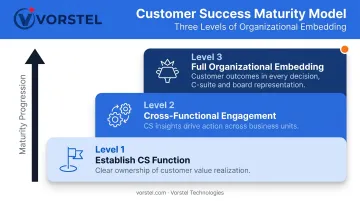
The gap between Level 1 and Level 2 is where competitive differentiation is built. Crossing that gap requires deliberate investment in cross-functional alignment, not just continued investment in the CS function itself.
Step 5 — Choose the Right Partner for Your Stage
Many transformation journeys don't start at the beginning. Organizations inherit partial implementations, stalled initiatives, or legacy architectures that predate the current strategy. In those scenarios, a restart is rarely the right answer.
Vorstel Technologies works within exactly this reality — joining client transformations at any stage and delivering measurable outcomes from that point forward. Key capabilities include:
- 200+ SAP project engagements across global enterprises and fast-scaling businesses
- 95% Salesforce CRM implementation success rate across multi-country deployments
- Full-stack coverage spanning SAP, Microsoft, Salesforce, AI, cloud, and custom development
- A Zero-Fee Solution Evaluation to diagnose current state and identify the highest-value starting points
Enabling Technologies That Power Customer Centricity
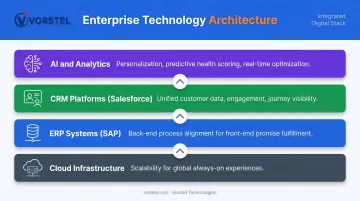
Technology is not the strategy — it enables the strategy defined by the seven pillars. The core stack for customer-centric transformation typically spans four layers:
- CRM platforms (Salesforce) for unified customer data, engagement tracking, and journey visibility across sales, service, and marketing
- ERP systems (SAP) for back-end process alignment that makes front-end customer promises — on delivery, pricing, availability — reliably fulfilled
- AI and analytics for personalization, predictive account health scoring, and real-time journey optimization
- Cloud infrastructure for the scalability needed to support always-on customer experiences across global markets
The Integration Imperative
These layers only create value when they operate as a connected system. When CRM, ERP, support, and analytics function as disconnected islands, customer data fragments across systems. Teams make decisions on incomplete pictures. Customers experience inconsistency at every handoff.
Salesforce's own research supports this: 82% of high-performing service organizations use the same CRM platform across service, sales, and marketing. Integration is a structural prerequisite for customer centricity, not an optional technical upgrade.
AI's Expanding Role
AI is expanding what's achievable at scale. Personalization and proactive relationship management that once required large teams now run on automated, intelligence-driven workflows:
- Intelligent self-service handles routine inquiries, freeing teams for higher-complexity customer needs
- Predictive account health scoring flags at-risk customers before they signal intent to churn
- Real-time journey optimization adjusts next-best-action recommendations dynamically
Salesforce projects that 50% of service cases will be resolved by AI by 2027, up from 30% in 2025. That shift is only possible with clean, connected data already in place. Organizations that invest in their data foundation now will be ready to deploy these capabilities as they mature; those that wait will spend their time catching up rather than competing.
Measuring Success: KPIs and Metrics That Matter
NPS and CSAT measure how customers feel after an interaction. They don't tell you whether customers are achieving their goals, whether your cost to serve is sustainable, or whether at-risk accounts are about to churn. A mature measurement framework spans three value dimensions:
- Customer value — Are customers achieving the outcomes they invested in?
- Experience value — Do interactions build trust, or create friction?
- Company value — Is customer success translating to revenue, retention, and lower cost to serve?
The KPIs That Signal Transformation Progress
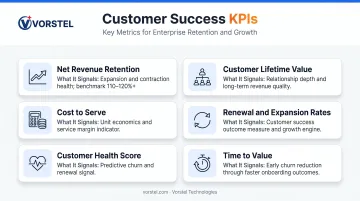
| KPI | What It Signals |
|---|---|
| Net Revenue Retention (NRR) | Whether existing customers are expanding or contracting; 110% is median, 120%+ signals healthy growth |
| Customer Lifetime Value (CLV) | Long-term revenue potential of the customer base; tracks whether relationships are deepening |
| Customer Health Score | Predictive indicator of renewal, growth, or churn risk based on usage, engagement, and satisfaction signals |
| Time to Value (TTV) | Speed at which customers achieve their first meaningful outcome; shorter TTV reduces early churn risk |
| Cost to Serve | Operational efficiency of delivering customer outcomes; critical for sustainable unit economics |
| Renewal & Expansion Rates | Direct measure of whether customers are succeeding enough to stay and grow |
Lead with Leading Indicators
Lagging indicators tell you what happened. Leading indicators tell you what's about to happen. NPS captures sentiment after the fact. Customer health scores, product adoption rates, and usage trends surface risk early — giving teams time to intervene before a customer churns. That window is where retention is actually won.
Frequently Asked Questions
Is digital transformation customer-centric?
Not automatically. Most initiatives begin with technology or operational objectives. Customer-centric digital transformation is a deliberate strategic orientation requiring explicit design choices in strategy, culture, operating model, and technology. It doesn't emerge from technology deployment alone.
What are the 7 pillars of customer centricity?
The seven pillars are:
- Customer Understanding & Insight
- Customer Journey Orchestration
- Personalization at Scale
- Cross-Functional Alignment
- Data & Technology Integration
- Culture & Change Leadership
- Continuous Value Measurement
Each pillar is interdependent — weakness in one limits the others.
What is the difference between customer-centric and channel-centric digital transformation?
Channel-centric transformation optimizes individual touchpoints — app, website, call center — producing siloed experiences. Customer-centric transformation starts with the end-to-end journey and ensures all channels work together to deliver a coherent, consistent experience across the full customer lifecycle.
How do you measure the success of customer-centric digital transformation?
Measure against three value dimensions:
- Customer value — are customers achieving their goals?
- Experience value — how do customers feel about interactions?
- Company value — revenue, retention, and cost-to-serve outcomes
Leading indicators like customer health scores and product adoption rates are more actionable than NPS alone.
What role does AI play in customer-centric digital transformation?
AI enables customer centricity at scale: powering personalization, predictive churn detection, real-time journey optimization, and proactive account health monitoring. These are capabilities no organization can sustain at enterprise scale through manual effort alone.