Introduction
Software ships faster than ever. Development cycles that once took months now compress into days, and continuous deployment has become the baseline expectation for competitive teams. The faster code moves, the wider the window for vulnerabilities to slip through undetected.
Vulnerability exploitation was an initial access vector in 20% of breaches in 2025, a 34% year-over-year increase according to Verizon's 2025 Data Breach Investigations Report. Third-party involvement in breaches doubled to 30% in the same period — a direct signal that the software supply chain is under serious pressure.
The traditional model — build fast, bolt on security at the end — leaves teams discovering vulnerabilities after deployment, when the cost to fix them is highest and the damage is already done.
DevSecOps was built to solve this. By integrating security into every phase of the software development lifecycle, teams can move quickly without treating security as an afterthought. This guide covers what DevSecOps is, why it matters, how it works in practice, and the challenges organizations face when adopting it.
Key Takeaways
- DevSecOps embeds security throughout the SDLC — not just at the end
- The "shift left" philosophy catches vulnerabilities early, when they're cheapest to fix
- Security integrates across culture, SDLC workflows, and tooling — SAST, SCA, and DAST included
- Teams ship faster, shrink vulnerability backlogs, and stay ahead of compliance requirements
- Successful adoption hinges on cultural buy-in, phased rollout, and tools that fit your pipeline
What Is DevSecOps? Definition and Core Concepts
DevSecOps stands for Development, Security, and Operations. As defined by OWASP, it is a culture that embeds security-related steps throughout the DevOps process, with automated testing and shared accountability across all roles. NIST puts it more concretely: integrating security practices into the SDLC and the developer toolchains teams already use.
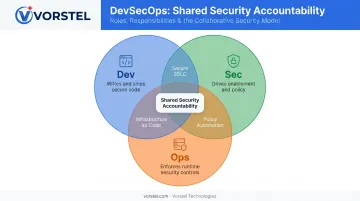
Each component has a distinct role:
- Dev — writes and delivers code, now with security practices built into daily workflow
- Sec — provides security expertise, tooling, and policy, shifting from gatekeeper to enabler
- Ops — manages infrastructure and deployment pipelines, with security controls embedded at runtime
Shift Left and Shift Right
These two concepts define when security happens in the development lifecycle:
| What It Means | Why It Matters | |
|---|---|---|
| Shift Left | Move security checks into planning, design, and coding — before pre-release review | Vulnerabilities found early cost less to fix; context is still fresh |
| Shift Right | Monitor and secure applications after they go live | Some flaws only appear under real production conditions; NIST's SSDF "Respond to Vulnerabilities" practices address these directly |
DevSecOps vs. DevOps — What's the Difference?
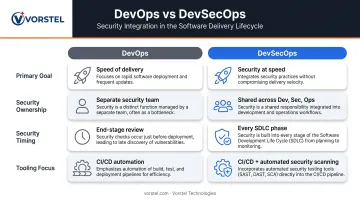
DevOps unites development and operations to accelerate delivery. DevSecOps extends this by adding security as a third, equally weighted discipline — not a separate team reviewing code after the fact.
| DevOps | DevSecOps | |
|---|---|---|
| Primary goal | Speed of delivery | Security at speed |
| Security ownership | Typically a separate security team | Shared across Dev, Sec, and Ops |
| Security timing | End-stage review | Every SDLC phase |
| Tooling focus | CI/CD automation | CI/CD + automated security scanning |
A related concept worth clarifying: SecOps combines security and operations without the development dimension. It focuses on monitoring, incident response, and threat detection in running systems. DevSecOps brings all three functions together from the first line of code, not as a later addition.
Why DevSecOps Matters: Benefits and Business Impact
Catching Vulnerabilities Earlier Costs Less
A 2002 NIST report on software testing economics found that defects caught at the system testing stage cost 40x more to fix than those caught earlier — and defects found in production cost 470x to 880x more. These ratios cover general software defects rather than security vulnerabilities specifically, but the principle translates directly.
More current evidence comes from Veracode's 2025 maturity analysis: leading organizations fix 50% of flaws in five weeks or less, while lagging organizations take over a year to reach the same point. That gap separates organizations that manage vulnerabilities from those that accumulate them.
Faster Time to Market
Manual security reviews create bottlenecks. When a security team must review every release before it ships, their capacity becomes the speed limit for the entire engineering organization.
Automated security scanning in CI/CD pipelines removes that constraint. Every code commit triggers checks automatically — no waiting, no scheduling, no back-and-forth between teams. The result is security that runs in parallel with development, not after it.
Proactive Regulatory Compliance
Regulated industries face a compliance burden that periodic audits struggle to meet. DevSecOps addresses this by embedding compliance controls directly into the development pipeline:
- PCI DSS — Requirement 6 requires secure system and software development practices
- HIPAA — HHS guidance mandates risk analysis and vulnerability management as core Security Rule requirements
- FedRAMP — Rev. 5 documentation explicitly references integrating security sensors within CI/CD pipelines for containerized environments
- SOC 2 — AICPA Trust Services Criteria include change management and monitoring requirements met by DevSecOps controls
Rather than scrambling before an audit, organizations with mature DevSecOps practices generate compliance evidence continuously.
Building a Security-Aware Culture
When security is only one team's responsibility, it becomes a bottleneck and a blame target. DevSecOps changes that dynamic: developers learn secure coding practices, operations teams embed security into infrastructure provisioning, and security specialists focus on enabling — not blocking.
The cultural shift matters as much as the tooling. Developers who understand why security matters write more secure code from the start — reducing what automated tools need to catch downstream.
Core Components of DevSecOps
DevSecOps rests on three pillars: People, Process, and Technology. All three must evolve together — investing in tools without changing culture, or changing culture without improving processes, produces partial results at best.
People — Culture and Collaboration
Security becoming everyone's responsibility sounds simple. In practice, it requires dismantling longstanding silos between development and security teams that have often operated in opposition.
What this looks like in practice:
- Developers receive regular security training relevant to their stack and role
- Security specialists are embedded in delivery teams, not isolated in a separate department
- Leadership sets shared metrics — security outcomes are part of engineering KPIs, not separate scorecards
- Communication channels between Dev, Sec, and Ops are explicit and routinely used
Without leadership buy-in, DevSecOps stays at the tool level. Culture change has to come from the top.
Process — Security Across the SDLC
Security integration follows the development lifecycle:
| SDLC Phase | Security Activity |
|---|---|
| Planning & Design | Threat modeling, security requirements definition |
| Development | Secure code review, developer security guidelines |
| Build / CI | Automated SAST and SCA scans on every commit |
| Testing | DAST against running environments, penetration testing |
| Release | Compliance gate checks, policy enforcement |
| Production | Continuous monitoring, vulnerability response |
The goal is making security protocols a standard part of the workflow — not a separate checklist that slows things down.
Technology — Key DevSecOps Tools
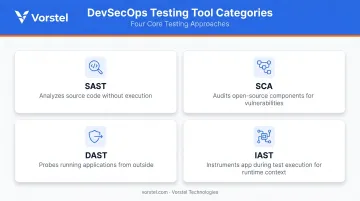
Four tool categories form the core of most DevSecOps toolchains:
SAST (Static Application Security Testing) analyzes source code or compiled binaries for vulnerabilities without executing the application. It runs during coding and CI stages, giving developers fast feedback before issues compound.
SCA (Software Composition Analysis) audits open-source and third-party dependencies for known vulnerabilities and license risks. This matters: 67% of developers rely on open-source libraries for at least a quarter of their code, yet only 21% of organizations produce a Software Bill of Materials (SBOM).
DAST (Dynamic Application Security Testing) probes running applications from the outside — simulating how an attacker would approach them — to surface runtime vulnerabilities that static analysis misses entirely.
IAST (Interactive Application Security Testing): this tool instruments the application during test execution, using live runtime context to identify vulnerabilities. It bridges the gap between SAST and DAST without requiring a separate testing pass.
Two more tools round out a complete toolchain: secrets management platforms prevent credentials from leaking into code repositories (GitLab tokens accounted for 50% of leaked CI/CD secrets found in public repositories in 2025), and infrastructure-as-code security scanners apply the same vulnerability checks to cloud infrastructure definitions.
Selecting the right combination depends on your language stack, pipeline architecture, and the scale at which your teams ship.
How to Implement DevSecOps: Key Practices
Start with Culture, Not Tools
Tooling without cultural alignment doesn't stick. Before buying a SAST scanner, ensure that:
- All stakeholders understand what DevSecOps is and why the organisation is adopting it
- Security champions are identified within engineering teams
- There are shared definitions of what "done" means for security — not just for features
Vorstel Technologies, a global DevOps and security consulting firm, consistently sees this pattern in practice: teams that sort out people and process first move through tooling adoption faster and with fewer rollbacks.
Integrate Automated Scanning into CI/CD
With the cultural foundation in place, the next step is embedding security checks directly into your delivery pipeline:
- Connect SAST and SCA to your pipeline so every commit triggers scans without manual intervention
- Set actionable thresholds — define which severity levels actually block a build, rather than flagging everything
- Surface findings in developer workflows via IDE plugins or pull request comments, not a separate security dashboard they'll ignore
- Manage false positives actively — 62% of security teams in a Snyk 2023 survey reported that at least one in four automated alerts were false positives, which erodes developer trust quickly
Adopt in Phases
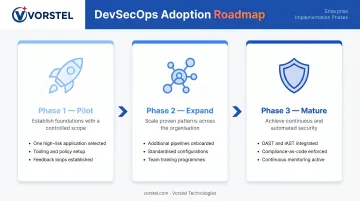
Instrumenting every application and pipeline at once typically causes the initiative to stall before it delivers value. A phased approach keeps momentum:
- Phase 1 — Pilot on one high-risk application or team; establish tooling, policies, and feedback loops
- Phase 2 — Expand to additional pipelines; standardise configurations and training
- Phase 3 — Mature practices with DAST, IAST, compliance-as-code, and continuous monitoring
Vorstel Technologies works with organisations at any point in this sequence — bringing in tooling expertise, policy frameworks, and implementation support without stalling active delivery cycles.
Common Challenges of Adopting DevSecOps
Cultural Resistance
The most common barrier isn't technical. Development teams prioritize speed; security teams prioritize caution. Each side often views the other as an obstacle.
Bridging this requires:
- Top-down commitment with visible leadership support
- Shared metrics that both teams care about (e.g., mean time to remediate, not just number of findings)
- Framing security as a quality attribute — not a separate function
Tool Integration Complexity
64% of DevSecOps professionals in GitLab's 2024 survey said they want to consolidate their toolchain. Most organisations have accumulated a mix of languages, frameworks, and CI/CD platforms over time, and connecting security tools across that environment without breaking existing pipelines requires phased integration, standardized APIs, and pipeline validation at each step.
Sprawling toolchains also create visibility gaps. That risk compounds when you consider that 67% of SDLC processes are already mostly or fully automated — poorly integrated security tools get bypassed rather than fixed.
Alert Fatigue and Noise
Automated scanning can generate enormous volumes of findings. When developers are buried in low-priority alerts, they start ignoring all of them — including the critical ones.
Better policy configuration is what actually reduces the noise:
- Define severity thresholds that match your risk tolerance
- Deduplicate findings across overlapping scanners
- Assign ownership clearly so findings don't sit in a queue indefinitely
Best Buy's implementation with Checkmarx reduced false positives by 80%. With the right thresholds and deduplication rules in place, teams spend less time triaging noise and more time resolving real vulnerabilities.
Frequently Asked Questions
What is the difference between DevOps and DevSecOps?
DevOps integrates development and operations to accelerate software delivery. DevSecOps extends this by embedding security throughout the pipeline — making it a shared responsibility across all three disciplines rather than a separate end-stage review by a dedicated security team.
What are the three pillars of DevSecOps?
The three pillars are People (culture and shared security accountability), Process (security controls integrated at every SDLC stage), and Technology (automated tools like SAST, SCA, and DAST). Gaps in any one pillar — even with the other two in place — tend to surface as bottlenecks or blind spots over time.
What are DevSecOps services?
DevSecOps services typically include pipeline security integration, automated vulnerability scanning, threat modeling, compliance management, secrets management, and continuous monitoring across CI/CD workflows — available as consulting engagements, managed services, or hands-on implementation support.
Is DevSecOps difficult to learn?
The core concepts are accessible, but practical adoption requires both technical knowledge and a cultural mindset shift. The learning curve depends heavily on a team's existing DevOps maturity — organizations with established CI/CD pipelines have a shorter path than those still building foundational practices.
What tools are commonly used in DevSecOps?
Core tools cover four testing categories: SAST, SCA, DAST, and IAST. Secrets management platforms, IaC security scanners, and compliance-as-code frameworks round out the stack — all integrated into CI/CD pipelines, not run as standalone processes.
What are the 7 DevOps practices?
The seven core practices are continuous integration, continuous delivery, infrastructure as code, monitoring and logging, communication and collaboration, automation, and security. DevSecOps takes that last practice — security — and transforms it from a periodic checkpoint into an automated, always-on layer across the rest.