Introduction
Remote-first work isn't a temporary arrangement — it's a structural shift that most organizations handled reactively. When the pandemic forced distributed work overnight, companies grabbed tools: a video conferencing license here, a cloud storage subscription there. The result was a patchwork of software that looked like digital transformation but wasn't.
True digital transformation for remote-first businesses means redesigning how operations work, not simply moving existing workflows online. Without intentional restructuring, friction compounds: teams miscommunicate, security gaps widen, and productivity erodes in ways that are hard to diagnose.
According to McKinsey, organizations that treat digital transformation as a tool-procurement exercise rather than an operational redesign are significantly more likely to report stalled productivity and employee disengagement in distributed environments.
This guide covers the core pillars of remote-first digital transformation, the challenges that derail most efforts, a phased implementation roadmap, and the technologies that tie it all together.
Key Takeaways
- Digital transformation for remote-first businesses means restructuring operations around digital-first processes, not simply layering new software onto old ones.
- Five pillars drive success: cloud infrastructure, unified communications, cybersecurity, data integration, and employee enablement.
- Common failure points include tool sprawl, security vulnerabilities, communication gaps, and poor performance visibility.
- A phased roadmap — assess, prioritize, implement, adopt, scale — reduces disruption during transformation.
- Working with an experienced consulting partner accelerates deployment and reduces implementation risk significantly.
Why Remote-First Businesses Need Digital Transformation Now
The Productivity Gap Is Already Showing
Cisco's 2025 Global Hybrid Work Study found that only 49% of employees believe their organization supports them with consistent tools and processes to work effectively from any location. There's also a telling perception gap: 53% of employers say collaboration tools significantly enhance productivity, but only 42% of employees agree. That gap between leadership assumption and ground-level reality is where remote-first operational inefficiency compounds.
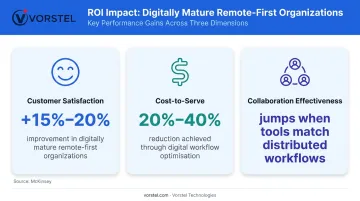
Companies that have closed this gap through deliberate digital transformation are seeing measurable returns across both operations and customer outcomes:
- Customer satisfaction improves by 15%–20% in digitally mature organizations, per McKinsey's research on digital customer-experience redesign
- Cost-to-serve drops by 20%–40% compared to less digitally mature peers
- Collaboration tool effectiveness jumps when tools are chosen to match how distributed teams actually work — not retrofitted from an office-first model
The Talent Angle Matters Too
Remote-first businesses that lack digital maturity face a compounding disadvantage in hiring. Today's distributed workforce has direct experience with well-run digital environments and won't stay long where the tooling is fragmented.
Cisco's study found that 63% of respondents would accept a pay cut to work remotely more often, and 57% said an organization's remote work policy significantly influenced their decision to accept their current role. Investing in digital infrastructure, then, isn't only an operational decision — it's a talent retention strategy.
Core Pillars of Digital Transformation for Remote-First Teams
Cloud Infrastructure
Cloud-first architecture is the foundation everything else sits on. Without it, remote employees can't access systems reliably, teams can't collaborate in real time, and scaling means buying hardware.
Lifting-and-shifting legacy systems to the cloud preserves old constraints in a new environment. Re-architecting for cloud-native performance (using microservices, containerization, and managed cloud services) unlocks the scalability and resilience that remote-first businesses actually need.
Unified Communications and Collaboration
The goal isn't to enable video calls. It's to eliminate the information silos and context-switching that fragment remote teams.
An intentional communications stack should cover:
- Synchronous communication (video calls, instant messaging)
- Asynchronous documentation (wikis, recorded updates, shared workspaces)
- Project management with clear ownership and visibility
- Integrated notification management to reduce noise
When these are ad hoc, information falls through the cracks. When they're designed as a system, distributed teams can operate with the same clarity as co-located ones.
Cybersecurity and Data Protection
Distributing a workforce multiplies the attack surface. Every home network, personal device, and remote endpoint is a potential entry point.
IBM's 2021 Cost of a Data Breach research found that breaches where remote work was a factor cost USD $1.07 million more on average than those where it wasn't — $4.96M versus $3.89M. Nearly 20% of organizations in that study identified remote work as a direct breach contributor.
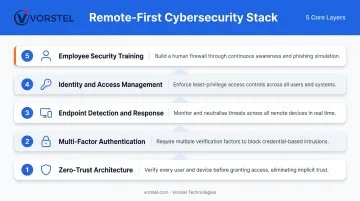
A layered security approach for remote-first businesses should include:
- Zero-trust architecture — never assume trust based on network location
- Multi-factor authentication across all systems
- Endpoint detection and response (EDR) for remote devices
- Identity and access management (IAM) with role-based permissions
- Ongoing employee security training — human error remains a primary attack vector
Data Integration and Analytics
Remote-first businesses can't afford to make decisions on gut instinct. When teams are distributed across time zones, shared data visibility is what keeps leadership and individual contributors aligned.
Digital transformation consolidates data from ERP systems, CRM platforms, and operational tools into unified dashboards. Rather than waiting for weekly reports, distributed teams get real-time performance signals.
Platforms like SAP, Salesforce, and Microsoft serve as the data backbone. Integrating them effectively is where many organizations hit their first major wall — one that requires both technical depth and process expertise to clear. Vorstel Technologies addresses this through ERP/CRM consulting focused on connecting business processes across platforms for consistent data flow and real-time decision-making.
Employee Enablement and Digital Adoption
The best platform implementation fails if people don't use it confidently. Remote employees can't walk over to a colleague's desk when they're confused about a new system, so the adoption gap hits harder in distributed environments.
Effective digital adoption for remote-first businesses requires:
- Role-specific training delivered asynchronously or live
- Internal process documentation updated to reflect new workflows
- Feedback mechanisms to catch adoption issues before they compound
- Cultural change management alongside technical rollout
Vorstel's Digital Transformation engagements treat cultural change management as part of the implementation itself, not an afterthought — because technology investments only generate returns when people are fully equipped to use them.
Common Challenges Remote-First Businesses Face During Digital Transformation
Communication Breakdown
Without structured digital communication, remote teams lose the ambient information that flows naturally in physical offices. There's no overhearing a conversation, no whiteboard session that happens to include the right people.
Fragmented tools make this worse. Common signs include:
- One team on Slack, another on email, a third in Teams — with no shared source of truth
- Decisions buried in meeting recordings no one watches
- Context gaps that only surface after a deadline is missed
By the time miscommunication becomes visible, the cost is already paid.
Shadow IT and Tool Sprawl
When organizations don't provide adequate tools, employees find their own. Research from Torii found that 52% of employees purchased their own applications without IT knowledge, and IT leaders typically underestimated the number of applications in use by 3x to 6x. The same research linked 80% of reported breaches to applications outside IT oversight.
The result: duplicate data, inconsistent workflows, and security gaps that compound with every new hire and every unapproved tool added to the stack.
Performance Visibility Gaps
Managers in remote-first environments lose the passive oversight that offices provide. Without the right digital systems, three things tend to fall through the cracks:
- Bottlenecks that go unaddressed until they become crises
- Coaching opportunities missed until an employee is already disengaged
- High performers who feel invisible — and start looking elsewhere
Gallup's 2025 research on fully remote workers found an uncomfortable paradox: they were the most likely to be engaged at 31%, but 57% were watching for or actively seeking a new job. Among remote workers who were both engaged and thriving, that figure dropped to 38% — suggesting that wellbeing and visibility gaps, not engagement alone, drive attrition.
Building a Digital Transformation Roadmap for Remote-First Businesses
Step 1: Assess Current State
Transformation starts with an honest audit, not a technology purchase. A good assessment covers:
- Which core business functions are still analog or siloed
- Current technology maturity and integration gaps
- Skills gaps across the workforce
- Security posture and compliance requirements
- Where manual processes are creating the most friction
Step 2: Define Objectives and Prioritize
Not everything can change at once. Translate business goals — faster decisions, global collaboration, reduced downtime — into 2-3 high-impact priorities. Attempting organization-wide transformation simultaneously is how well-resourced initiatives stall.
Choose areas where improvement is visible, measurable, and connected to revenue or retention. Those early wins build the internal credibility that sustains longer transformation programs.
Step 3 — Select and Implement Scalable Technology
Platform selection criteria should include:
- Integration capability — does it connect with existing systems?
- Scalability — will it handle 3x the current user load?
- Security standards — does it meet your compliance requirements?
- Vendor support — what does implementation support actually look like?
- Total cost of ownership — licensing, implementation, training, and ongoing maintenance
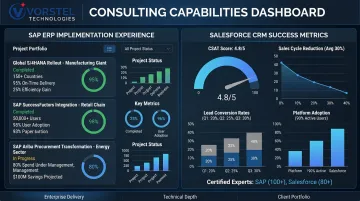
This is the stage where a consulting partner delivers the clearest ROI. Vorstel Technologies has experience across 200+ SAP projects — spanning S/4HANA implementation, SAP BTP, and SAP Automation & Analytics — and maintains a 95% success rate in Salesforce CRM implementations. They can step into a client's transformation process at any stage, not just from day one.
Step 4: Train, Change-Manage, and Adopt
Technology investments don't generate returns on go-live day. For remote employees who can't lean on in-person support, the adoption curve is where many implementations break down before they ever deliver value.
Build a change management layer that covers:
- Role-specific training tailored to each team's workflows
- Updated process documentation reflecting the new tools
- A structured feedback loop in the first 60–90 days post-deployment
Catch adoption issues early, before they calcify into workarounds.
Step 5: Measure, Iterate, and Scale
Digital transformation is an ongoing capability, not a project with an end date. KPIs worth tracking for remote-first businesses include:
- Deployment speed and system uptime
- Employee productivity metrics (output per workflow, not hours online)
- Tool adoption rates across teams
- Customer satisfaction scores tied to operational changes
Use this data to expand what's working and retire what isn't. For remote-first businesses specifically, tool adoption rates and productivity metrics often reveal friction points that no one flagged during rollout — and catching those early is what separates a transformation that sticks from one that gets quietly shelved.
Technologies Powering Remote-First Digital Transformation
Cloud Platforms and SaaS Applications
Cloud platforms — AWS, Azure, Google Cloud — paired with best-in-class SaaS applications form the operating backbone of a remote-first enterprise. SaaS tools for ERP (SAP), CRM (Salesforce), and productivity (Microsoft 365) eliminate infrastructure overhead while enabling real-time global access regardless of where employees sit.
Scale is already there: Okta's 2024 Businesses at Work report found that the average number of apps deployed per company grew 4% year over year to 93, driven in large part by the remote work shift. The challenge isn't access to tools — it's selecting and integrating the right ones.
Vorstel Technologies implements Microsoft 365, SAP BTP, and Salesforce CRM with end-to-end focus: configuration, integration, and driving actual user adoption across distributed teams.
AI and Automation
As remote teams lose passive visibility into day-to-day work, AI fills the gap. It's moved from optional to operationally necessary for distributed organizations. Microsoft's 2024 Work Trend Index found that among AI users, 90% said AI helps them save time and 85% said it helps them focus on their most important work.
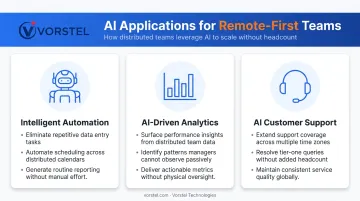
For distributed teams, the practical applications are significant:
- Intelligent automation handles repetitive tasks — data entry, report generation, scheduling
- AI-driven analytics surface performance insights that managers can't observe passively
- AI assistants extend customer support coverage across time zones without proportional headcount increases
Vorstel's AI practice covers process automation, machine learning models, natural language processing via Azure Cognitive Services, and predictive analytics — all scoped to real operational needs, not theoretical roadmaps.
Cybersecurity Tools
Once AI and automation are in place, security becomes the next critical layer. Perimeter-based defenses don't apply when every employee's home network is the perimeter. The essential security stack for remote-first businesses:
- Zero-trust network access (ZTNA) — verify every user and device, every time
- Endpoint detection and response (EDR) — monitor and respond to threats on remote devices
- Identity and access management (IAM) — role-based access with least-privilege principles
- Encrypted cloud storage — protect data at rest and in transit
Vorstel's Cloud & Security Consulting services are built around this layered model — custom security strategies tied to each client's infrastructure and compliance requirements, not generic frameworks.
DevOps and Continuous Delivery
Security protects the environment; DevOps keeps it moving. For remote-first engineering and product teams, CI/CD pipelines are what make distributed development work at speed. The performance gap between high and low DevOps performers is substantial: Google Cloud's 2024 DORA Report found that elite performers achieved 182x more deployments per year and 127x faster lead times than low performers.
Vorstel's DevOps services focus on CI/CD implementation and automation best practices — capabilities that support the agility distributed product teams require.
Frequently Asked Questions
What are the 4 P's of digital transformation?
The 4 P's typically refer to People, Process, Platform, and Performance. They cover the human, operational, technological, and measurement dimensions of transformation — all four must align for a successful initiative rather than technology alone driving change.
What are the 7 pillars of digital transformation?
Commonly cited pillars include strategy, culture, customer experience, data and analytics, operations, technology, and talent. Together, these span everything from executive vision to day-to-day execution — covering both the "why" and the "how" of transformation.
What are the 4 stages of digital transformation?
The four stages are: digitization (converting analog to digital), digitalization (improving processes using digital tools), digital transformation (rethinking business models around digital capabilities), and digital maturity (continuous innovation driven by data and AI).
What technologies are most critical for remote-first digital transformation?
Cloud infrastructure, unified communication platforms, cybersecurity frameworks, SaaS applications (ERP, CRM), and AI/automation tools form the foundational layers. The real value depends on how tightly these systems integrate — gaps between them are where remote-first operations typically break down.
How long does digital transformation take for a remote-first business?
McKinsey's research suggests meaningful value typically emerges within 12–18 months, with transformational impact compounding over 3–5 years. A phased approach focused on 2–3 high-impact areas first moves faster and builds momentum more reliably than attempting a full-scale rollout at once.
Vorstel Technologies offers a Zero-Fee Solution Evaluation for organizations at any stage of their digital transformation journey — providing free expert advice on IT strategy, cloud solutions, automation, and software development. It's a low-risk way to get expert perspective on where to start and what to prioritize.