
That gap between "moving to the cloud" and being genuinely cloud-first is where transformation stalls. McKinsey's survey of European cloud leaders found that 82% of companies report cloud impact is limited to specific areas, only partially realized, or still in early stages — despite widespread adoption.
This article covers what cloud-first digital transformation actually means, the benefits that make it worth the effort, and a practical strategy for executing it without the common pitfalls.
Key Takeaways
- Cloud-first means evaluating cloud solutions before on-premise alternatives — a deliberate strategic posture, not a one-time migration exercise
- Core benefits include faster deployment cycles, lower infrastructure costs, stronger compliance posture, and better business continuity
- A phased roadmap with measurable KPIs prevents transformation from stalling mid-journey
- Legacy complexity, skill gaps, and uncontrolled cloud costs are the three barriers that derail most programs
- Enterprise SaaS platforms — SAP, Salesforce, Microsoft 365 — only deliver their full value when implemented with a clear integration and governance strategy
What Cloud-First Digital Transformation Actually Means
Cloud-First as Organizational Default
Cloud-first digital transformation is an organizational approach where organizations evaluate and prioritize cloud solutions before on-premise alternatives — for every new business challenge, workflow, or technology need. It's not a project with a start and end date. It's a default orientation that shapes every technology decision.
This distinction matters because many companies claim to be cloud-first while still defaulting to on-premise thinking. A new business application gets evaluated with legacy architecture assumptions. A workflow redesign skips cloud-native tooling entirely. The gap between the label and the actual decision-making process is where most transformations stall.
A true cloud-first posture requires:
- Teams trained to default to cloud-native options when evaluating tools
- Procurement processes that require cloud justification before on-premise approval
- Leadership that actively sponsors cloud adoption, not just tolerates it
- Ongoing workload reassessment, not a one-time migration project
Cloud-First Is Not Cloud-Only
One of the most persistent misconceptions: cloud-first means eliminating everything on-premise. It doesn't. Regulatory constraints, latency requirements, and tightly coupled legacy systems mean some workloads legitimately belong outside the public cloud. Hybrid and multi-cloud models exist precisely to address these constraints. Flexera reports that 89% of organizations already use a multi-cloud strategy. The goal is intentionality — cloud is the default evaluation starting point, not the mandatory endpoint for every workload.
Where Digital Transformation Fits
Digital transformation is the broader mission: using technology to change how a business operates and delivers value. Cloud-first is the architectural and strategic lens through which that transformation is most efficiently delivered — providing the scalable infrastructure, automation capabilities, and integration flexibility that operational change actually requires.
Key Benefits of Cloud-First Transformation
Scalability and Operational Flexibility
Cloud infrastructure lets organizations scale compute, storage, and applications up or down in real time. The practical impact: teams stop over-provisioning capacity to handle peak demand and stop under-provisioning for growth. Resources match actual need.
Gartner forecasts worldwide public cloud spending will reach $723.4 billion in 2025, up from $595.7 billion in 2024 — a trajectory that reflects how enterprises are voting with their budgets on scalability.
Faster Deployment and Innovation Velocity
Cloud-native development environments (CI/CD pipelines, microservices, containers) compress deployment cycles from months to weeks. Teams can experiment, iterate, and release without waiting on hardware provisioning or environment setup.
The 2023 DORA report from Google Cloud found that public cloud users were 1.6 times more likely to be high performers in software delivery, with elite performers deploying multiple times per day versus low performers deploying once a month or less.
That pattern holds in client engagements, too. Vorstel Technologies' clients have achieved deployment cycles 92% faster than industry averages through cloud-native implementations.
Enhanced Security and Compliance Posture
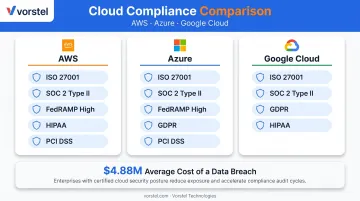
The assumption that on-premise is inherently more secure than cloud is outdated. Leading hyperscalers publish extensive compliance certifications that most individual enterprises cannot replicate on their own:
- AWS: ISO, SOC 1/2/3, FedRAMP, GDPR
- Azure: SOC 1/2/3, ISO 27001, ISO 27017, HIPAA, HITRUST, PCI DSS
- Google Cloud: ISO 27001, SOC 2/3, FedRAMP, PCI DSS
The real risk is unmanaged cloud environments, not cloud itself. The IBM 2024 Cost of a Data Breach Report found the global average breach cost hit $4.88 million, with 70% of breached organizations reporting significant operational disruption. Cloud platforms with proper identity and access management, encryption at rest and in transit, and automated compliance controls reduce that exposure meaningfully.
Business Continuity and Reduced Downtime
Cloud platforms provide built-in disaster recovery capabilities that legacy infrastructure cannot match at comparable cost. AWS Well-Architected's multi-Region active-active architecture targets near-zero recovery point objectives and potentially zero recovery time objectives — results that would otherwise require dedicated redundant data centers on-premise.
The cost of failing here is concrete: Uptime Institute's 2024 outage analysis found 54% of respondents said their most significant outage cost more than $100,000, with 16% reporting costs exceeding $1 million. Vorstel's enterprise clients have seen a 45% reduction in system downtime following cloud-first implementations.
Building a Cloud-First Digital Transformation Strategy
Assess Your Current State
Before any migration begins, conduct a thorough audit of existing applications, infrastructure, and workflows. The goal is to categorize workloads into three buckets:
- Cloud-ready — can migrate with minimal changes
- Refactor-needed — require architectural changes before cloud deployment
- Poor candidates — regulatory, latency, or dependency constraints make cloud migration impractical or high-risk
Not every workload belongs in the cloud. Prioritization by business value — not technical convenience — determines what moves first.
Define Goals and Measurable KPIs
Vague transformation goals produce vague results. Set both:
Quantitative KPIs:
- Deployment cycle time (before vs. after)
- Infrastructure cost per workload
- System uptime/downtime hours
- Mean time to recovery
Qualitative KPIs:
- Employee adoption rates across new cloud tools
- Customer satisfaction scores tied to system performance
- Speed of new feature or product delivery
With clear KPIs in place, the roadmap becomes something you execute against — not just report on after the fact.
Build a Phased Cloud Roadmap
A phased approach prevents the transformation from stalling and keeps budget and timelines accountable. The sequencing:
- Quick wins — migrate low-risk, high-frequency workloads first; demonstrate ROI early
- Core business applications — move critical systems once the team has cloud operational confidence
- Complex legacy systems — tackle tightly coupled or heavily customized systems last, with appropriate refactoring
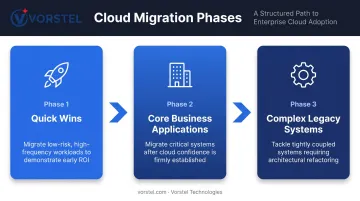
This order matters. Teams that attempt to migrate complex legacy systems first often exhaust budgets and lose executive support before reaching simpler, higher-value workloads.
Secure Leadership Buy-In and Manage Change
Cloud-first transformation fails without executive sponsorship. The business case for the C-suite is direct: lower infrastructure costs, faster operational response, and a competitive edge that compounds over time.
Change management is equally non-negotiable. IDC found that 62% of IT leaders said skills gaps resulted in missed revenue, quality problems, or reduced customer satisfaction. Three tactics that reduce adoption resistance before it becomes a blocker:
- Upskilling programs tied to specific cloud tools and workflows
- Internal cloud champions who advocate for the change within their teams
- Clear communication of the transformation rationale at every stage
Choose the Right Implementation Partner
Once leadership is aligned and the roadmap is set, partner selection becomes one of the highest-leverage decisions in the program. Criteria for evaluating a cloud implementation partner:
- Deep domain expertise across cloud platforms (AWS, Azure, GCP)
- Track record across enterprise SaaS platforms — SAP, Salesforce, Microsoft 365
- Ability to engage at any stage of the transformation journey, not just greenfield projects
- Experience with hybrid and multi-cloud environments
- Clear visibility into cloud cost governance
Vorstel Technologies is built around this model — 200+ SAP project engagements, a 95% Salesforce CRM implementation success rate, and Microsoft 365 deployment experience across global enterprise clients. The firm takes on transformation work at any stage, from initial assessment through post-implementation optimization.
Common Challenges and How to Overcome Them
Legacy System Dependencies
Tightly coupled legacy architectures create integration bottlenecks that slow cloud migration to a crawl. Flexera's 2026 State of the Cloud report identifies understanding application dependencies as the top migration challenge.
The recommended approach is the strangler fig pattern: gradually replacing legacy functionality with cloud-native services at the edges, rather than attempting a full rip-and-replace. This manages risk without halting existing operations.
Skill Gaps and Change Resistance
Cloud-native skills (infrastructure-as-code, FinOps practices, containerization, CI/CD) are not evenly distributed across enterprise IT teams. Many organizations underestimate the cultural shift required alongside the technical one.
Effective responses:
- Dedicated upskilling programs tied to specific cloud platforms in use
- Internal cloud champions who evangelize new approaches peer-to-peer
- Clear, repeated communication of why the transformation is happening — not just what is changing
Cloud Cost Sprawl
Without governance, cloud costs scale faster than expected. Flexera reports 84% of organizations struggle to manage cloud spend, and teams spinning up resources without oversight are the primary cause.
The fix requires FinOps practices from day one:
- Cost visibility dashboards surfacing spend by team or workload
- Mandatory resource tagging policies for every provisioned asset
- Regular optimization reviews to right-size or decommission idle resources
- Defined approval thresholds before spinning up new cloud resources
Sixty percent of organizations now have dedicated FinOps teams. The ones without one tend to be the same 84% struggling with runaway spend.
The Role of SaaS Platforms in Cloud-First Execution
Enterprise SaaS platforms are the operational backbone of most cloud-first transformations. SAP handles ERP, Salesforce manages CRM, and Microsoft 365 covers collaboration and productivity. Each delivers pre-built, cloud-native functionality that accelerates time-to-value compared to custom builds — without the overhead of managing underlying infrastructure.
What's often underestimated is that licensing a platform and implementing it well are two very different things. SaaS tools require strategic configuration, integration, and change management to deliver their full value. Poorly configured deployments simply replicate legacy inefficiencies inside a cloud wrapper — the technology is new, but the dysfunction remains.
Multi-platform adoption introduces another layer of complexity: interoperability. Without a deliberate integration strategy, organizations trade one set of data silos for another. Key approaches to prevent this include:
- API-first architecture — connects platforms through standardized interfaces that scale as new tools are added
- Middleware integration layers — routes data flows between SAP, Salesforce, Microsoft 365, and other systems without point-to-point dependencies
- Master data governance — ensures consistent records across platforms, preventing duplication and reporting errors
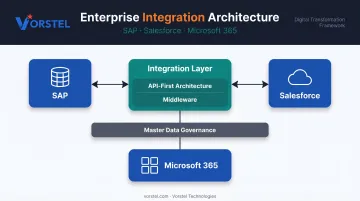
Implementation expertise directly determines whether SaaS platforms deliver their intended value. Vorstel Technologies brings hands-on depth across SAP (S/4HANA, BTP, Ariba, and MDG), Microsoft Azure Cognitive Services, and Salesforce CRM — configuring each platform to align with actual client workflows rather than out-of-the-box defaults that rarely survive contact with real operations.
Cloud-First as the Foundation for AI Innovation
A mature cloud-first architecture is the prerequisite for deploying AI and machine learning at scale. Cloud platforms provide the compute power, managed AI services, and integrated data pipelines that make enterprise AI practical — and organizations that delay this foundation also delay their ability to compete with AI-powered processes.
The numbers support urgency here. IDC forecasts that by 2026, 75% of organizations will use specialized accelerated cloud computing services to optimize AI scaling, and 82% of cloud buyers plan to modernize cloud estates specifically to improve agility for AI workloads.
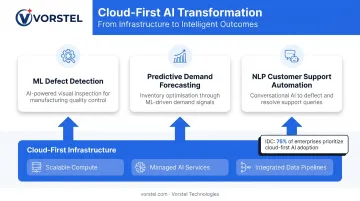
Vorstel Technologies has put this into practice across industries, delivering outcomes that depend directly on scalable, integrated cloud infrastructure:
- ML-based defect detection for manufacturing quality control
- Predictive demand forecasting for retail inventory management
- NLP-powered customer support automation for e-commerce via Microsoft Azure Cognitive Services
Each result traces back to the same foundation: a cloud estate built to support data at scale.
The competitive advantage in enterprise AI isn't just the sophistication of the model — it's the infrastructure that makes deployment fast and repeatable. That infrastructure starts with cloud-first transformation.
Frequently Asked Questions
What is cloud-first digital transformation?
Cloud-first digital transformation is a strategic approach where cloud solutions are evaluated before on-premise alternatives for every new business or technology need. It's an organizational mindset shift — not just a migration project — that shapes how teams procure tools, design workflows, and modernize operations.
What is the difference between cloud-first and cloud-only?
Cloud-first means defaulting to cloud solutions as the first option evaluated, not eliminating all non-cloud infrastructure. Cloud-first accommodates hybrid and multi-cloud models where regulatory requirements, latency constraints, or legacy dependencies make on-premise or private cloud the better fit.
What are the biggest challenges of cloud-first digital transformation?
The three most common blockers are legacy system complexity creating integration bottlenecks, employee skill gaps and resistance to new cloud-native workflows, and cloud costs that spiral as teams provision resources without central oversight.
How long does cloud-first digital transformation typically take?
Timelines vary based on organizational size and legacy complexity. A phased approach typically delivers early wins within 3–6 months, with broader transformation unfolding over 1–3 years. Starting with clearly scoped workloads and a defined roadmap compresses that timeline meaningfully.
How do you measure the success of a cloud-first transformation?
Track quantitative metrics — deployment cycle time, infrastructure cost reduction, system uptime — alongside qualitative indicators like employee adoption rates and speed of new feature delivery. Establishing baselines before migration begins is what makes improvement measurable.
Which industries benefit most from a cloud-first approach?
Manufacturing, retail, financial services, and e-commerce see particularly high impact. These sectors depend on real-time data access, scalable operations during demand spikes, and distributed team collaboration — areas where cloud infrastructure consistently outperforms legacy alternatives.