Introduction
Technology rarely kills a digital transformation. People do.
Most organizations invest heavily in selecting the right platform — SAP, Salesforce, a new AI-driven workflow — and underinvest in preparing the people who will actually use it. The result is predictable: systems go live, adoption stalls, and the business value never materializes.
According to BCG's 2020 research, 70% of digital transformations fall short of their objectives — not because the technology failed, but because the human and organizational layers weren't managed deliberately. Only 30% met or exceeded their target value and created lasting change.
Change management in digital transformation is the structured approach to guiding people and processes through technology-driven transitions: reducing resistance, building adoption, and sustaining results after go-live.
The five strategies below target the specific failure points where most transformations break down.
Key Takeaways
- 70% of digital transformations fall short of their goals — the gap is almost always human, not technical
- The five strategies: leadership alignment, two-way communication, incentive realignment, continuous training, and organizational change readiness
- Digital transformation has no defined endpoint — traditional one-time change models don't fit
- Without deliberate change management, even well-implemented technology underperforms
What Is Change Management in Digital Transformation?
Traditional change management follows a familiar arc: move an organization from State A to State B, stabilize, and move on. That model made sense when technology changes were discrete events.
Digital transformation breaks that assumption entirely. McKinsey defines it as the "rewiring" of an organization to create value by continuously deploying technology at scale, while Forrester puts it plainly: digital transformation has no finish line where change stops and a stable new normal begins.
This distinction matters practically. When there is no defined endpoint, change management cannot be treated as a project phase. It has to become an ongoing organizational capability — not a one-time project deliverable.
Despite this, many organizations still approach it as a checklist item: a communication plan drafted pre-launch and a training session scheduled for go-live week. The result is adoption that peaks briefly, then decays as employees revert to familiar habits.
Effective change management in this context serves three goals:
- Ensures new systems actually perform as intended operationally, not just technically
- Captures the competitive value that justified the transformation investment
- Builds genuine confidence and competency in employees, not just surface-level compliance
For organizations working through complex implementations — SAP S/4HANA migrations, Salesforce CRM rollouts, or AI-driven workflow adoption — these goals require sustained support across the entire lifecycle. Vorstel Technologies is built specifically for this: the firm joins client engagements at any stage, whether that means rescuing a stalled mid-implementation or establishing strategy from the ground up.
5 Change Management Strategies for Digital Transformation
These strategies draw from established frameworks and real-world transformation experience. They apply whether an organization is at the start of its journey or working to recover momentum mid-project.
Strategy 1: Anchor Change in Leadership — From C-Suite to Middle Management
Executive sponsorship matters. But C-suite commitment alone does not drive adoption at the team level.
The gap between a CEO announcing a transformation and an operations manager explaining to her team why their workflow is changing next month is exactly where most transformations stall. Middle managers are the critical link. They translate high-level strategy into daily reality, answer team-specific questions, and model the behaviors the transformation requires.
When middle managers are excluded from planning phases or left without communication frameworks, they fill the void with uncertainty. Their teams pick up on that uncertainty, and resistance grows.
Concrete actions for leadership alignment:
- Involve middle managers in planning phases, not just rollout communication
- Equip them with talking points and Q&A guides tailored to their team's specific concerns
- Position them as change champions, not just message-forwarders
- Ensure C-suite messaging focuses on organizational direction, while manager-level messaging addresses personal impact
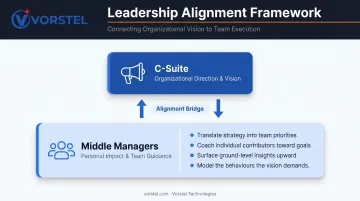
Research from McKinsey found that digital transformation success rates were 3x greater when senior managers and initiative leaders used digital channels to reach employees directly — not just through cascaded communications.
Strategy 2: Build a Two-Way Communication Plan
Count the emails sent, the town halls held, the intranet posts published — and you'll find most transformation communication plans measure volume, not adoption. They send information down the hierarchy and call it engagement.
That approach generates noise, not adoption. Gartner's research on change fatigue is direct: employees experiencing excessive change initiatives show reduced intent to stay, lower responsiveness, and discretionary effort that can drop by up to 50%.
Effective communication during transformation is a listening strategy first.
What a two-way communication plan looks like:
- Segment by role and concern — a finance analyst and a warehouse supervisor have fundamentally different questions about the same ERP implementation
- Answer "what does this mean for me" before broadcasting what the transformation means for the organization
- Create structured feedback channels: pulse surveys, open Q&A sessions, and manager feedback loops so concerns surface early rather than becoming underground resistance
- Audit your channels — in-person briefings, async updates, and internal tools serve different purposes. Information overload is as damaging as information gaps
Key messages need to be repeated five to seven times across different formats before they land. But repetition without responsiveness is just noise. Consistent messaging combined with active listening is what builds trust.
Strategy 3: Align Incentives to Drive Behavioral Change
Organizations develop behavioral muscle memory. When existing performance metrics reward current routines — and nothing in the incentive structure rewards using new tools or workflows — employees face a rational choice: take a productivity hit to adopt something unfamiliar, or stick with what's always worked.
Most choose the familiar. Not because they're resistant to change in principle, but because the incentive structure points them there.
Forrester states this plainly: if incentives do not change, behaviors will not either.
Incentive alignment in practice:
- Update KPIs to include adoption metrics — usage rates, proficiency milestones, workflow completion in new systems
- Recognize early adopters visibly, not just in year-end reviews
- Adjust performance conversations to include digital fluency goals
- Audit whether existing bonuses, promotions, or recognition systems inadvertently reward old behaviors
Employees disengage quickly when transformation messaging feels dishonest. If a new system means role changes, skill gaps, or restructuring, acknowledge those trade-offs directly. Communicating only the benefits while obscuring the real adjustments employees will need to make destroys credibility — and makes every subsequent message harder to believe.
Strategy 4: Invest in Continuous Training and Upskilling
Finance teams navigating a new ERP. Operations staff adapting to AI-assisted workflows. HR managing people data in unfamiliar platforms. Digital fluency is no longer the IT department's problem — it's everyone's. And that competency needs to be refreshed as tools evolve.
The scale of this challenge is significant. The World Economic Forum's 2023 Future of Jobs Report found that 44% of workers' core skills are expected to change between 2023 and 2027. For organizations mid-transformation, this means the training provided at go-live will be outdated faster than most assume.
What makes training programs work:
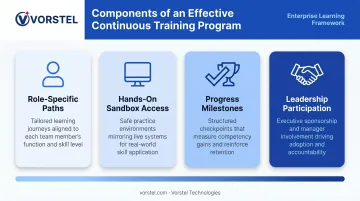
- Role-specific learning paths generate better retention than generic content — map training to how a person actually uses the system
- Sandbox access, hackathons, or simulation tools allow hands-on experimentation without production risk
- Progress indicators and visible milestones create momentum and reduce anxiety about new platforms
- When managers and executives visibly engage in training, it signals that digital fluency is expected at every level
The most common mistake is treating training as a one-time event tied to launch. Systems get updated. Processes evolve. New team members join. Continuous upskilling needs to be a permanent line item, not a project budget.
Strategy 5: Build Change Readiness as an Organizational Capability
The organizations that sustain transformation outcomes over time share one characteristic: they stopped treating change as a project and started treating it as a core competency.
This means building internal structures — often a dedicated team or Center of Excellence (CoE) — that own the change management discipline on an ongoing basis rather than standing up a new effort for each initiative.
What a digital Center of Excellence typically handles:
- Setting change management standards and frameworks across the organization
- Leading internal communication for transformation initiatives
- Tracking adoption KPIs and feeding insights back into program planning
- Conducting ongoing research into emerging technologies relevant to the business
- Supporting continuous learning and development programs organization-wide
Prosci's maturity model maps this evolution across five levels, from organizations with no formal change management to those where it functions as an organizational competency. The gap in outcomes between those levels is significant: projects with excellent change management are up to 7x more likely to achieve their intended results.
Reactive change management means spinning up a new effort every time a new system launches. Proactive change readiness means the capability already exists. That distinction is what separates organizations that sustain transformation value from those that stall after the first implementation.
Why Traditional Change Management Fails in Digital Transformation
The frameworks most organizations learned — Kotter's 8 steps, classic Prosci methodology — were designed for a world where change had a beginning, a middle, and an end. You moved from a current state to a defined future state, managed the transition, and stabilized.
Digital transformation doesn't work that way. By the time an SAP migration goes live, the next phase of the roadmap has already started — there is no stable future state to land in, only a continuous series of transitions.
The most common failure patterns:
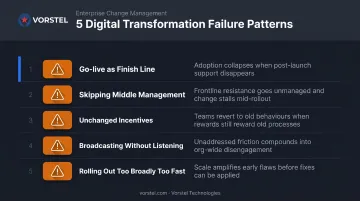
- Go-live treated as the finish line — adoption work stops just when it needs to accelerate
- Skipping middle management entirely — C-suite alignment exists on paper while team-level reality is confusion
- Leaving incentives unchanged — employees are told to change while being rewarded for staying the same
- Broadcasting without listening — communication plans that measure output, not actual understanding or sentiment
- Rolling out too broadly, too fast — HBR notes this is an underappreciated reason digital transformations stall
Forrester's research on global services decision-makers found that **21% cited implementation of new processes and capabilities as one of their greatest transformation challenges** — ranking it as a top execution difficulty.
That number points to something most transformation roadmaps still underfund: the human and process side needs its own budget line, its own milestones, and its own accountability — not a footnote in the technical delivery plan.
How to Measure Change Management Success
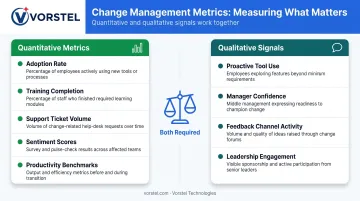
Measuring change management effectiveness requires tracking both quantitative and qualitative signals — neither alone gives the full picture.
Quantitative metrics to track:
| Metric | What It Tells You |
|---|---|
| User adoption rate | Percentage of intended users actively using new systems |
| Training completion rate | Coverage and engagement with upskilling programs |
| Support ticket volume post-launch | Proxy for confusion and friction after go-live |
| Employee sentiment scores | Engagement and trust during the transition |
| Productivity benchmarks (before vs. after) | Whether transformation delivered operational value |
Prosci's ADKAR framework adds three dimensions that numbers alone don't surface: how quickly people actually change their behavior, what share ultimately use the new tools in daily work, and how well they use them — not just whether they log in.
Qualitative signals that matter equally:
- Are employees proactively using new tools, or only when required?
- Are managers confidently guiding their teams, or deflecting questions?
- Are feedback channels generating actionable input, or silence?
- Do leaders talk about transformation in meetings, or has it become background noise?
These qualitative signals reveal what the scorecard can't: whether change is actually sticking. Yet Deloitte found that 81% of organizations measure digital transformation ROI primarily through productivity — which misses adoption depth, cultural shift, and long-term sustainability. A more complete approach tracks across financial, customer, process, and workforce dimensions at once.
Conclusion
Digital transformation succeeds or fails at the people layer. The five strategies covered here form a practical framework for closing the gap between technology investment and realized value:
- Align leadership from C-suite to front-line managers
- Build communication that listens before it broadcasts
- Realign incentives to reward new behaviors
- Invest in continuous upskilling
- Build organizational change readiness as a permanent capability
None of this happens in a single project phase. Change management in digital transformation is a continuous discipline, not a launch checklist.
If your organization is navigating an SAP migration, Salesforce implementation, Microsoft 365 rollout, or AI-driven workflow adoption (whether you're at the start of that journey or mid-implementation and losing momentum), Vorstel Technologies brings deep expertise across these platforms and can step in at any stage to help you deliver the expected outcome.
Book a Zero-Fee Solution Evaluation to get a no-cost expert assessment of where your change management strategy stands today.
Frequently Asked Questions
What is digital transformation change management?
Digital transformation change management is the structured process of guiding people, processes, and culture through technology-driven organizational change. Unlike traditional change management, it has no defined endpoint — it must be treated as a continuous discipline that evolves alongside the technology and the business.
What are the 4 P's of Prosci?
Prosci's 4 P's exercise — Project name, Purpose, Particulars, and People — helps leaders communicate the case for change clearly and consistently. It connects a transformation initiative to business results by defining what the change is, why it matters, what it involves, and who is affected.
What are the 5 C's of change management?
The 5 C's — Clarity, Communication, Commitment, Consistency, and Coaching — are a practitioner framework for guiding smoother adoption during change. This is not an official Prosci model; Prosci's individual-change framework is ADKAR (Awareness, Desire, Knowledge, Ability, Reinforcement).
Why do digital transformation change management initiatives fail?
The most common failure drivers are: skipping middle management enablement, leaving incentive structures unchanged while expecting new behaviors, treating change as a time-limited project rather than an ongoing capability, and running communication that broadcasts without ever listening.
How long does change management take in a digital transformation?
Change management in digital transformation is ongoing, not time-bound. For specific implementations like an ERP rollout, the initial adoption phase typically ranges from several months to over a year, depending on organizational size, scope, and readiness.
How do you measure the success of change management in digital transformation?
Key metrics include user adoption rates, training completion, employee sentiment scores, support ticket volume post-launch, and productivity benchmarks. Qualitative signals — such as whether managers are confidently leading their teams — matter just as much as the numbers.