Introduction
Most organizations have accepted that AI will transform their operations. The harder question is where to start — and the gap between intent and execution is exactly where efficiency bleeds out.
The numbers reflect this tension. The intelligent process automation market was valued at USD 14.55 billion in 2024 and is projected to reach USD 44.74 billion by 2030 — a 22.6% CAGR. Yet McKinsey's 2025 workplace AI report found that nearly every company invests in AI, but only 1% believe they've reached maturity.
This article breaks down what AI business process optimization actually means, where organizations see the fastest ROI, and how to build a strategy that holds up against legacy infrastructure constraints.
Key Takeaways
- AI process optimization combines ML, NLP, and intelligent automation to handle complex workflows that rule-based scripts can't manage
- Key gains include faster cycle times, lower error rates, reduced operational costs, and better decision-making
- Finance, supply chain, HR, and IT operations deliver the highest-impact results
- Start with process discovery — automating a broken process just speeds up the problem
- Data readiness and integration quality are prerequisites — poor foundations stall even well-designed AI implementations
What Is AI Business Process Optimization?
Business process optimization (BPO) is the systematic improvement of workflows to increase efficiency, cut costs, and produce better outcomes. AI extends this by embedding intelligence, adaptability, and predictive capability directly into the process layer — adding judgment alongside speed.
AI vs. Rule-Based Automation
Conventional automation works on fixed rules: if X happens, do Y. It breaks when inputs vary, exceptions occur, or unstructured data enters the picture. AI-powered optimization handles what rigid scripts can't:
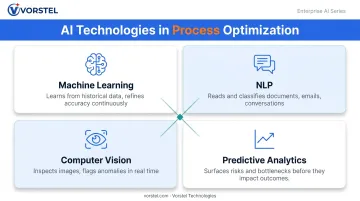
- Machine learning identifies patterns across historical data and continuously refines its accuracy
- NLP reads and classifies documents, emails, and conversations without manual intervention
- Computer vision inspects images and flags anomalies in real time
- Predictive analytics flags risks and bottlenecks before they affect outcomes
The practical difference: an RPA bot can extract a value from a structured invoice field. An AI system can read a handwritten purchase order, interpret intent, and route it appropriately — even when the format has never appeared before.
Process Mining as the Starting Point
Before automating anything, you need an accurate picture of what's actually happening — not what the process map says should happen.
Process mining reads event log data from ERP, CRM, and IT service platforms (each transaction recorded with a Case ID, Activity, and Timestamp) to reconstruct actual workflow execution. According to SAP Signavio, this enables process discovery, conformance checking, and performance analysis including cycle times, error rates, and costs. IBM Process Mining applies specialized algorithms to these logs to identify automation opportunities and prioritize them by business impact.
The output is a prioritized list of high-impact automation targets — grounded in actual execution data, not assumptions.
How AI Automates and Optimizes Business Processes
Intelligent Document Processing
High-volume document workflows — invoices, contracts, purchase orders, onboarding forms — are among the most expensive manual processes in any organization. Intelligent Document Processing (IDP) converts incoming documents into structured, actionable data without human entry.
The results at scale are significant. Thermo Fisher Scientific processes 824,000 invoices annually using UiPath Document Understanding, achieving a 70% reduction in processing time, 53% straight-through processing, and 82.4% initial document-reading accuracy — with reduced workload for 8 FTEs.
Vorstel Technologies has delivered similar implementations for manufacturing clients using AI Builder, replacing a manual cycle of downloading, entering, and archiving invoices with a fully automated workflow that reads, validates, updates the ERP, and stores documents automatically.
Predictive Analytics and Decision Support
ML models trained on historical and real-time data don't just report what happened — they surface what's likely to happen and what to do about it. Common applications include:
- Demand forecasting from sales history and seasonal patterns
- Risk scoring for loan approvals or procurement decisions
- Pricing scenario simulation before committing to a rate
- Supplier reliability prediction based on performance trends
For a retail client, Vorstel built predictive analytics models on historical sales and promotional data to generate weekly demand forecasts, reducing overstock and stockout events.
Hyperautomation: AI and RPA Working Together
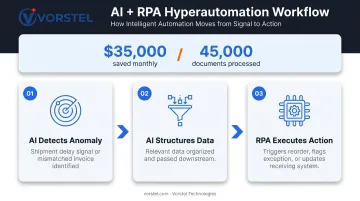
AI extracts and interprets; RPA executes. The combination — often called hyperautomation — handles end-to-end workflows that neither technology could manage alone.
A global freight provider processed 45,000 documents monthly, supported 22,000 shipments, and saved $35,000 monthly through this combined approach. In practice, the flow looks like this:
- AI detects an anomaly — a shipment delay signal or mismatched invoice
- Structures the relevant data and passes it downstream
- RPA triggers a reorder, flags an exception, or updates the receiving system
Customer-Facing Process Optimization
AI-powered chatbots, virtual assistants, and intelligent ticket routing reduce response times while freeing human agents for genuinely complex cases. Service teams using AI agents expect an average 20% decrease in service costs and case resolution times, according to Salesforce.
Vorstel applied this for a global e-commerce client by deploying an NLP solution via Microsoft Azure Cognitive Services. It automatically classifies incoming support queries by intent and urgency, eliminating the manual triage that was slowing response times.
Continuous Improvement Through Adaptive Learning
Unlike static automation, AI systems learn from outcomes. A process running for six months generates feedback — flag rates, exception patterns, approval delays — that the system uses to refine itself.
Bottlenecks surface automatically. Workflow improvements emerge from data rather than assumptions. Over time, organizations shift from reacting to process failures to anticipating and preventing them.
Key Benefits of AI-Driven Process Optimization
| Benefit | What Drives It |
|---|---|
| Operational efficiency | Automating repetitive tasks reduces time-on-task and eliminates rework |
| Cost reduction | Less manual intervention, fewer errors, lower rework and penalty exposure |
| Faster decisions | Real-time data synthesis compresses decision cycles from days to minutes |
| Compliance and auditability | Structured activity logs enforce policy-aligned workflows automatically |
| Scalability | Processes scale with demand without proportional headcount growth |
The numbers back this up:
- A Gartner survey of 822 business leaders found GenAI adopters reported an average 22.6% productivity improvement
- The same survey reported an average 15.2% cost reduction from GenAI adoption
- Molina Healthcare managed 420% growth in invoice volume with only a 10% staff increase, achieving 250% higher invoice processing efficiency
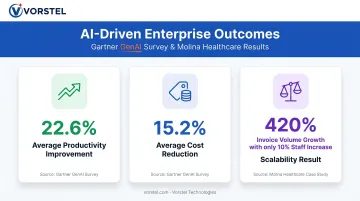
That last point on scalability deserves a closer look. For retail, e-commerce, and growth-stage enterprises facing seasonal demand spikes, absorbing volume increases through headcount is a linear cost model. AI-enabled processes scale differently — the work grows, but the cost curve doesn't have to.
AI Process Optimization Use Cases Across Industries
Across finance, supply chain, HR, and IT operations, AI process optimization delivers measurable results. Here's what the numbers show.
Finance and Procurement
Invoice matching, PO reconciliation, and expense approvals are ideal targets — high volume, rule-rich, and expensive to get wrong.
- GameStop eliminated 750,000 annual manual entries, increased first-time invoice match rate by 82%, and cut average processing time by 70%
- Reddit compressed month-end close from 15 days to 6 days or less, saving $6M over three quarters
- SUEZ doubled annual savings from £6M to £15M with a 58% first-time invoice match rate
Supply Chain and Logistics
AI-enabled supply-chain early adopters improved logistics costs by 15%, inventory levels by 35%, and service levels by 65% versus slower competitors, according to McKinsey. Real-time analysis of purchase and demand data enables anomaly detection, disruption prediction, and automated reorder or rerouting — often hours before manual review would catch the issue.
HR and Talent Operations
The RPG Group deployed Leena AI's virtual HR assistant to handle employee support requests:
- 92% of requests resolved within minutes
- Ticket resolution reduced from 1 day to 4 hours
- 1,600+ hours saved across the support function
The same AI layer handles candidate screening, onboarding document processing, and policy query handling.
IT Operations and Security
HMCTS, working with Dynatrace, reduced mean time to resolution (MTTR) by 70% and detected issues 1.45x faster through AI root-cause analysis:
- Continuous infrastructure monitoring flags anomalies before they escalate
- Automated access control reduces manual overhead and response lag
- AI-managed deployment cycles cut unplanned downtime
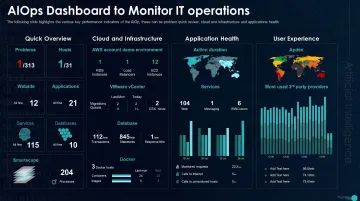
System downtime remains one of the clearest operational metrics for IT leaders — and it's one of the first to move when AI enters the picture.
How to Build an AI Process Optimization Strategy
Step 1: Map Before You Automate
Process discovery comes before any tool selection. Use process mining or structured workflow audits to identify:
- High-volume, repetitive tasks consuming the most labor hours
- Error-prone steps generating rework or exception handling
- Slow handoffs creating cycle time delays
- Decision points relying on fragmented or manual data
A critical principle: automating a broken process just makes the broken process run faster. Fix the workflow logic first, then apply AI to accelerate it.
Step 2: Align Your Data Infrastructure
AI performs only as well as the data it receives. Before scaling automation:
- Integrate ERP, CRM, and cloud platforms so data flows without manual extraction
- Establish data governance policies covering quality standards and access controls
- Clean and normalize data that AI models will be trained on or queried against
Working with consultants who understand both AI implementation and platforms like SAP, Microsoft, and Salesforce can cut integration friction considerably. Vorstel Technologies, for example, works across these environments and can step into a transformation at any stage — without requiring clients to rebuild foundational integrations from scratch.
Step 3: Define KPIs and Build for Iteration
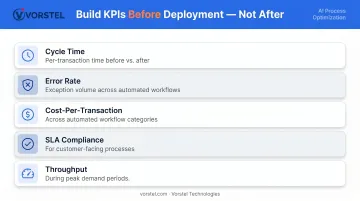
Set measurable targets before deployment, not after. Useful KPIs include:
- Cycle time per transaction (before vs. after)
- Error rate and exception volume
- Cost-per-transaction across automated workflows
- SLA compliance for customer-facing processes
- Throughput during peak demand periods
Review these on a consistent cadence. AI process optimization delivers compounding returns — but only when actively monitored, adjusted, and built upon over time.
Common Challenges and How to Address Them
Data Quality and Integration Complexity
Gartner predicted that at least 30% of GenAI projects would be abandoned after proof of concept by end of 2025 — citing poor data quality as a leading cause. AI models trained on siloed, inconsistent, or incomplete data produce unreliable outputs. Address this by prioritizing data unification through an integration layer and establishing governance policies before scaling.
Workforce Adaptation
McKinsey's supply-chain survey found **82% of respondents cited change management** and 70% cited poor process design as top implementation concerns. When automation is framed as a threat, resistance follows. Frame it as a productivity tool — one that removes the tedious work, not the worker. Practical steps that reduce friction:
- Involve teams early in process redesign, before decisions are finalized
- Invest in upskilling so employees grow alongside the new tools
- Communicate clearly what changes, what stays the same, and why
Governance, Bias, and Compliance
AI systems can inherit biases from training data or operate unchecked. For high-stakes decisions — loan approvals, hiring, medical records — build in human review steps and maintain structured audit trails.
Align governance frameworks with applicable regulations:
- GDPR Article 22 — rights and safeguards for automated decision-making
- HIPAA — standards for handling protected health information
- NIST AI RMF — structured risk identification, measurement, and mitigation across the AI lifecycle
Frequently Asked Questions
What are some AI ideas for business optimization?
High-impact starting points include intelligent document processing for invoices and contracts, predictive analytics for demand planning or risk scoring, NLP-based customer service routing, automated financial reconciliation, and HR workflow automation for onboarding and query handling. Each offers measurable ROI with manageable implementation complexity.
What is the difference between AI process optimization and RPA?
RPA automates structured, rule-based tasks — form filling, data entry, system updates — where inputs are predictable. AI handles unstructured data, learns from patterns, and makes dynamic decisions. The two are most effective when combined: AI handles interpretation and decision-making while RPA carries out execution.
How does AI reduce operational costs in business processes?
AI drives cost reductions across several areas:
- Reduces manual labor on routine, repetitive tasks
- Cuts rework cycles caused by data entry errors
- Speeds up processing to shorten cycle times and free working capital
- Prevents costly disruptions through predictive capabilities
Which business processes should be automated with AI first?
Start with high-volume, repetitive workflows where errors are frequent and costly — invoice processing, customer inquiry routing, employee onboarding, and inventory monitoring. These deliver the fastest ROI with lower implementation risk.
What are the biggest challenges of implementing AI in business processes?
Data quality issues, integration with legacy systems, workforce resistance to change, and the need for ongoing governance and model monitoring are the most common barriers. Of these, data readiness is the most important thing to address before deployment begins.
How long does it take to see ROI from AI process optimization?
Well-scoped automation of document-heavy or high-volume workflows can show measurable gains within weeks. Broader enterprise transformation typically delivers compounding returns over 6–18 months, with timelines shaped by process complexity and change management execution.