Introduction
Running outdated systems is expensive — and not just in the obvious ways. According to Deloitte's Tech Trends 2024 report, CIOs spend 10%–20% of total IT budgets resolving technical debt from outdated systems, while 70% of technology leaders identify that debt as their top cause of productivity loss. Developers, meanwhile, burn roughly a third of their time on maintenance rather than building anything new.
That cost pressure forces a decision — but it's not the binary choice between "do nothing" and "rip and replace" that it once was. Organizations today can choose from a spectrum of approaches, and picking the wrong one can be just as costly as staying put.
This guide breaks down the most widely used modernization strategies, explains when each one applies, and gives you a structured way to match the right approach to your systems, constraints, and business objectives.
Key Takeaways
- Legacy modernization ranges from cloud migration to full architectural rebuilds — not every project starts from scratch
- The 7 Rs framework (Retain, Retire, Rehost, Replatform, Refactor, Re-architect, Replace) is the standard decision tool used across the industry
- The right approach depends on system complexity, budget, risk tolerance, and long-term IT goals
- Always start with a structured system assessment before committing to any strategy
- An experienced modernization partner reduces implementation risk and shortens delivery timelines
What Is Legacy Modernization and When Do You Need It?
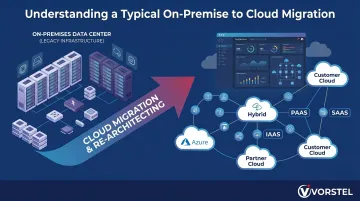
Legacy modernization is the process of upgrading or replacing outdated software, hardware, or architecture to meet current business requirements, security standards, and scalability demands. The scope ranges from lifting a server to the cloud with zero code changes to rebuilding an entire application architecture from the ground up.
Knowing when to act starts with recognizing the signals. Common warning signs include:
Warning Signs Your System Needs Modernization
- Vendor support has ended or is ending soon
- Maintenance costs keep climbing without corresponding business value
- The system cannot integrate with modern tools, cloud platforms, or APIs
- Frequent downtime, crashes, or performance degradation
- Security and compliance requirements are increasingly hard to satisfy
- Critical system knowledge lives in the heads of a few employees nearing retirement
These signals rarely stay contained to IT. They surface in missed deadlines, blocked initiatives, and deals that stall because systems can't keep up.
The Broader Stakes
Legacy systems are a strategic liability, not just a technical one. Salesforce's 2024 Connectivity Benchmark Report found that 95% of IT leaders say integration issues impede AI adoption, and **81% say data silos hinder digital transformation**. Organizations that delay modernization lose the data capabilities and integration flexibility needed to compete — regardless of how good their strategy looks on paper.
Top Legacy Modernization Approaches
Not every system warrants the same treatment. The goal is matching each system's risk profile, business value, and complexity to the most appropriate path. The 7 Rs framework — popularized by AWS and extended by Microsoft — provides the standard decision structure used across the industry.
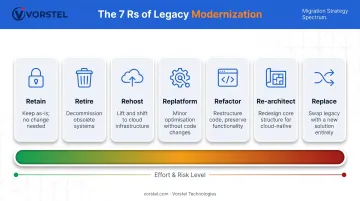
Here is how each approach works in practice.
Rehosting (Lift and Shift)
Rehosting moves an existing application to new infrastructure — typically cloud — without changing the code, functionality, or architecture. It is the fastest and lowest-disruption option available.
What makes it useful: minimal technical expertise required, near-zero code risk, and business continuity is preserved throughout the migration.
The key limitation: rehosting does not resolve underlying technical debt or unlock cloud-native capabilities like auto-scaling, serverless functions, or managed services. The same structural problems follow the application to its new environment.
| Factor | Detail |
|---|---|
| Best For | Organizations needing rapid infrastructure migration with minimal disruption and no immediate requirement to modernize application logic |
| Estimated Effort | Low — weeks to a few months depending on system size |
| Risk Level | Low, but long-term technical debt remains unaddressed |
Microsoft recommends rehosting only when a workload is expected to remain in its current state for at least two years — otherwise, the effort of migrating twice outweighs the short-term simplicity.
Replatforming
Replatforming is the middle-ground approach. The application moves to a new platform with targeted optimizations — updating the database engine, OS layer, or runtime environment — but the core application logic stays intact.
It delivers meaningful performance and compatibility improvements over a pure lift-and-shift, without the investment or risk of full refactoring. The application logic stays untouched; only the underlying platform changes.
| Factor | Detail |
|---|---|
| Best For | Organizations seeking modernization gains with manageable engineering effort |
| Estimated Effort | Medium — requires engineering input but no full codebase overhaul |
| Risk Level | Moderate — some integration testing required |
Replatforming suits systems that are structurally sound but running on outdated database versions, unsupported OS releases, or runtime environments that no longer receive security patches.
Refactoring
Refactoring restructures existing code to improve maintainability, efficiency, and compatibility with modern standards — without changing the application's external behavior. It is commonly used when transitioning toward microservices or containerized architectures.
The key benefit: it directly attacks technical debt and improves long-term code quality. McKinsey research found that organizations in the bottom 20th percentile for technical debt severity are 40% more likely to have canceled or incomplete IT modernization projects — refactoring addresses that risk head-on.
Worth noting: refactoring is labor-intensive and requires deep system knowledge. If the underlying architecture has fundamental structural problems, refactoring alone may not be enough.
| Factor | Detail |
|---|---|
| Best For | Organizations with hard-to-maintain codebases that still have valid business logic worth preserving |
| Estimated Effort | Medium to High — requires skilled engineering and time investment |
| Risk Level | Moderate — regression risk if test coverage is limited |
Re-architecting
Re-architecting involves a comprehensive redesign of the system's underlying structure. This typically means breaking monolithic applications into microservices, introducing containerization, or rebuilding for cloud-native deployment — while preserving existing business logic where possible.
This approach delivers the highest long-term scalability, flexibility, and integration capability. It is the right path when a system needs to support evolving business models, rapid user growth, or deep integration with AI and modern platforms.
Capital One's re-architecting effort — closing eight on-premises data centers and rebuilding nearly 2,000 cloud applications — shows what is possible. Development environment build time dropped from three months to minutes. Disaster recovery improved by 70%, and critical incident resolution times fell by 50%.
| Factor | Detail |
|---|---|
| Best For | Enterprises with mission-critical systems that need long-term adaptability and cannot scale on existing architecture |
| Estimated Effort | High — typically 6–18 months for complex systems |
| Risk Level | High — requires careful phasing, rollback planning, and expert oversight |
Encapsulation and API Modernization
Encapsulation preserves legacy core components while exposing their functionality through modern APIs or new access layers. It adds a modern interface around legacy code without replacing the underlying system — particularly useful for extending legacy capabilities to integrate with modern applications or third-party platforms.
A concrete example: RBC Wealth Management used API-led modernization to digitize an onboarding process that previously required 200–300 page paper bundles. The result? Onboarding time dropped from several weeks to an average of 24 minutes, maintenance costs fell 50%, and project delivery accelerated 3x.
Encapsulation extends system life and enables integration quickly. It does not, however, fix maintenance issues, performance limits, or long-term technical debt. Use it as a bridge strategy — or when the core logic is reliable but the interfaces are outdated.
| Factor | Detail |
|---|---|
| Best For | Organizations needing to integrate legacy systems with modern tools without major code changes |
| Estimated Effort | Low to Medium — API layer development is manageable but requires security planning |
| Risk Level | Low for core systems, moderate if API security is not properly managed |
Full Replacement
Full replacement means decommissioning the legacy system entirely and either building a new custom application or adopting a modern SaaS solution. It offers the most flexibility but carries the highest cost, time, and disruption burden.
When replacement is the right call:
- The legacy system is too outdated to integrate with any modern platform
- Technical debt has accumulated to the point where no other approach is viable
- A commercially available solution would deliver better outcomes than maintaining proprietary code
The risks are real. McKinsey's analysis of over 5,400 IT projects found that large IT projects run 45% over budget on average and deliver 56% less value than predicted. Roughly 17% of large IT projects become what McKinsey calls "black swans" — with budget overruns exceeding 200%. Gartner adds that by 2027, more than 70% of recently implemented ERP initiatives will fail to fully meet their original business goals.
Full replacement should be a last resort after other approaches have been evaluated and ruled out.
| Factor | Detail |
|---|---|
| Best For | Organizations whose legacy systems are blocking innovation and where no other approach can deliver the required outcomes |
| Estimated Effort | Very High — often 12+ months with significant resource commitment |
| Risk Level | High — requires thorough data migration planning, user retraining, and change management |
How to Choose the Right Legacy Modernization Approach
The right starting point is not picking a strategy — it's understanding what you have. A structured system assessment should evaluate each legacy application across six dimensions:
- Business fit: Does the system still support current business processes effectively?
- Current value: What would it cost to lose or replace this system's capabilities?
- Agility constraints: How much does the system slow down development or deployment?
- Security and compliance risk: What vulnerabilities or regulatory gaps exist?
- Maintenance cost trajectory: Are costs stable, growing, or accelerating?
- Integration complexity: How many downstream systems depend on it, and how tightly coupled are they?
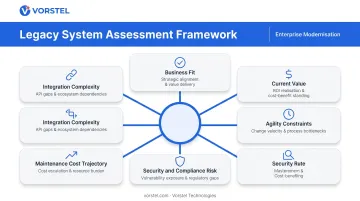
Scoring each dimension on a simple scale (1–5 works well) helps prioritize which systems need modernization first and which can be retained or retired without consequence. AWS recommends using 2–10 data points per workload in scoring models and notes that decision-tree logic is generally valid for 70%–80% of workloads — but does not replace deeper analysis for exceptions.
Four Practical Decision Factors
Once you have the assessment data, four factors drive the final choice:
- Business goals: Cost reduction, performance, security, or innovation all point toward different approaches
- Budget and timeline: Rehosting is fast and low-cost; re-architecting or replacement requires higher investment but greater long-term ROI
- System complexity: Heavily customized or mission-critical systems often require refactoring or re-architecting to preserve functionality
- Integration requirements: If the system must connect with AI, cloud platforms, or modern SaaS tools, encapsulation or re-architecting may be the only viable paths
Common Mistakes to Avoid
- Choosing the most technically sophisticated approach without assessing organizational readiness
- Underestimating data migration complexity — it's one of the top causes of budget overruns
- Skipping employee change management planning (culture and mindset was the top barrier to microservices adoption, cited by 40% of respondents in O'Reilly's research)
- Committing to full rollout without a pilot phase
The recommended pattern: incremental modernization using the strangler fig approach, described by Martin Fowler as gradually building new functionality alongside the legacy system until the old system can be retired safely. DORA specifically recommends this pattern for replacing monolithic architectures with componentized ones. It keeps the legacy system running while replacement components are validated in production, which significantly reduces deployment risk.
Organizations uncertain where to start benefit from getting an outside perspective before committing resources. Vorstel Technologies offers a Zero-Fee Solution Evaluation to help enterprises assess their current systems and identify the most practical modernization path relative to their business objectives and IT roadmap. The team is structured to engage at any stage of the journey.
Conclusion
Legacy modernization succeeds when it's treated as an ongoing strategy rather than a one-time project. The right approach depends on a careful assessment of system value, complexity, budget, and long-term goals — matched to business outcomes, not to whatever technology happens to be newest.
The most successful programs start small, validate with pilots, and scale incrementally. Progress is measured by performance gains, reduced operational costs, and improved scalability — concrete outcomes that justify each phase of investment.
Vorstel Technologies works with organizations at every stage of this process, including initial system assessment, IT strategy, cloud migration, re-architecting, SAP modernization, and DevOps enablement. If you're ready to map out the right modernization path for your systems, reach out for a free consultation.
Frequently Asked Questions
What is the legacy modernization approach?
A legacy modernization approach is the strategic method an organization uses to upgrade or transform outdated systems, ranging from simple rehosting to full system replacement. The right approach depends on factors like system complexity, budget, integration requirements, and business goals.
Which is an example of legacy modernization?
One common example is wrapping a legacy COBOL banking application with modern REST APIs so it can integrate with digital banking services, without replacing the core system. Another is migrating a monolithic on-premises ERP to a cloud-based platform through phased replatforming.
What are some examples of legacy systems?
Common examples include mainframe systems running COBOL or Assembly code, on-premises SAP or Oracle deployments on outdated hardware, and older CRM or inventory platforms built on unsupported frameworks. Some critical federal systems are over 60 years old.
What are the 7 Rs of legacy modernization?
The 7 Rs are Retain, Retire, Rehost, Replatform, Refactor, Re-architect, and Replace. This framework helps organizations map each legacy system to the modernization path that best balances risk, cost, and long-term business value.
What is the difference between rehosting and replatforming?
Rehosting (lift and shift) moves a system to new infrastructure with zero code changes. Replatforming makes targeted adjustments (such as updating the database engine or runtime) to improve performance and compatibility, without redesigning core application logic.
How long does legacy system modernization take?
Timelines vary widely. Rehosting a non-critical system may take a few weeks; re-architecting or replacing a mission-critical enterprise platform typically takes 12-18 months or more.