The challenge is the vendor landscape. Hundreds of IT service providers operate across Germany, and distinguishing genuine DevOps expertise from rebranded project management isn't straightforward. Compliance requirements under DSGVO, sovereign cloud mandates, and the acute IT skills shortage (149,000 unfilled IT positions in 2023 according to Bitkom) make the stakes higher.
This article covers a curated list of the top DevOps consulting and service companies in Germany, the criteria used to select them, and what to look for when making a final decision.
Key Takeaways
- Germany's ICT market reached €222.6B in 2024 and 81% of German companies already use cloud — creating direct demand for DevOps-capable partners
- Top providers range from T-Systems and Capgemini (enterprise scale) to TNG Technology Consulting and ThoughtWorks (engineering-led)
- Key selection criteria: CI/CD depth, cloud expertise, DevSecOps capability, and DSGVO compliance alignment
- Vorstel Technologies offers boutique global DevOps delivery with Germany operations — 92% faster deployment cycles and 45% reduction in system downtime for enterprise clients
- Vorstel joins engagements at any stage — from pipeline assessment to full CI/CD implementation — with no upfront evaluation fee
DevOps in Germany: Market Context and Why It Matters
DevOps is the practice of unifying software development and IT operations to deliver faster, more reliable releases — and for German enterprises, it has become the infrastructure layer powering digital transformation across automotive, manufacturing, financial services, and retail.
The scale of that transformation is measurable. According to GTAI citing Bitkom, Germany's ICT market reached €222.6B in 2024, with a 2025 forecast of €232.8B — a 4.6% growth trajectory.
Cloud adoption has already taken hold across the business landscape:
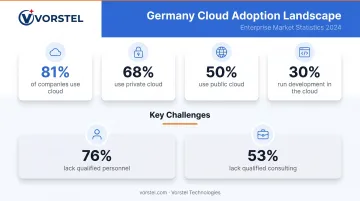
- 81% of German companies with 20+ employees use cloud computing
- 68% run on private cloud; 50% use public cloud
- 30% already operate software development solutions in the cloud
- 41% plan to move development workloads to the cloud within five years
Yet adoption creates its own pressure. 76% of German companies cite a lack of qualified personnel for cloud projects, and 53% cite a lack of qualified external consulting. That gap is exactly where DevOps partners earn their value — not by installing tools, but by building delivery capability that outlasts the engagement.
As demand grows, so does the number of providers claiming DevOps expertise. The companies listed below have been evaluated on technical depth, delivery track record, and relevance to the German market — so you can compare options with a clearer baseline.
Top DevOps Consulting and Service Companies in Germany
These companies were selected based on technical depth, delivery track record, industry coverage, and demonstrated business outcomes — not brand size alone.
Vorstel Technologies
Vorstel Technologies is a global DevOps and digital transformation consulting firm with active operations in Germany, India, Hungary, Singapore, and Finland. The company serves 30+ global clients — including Infosys and HeyMate — with a 97% client satisfaction rate across multiple countries.
What distinguishes Vorstel from larger generalist firms is its ability to enter engagements at any stage of a client's transformation journey: strategy, mid-implementation, or recovery. The model is built for rapid onboarding and outcome-focused delivery.
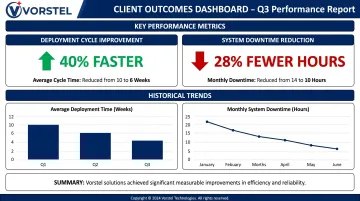
Measurable results back that claim: enterprise clients have seen 92% faster deployment cycles and a 45% reduction in system downtime.
The firm also offers a Zero-Fee Solution Evaluation: a no-cost initial consultation covering IT strategy, cloud solutions, automation, and DevOps direction — available virtually for German enterprises and startups.
| Category | Details |
|---|---|
| Core DevOps Services | CI/CD pipeline setup, cloud infrastructure automation, DevSecOps, containerisation (Kubernetes/Docker), enterprise architecture |
| Industries Served | Retail, manufacturing, e-commerce, enterprise IT, fast-moving startups |
| Key Differentiator | Boutique global presence with Germany operations; joins at any project stage; AI-assisted DevOps delivery |
T-Systems
T-Systems is Deutsche Telekom's IT services arm and ranks first in the Lünendonk ranking among IT service companies in Germany. Large German enterprises requiring hybrid infrastructure, managed security, and compliant cloud environments will find it the most locally credentialed option available.
Its public cloud offering meets BSI C5:2020, SOC 1, SOC 2, and SOC 3 requirements, and its Open Sovereign Cloud is built specifically for European regulatory frameworks. That compliance depth is particularly relevant for public sector, telecoms, and financial services clients.
| Category | Details |
|---|---|
| Core DevOps Services | Enterprise cloud and DevOps implementation, hybrid IT management, cybersecurity integration, managed services |
| Industries Served | Telecommunications, manufacturing, public sector, financial services |
| Key Differentiator | Deutsche Telekom backing; strongest local compliance and data sovereignty credentials in Germany |
TNG Technology Consulting
Founded in 2001 and headquartered in Munich, TNG Technology Consulting is an engineering-first boutique with a strong reputation for technical depth and hands-on delivery. The firm holds BAYERNS BEST 50 (2024) and Kununu Top Company 2025 recognition — signals of both business performance and team quality.
TNG's DevOps and Cloud services span infrastructure design, CI/CD implementation, containerisation, container orchestration, and ongoing consulting covering stability, security, and cost structure. Its typical clients are large national and multinational corporations across telecoms, insurance, e-commerce, automotive, and logistics.
The defining characteristic of TNG's approach: knowledge transfer over consulting dependency. Engagements are designed to leave internal teams more capable, not more reliant on external support.
| Category | Details |
|---|---|
| Core DevOps Services | CI/CD pipeline design, infrastructure as code, container orchestration, test automation, cloud-native architectures |
| Industries Served | Technology, finance, logistics, industrial engineering |
| Key Differentiator | Engineering-first boutique firm; prioritises internal capability building over long-term consulting dependency |
Capgemini Germany
Capgemini Germany operates from offices across Berlin, Dortmund, Düsseldorf, Bremen, and beyond — making it one of the most geographically distributed consulting presences in the country. At enterprise scale, few firms can coordinate DevOps transformation alongside parallel programmes like SAP migration, cloud modernisation, and regulatory compliance as effectively.
A concrete reference: Capgemini was selected to accelerate software development for a leading German automotive manufacturer — migrating to cloud and transforming to a microservices environment using DevOps. The firm is also recognised as a Leader in ISG Provider Lens SAP Ecosystem 2024 for Germany.
| Category | Details |
|---|---|
| Core DevOps Services | CI/CD pipeline setup, cloud-native application development, agile and DevOps transformation, DevSecOps, infrastructure as code |
| Industries Served | Automotive, banking, insurance, energy, telecommunications |
| Key Differentiator | Enterprise-scale DevOps coordinated with broader digital transformation programmes; strong regulatory compliance posture |
ThoughtWorks Germany
ThoughtWorks maintains offices in Berlin, Cologne, Hamburg, Munich, and Stuttgart. German enterprises choose the firm not just for tooling implementation, but for reshaping how software is built, tested, and delivered at a cultural level. Its work with BMW Group on a scalable Kubernetes and AWS platform for connected AI services — proof of concept completed in four months — illustrates the scope of engagements it handles.
ThoughtWorks also publishes continuous delivery guidance and has commissioned Forrester research on delivery maturity models. That methodological depth shows up in how engagements are scoped and sustained over time.
| Category | Details |
|---|---|
| Core DevOps Services | Continuous delivery platform design, CI/CD automation, microservices architecture, cloud-native DevOps, organisational DevOps coaching |
| Industries Served | Financial services, retail, healthcare, technology, manufacturing |
| Key Differentiator | Thought leadership in DevOps methodology; engineering culture focus; sustainable long-term transformation over short-term fixes |
How We Chose the Best DevOps Companies in Germany
Choosing a DevOps vendor based on brand recognition alone is a common misstep. The right partner for a Frankfurt-based bank looks very different from the right one for a Berlin fintech or a Stuttgart automotive Tier 1 supplier — maturity level, sector, and regulatory context all shape what good looks like.
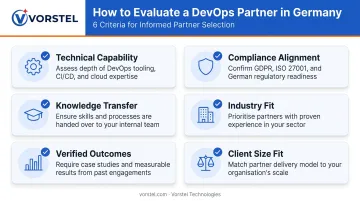
These companies were assessed across the following dimensions:
- Technical capability: Depth of CI/CD, cloud platform coverage (AWS, Azure, GCP), DevSecOps integration, and containerisation expertise
- Compliance alignment: DSGVO/GDPR posture, BSI C5 credentials, data sovereignty capabilities — particularly relevant given Bitkom's finding that 99% of German companies rate trust in IT security and data protection as a must-have when selecting cloud providers
- Knowledge transfer practices: Whether the firm builds client capability or creates long-term consulting dependency
- Industry fit: Sector-specific experience across automotive, manufacturing, financial services, and retail
- Verified outcomes: Deployment frequency improvements, downtime reduction, and lead time metrics from actual client engagements
- Client and market size fit: Ability to serve both enterprise organisations and growth-stage companies with appropriate engagement models
Each of these criteria reflects a different failure mode — firms that are technically strong but compliance-weak, or sector-experienced but unable to transfer knowledge to your team.
No single firm on this list suits every organisation. Matching partner strengths to your specific context — technical maturity, regulatory environment, sector, and internal capability — determines whether a DevOps engagement produces measurable improvements in deployment speed, reliability, or compliance posture.
Conclusion
Germany's DevOps consulting market has genuine depth, spanning Deutsche Telekom-backed enterprise infrastructure specialists to boutique engineering consultancies with strong knowledge transfer practices.
The decision shouldn't be driven by name recognition. Evaluate scalability, compliance posture, knowledge transfer practices, and verifiable delivery outcomes before committing to an engagement.
If you're looking for a DevOps partner that can enter your transformation at any stage — from CI/CD pipeline design to cloud infrastructure automation to AI-leveraged delivery — Vorstel Technologies offers a Zero-Fee Solution Evaluation to help you define the right path forward.
Frequently Asked Questions
Is DevOps in demand in Germany?
Yes. Cloud adoption is at 81% among German companies, and 30% already run software development in the cloud — creating direct demand for DevOps capability. Combined with 149,000 unfilled IT positions in 2023, many organisations are turning to external DevOps partners to bridge the delivery gap.
How much does a DevOps engineer make in Germany?
According to StepStone's 2026 salary data, the average DevOps engineer in Germany earns around €55,200 per year, with junior roles averaging €46,600 and senior engineers reaching €67,200. Salaries vary by city, sector, and specific cloud platform expertise.
What services do DevOps consulting companies in Germany typically offer?
Core offerings typically include:
- CI/CD pipeline setup and automation
- Cloud migration and infrastructure as code
- Containerisation (Docker/Kubernetes) and DevSecOps
- Monitoring, observability, and incident response
- Platform engineering and agile transformation support
How do I choose the right DevOps partner in Germany?
Assess industry experience, cloud platform expertise, and DSGVO compliance alignment first. Then evaluate whether the partner builds your internal capability or creates long-term dependency — and ask for verifiable delivery metrics, not just case study narratives.
What is the difference between DevOps consulting and DevOps managed services?
DevOps consulting covers strategy, pipeline design, implementation, and knowledge transfer — typically a defined project engagement. Managed services involve the ongoing operation, monitoring, and optimisation of pipelines and cloud environments on the client's behalf, as a continuous operational arrangement.
Do DevOps companies in Germany work with startups or only large enterprises?
Most firms on this list serve both segments. Startups typically need lean, fast CI/CD setups with minimal governance overhead, while enterprises require multi-team coordination, compliance frameworks, and formal change management. Confirm your potential partner has direct experience in your segment before engaging.